Before and After: How a Caulk Sculpture Becomes a Rooster Painting
Two photos. One white caulk sculpture. One finished rooster painting. See exactly how Jay the Painter transforms raw flexible caulk into a dimensional rooster portrait — before a single drop of paint is applied.
Before and After: How a Caulk Sculpture Becomes a Rooster Painting
Most people have never seen a painting before it was a painting.
They see the finished work — the color, the composition, the subject. But the process that created it is invisible by the time the painting reaches a wall. With caulk art, the process is the point. And the rooster transformation is one of the clearest examples of what makes this technique unlike anything else.
Two photos. Same canvas. Completely different objects.
The Before: Raw Caulk Sculpture
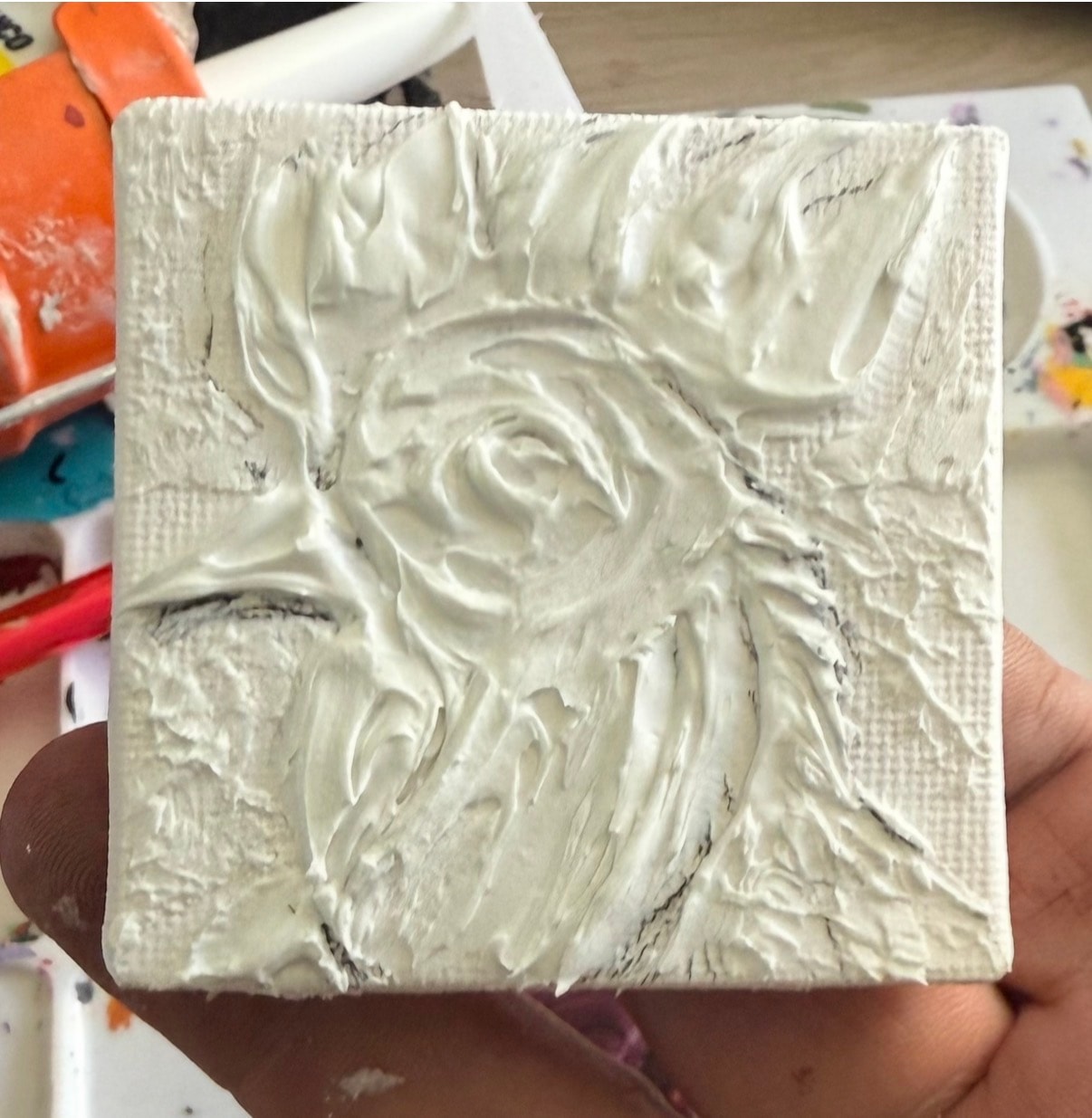
The rooster before any paint is applied. Every form you see is flexible acrylic caulk, sculpted by hand onto canvas.
This is what a caulk texture painting looks like before it becomes a painting.
Everything white in this photo is caulk. Jay applied it directly to the canvas using palette knives, spreaders, and his hands — building up the rooster's form layer by layer. The feathers are individual ridges of caulk. The comb and wattle are sculpted caulk forms. The eye socket is a depression pressed into the caulk surface.
At this stage, the canvas weighs more than it will when finished. The caulk is thick — in some areas, it stands nearly a centimeter off the canvas surface.
What You're Looking At
Every element of the rooster's anatomy is present in the caulk sculpture:
The feathers — each one is a separate ridge of caulk, applied in overlapping layers to create the sense of depth and layering that real feathers have. The direction of each ridge follows the direction the feather would grow. This isn't decorative texture — it's structural information built into the surface.
The comb and wattle — the fleshy red crest on top of a rooster's head and the hanging skin below the beak. In the caulk stage, these are smooth, rounded forms. They'll become red and textured once paint is applied, but their three-dimensional shape is already established.
The eye — a carefully shaped depression in the caulk, with a raised rim around it. The eye in the finished painting sits in a real socket, not a painted circle on a flat surface.
The beak — a hard, angular form built up from the canvas. The caulk gives it a physical sharpness that paint alone couldn't create.
This stage takes longer than the painting stage. Jay works the caulk while it's still workable — flexible caulk has a window of time before it begins to set. Once it cures, it's permanent. There's no going back.
Then he waits. The caulk needs to cure completely before paint can be applied — typically 24 hours or more depending on thickness. Painting over uncured caulk would trap moisture and cause problems later.
The After: Finished Caulk Art Painting
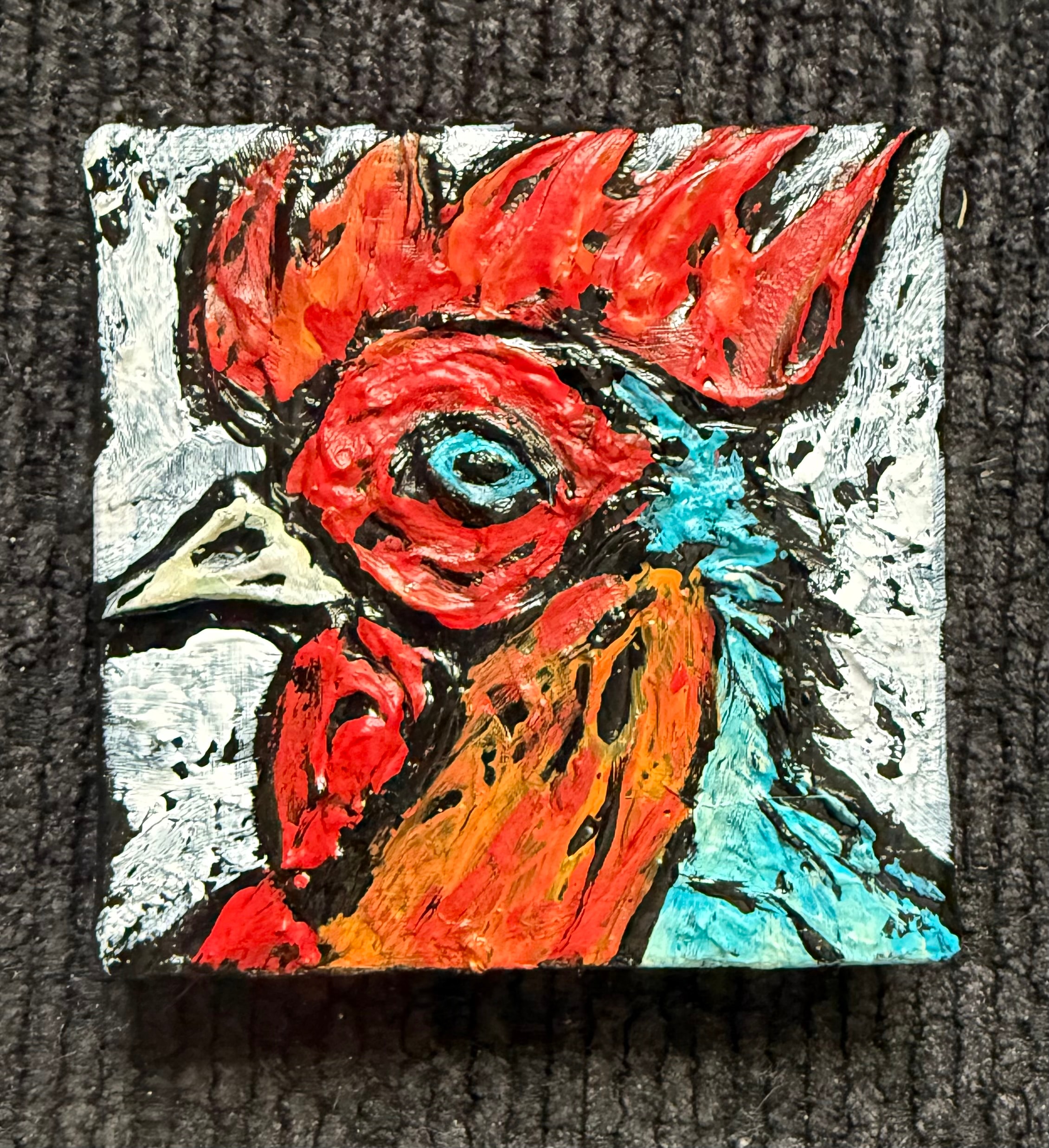
The same canvas, after painting. The caulk sculpture is still there — now it's the foundation of the finished work.
The caulk sculpture didn't change. The canvas didn't change. What changed is that Jay painted over the three-dimensional surface he built, using the caulk texture as the foundation for every color and value decision.
What the Paint Does
In conventional painting, the paint creates both the form and the color. In caulk art, the form already exists. The paint's job is to reveal it.
The feathers — each caulk ridge catches paint differently depending on its angle. The raised surfaces catch more paint and appear lighter. The recessed areas between ridges hold more paint and appear darker. This creates natural shading that follows the actual three-dimensional form — not shading that Jay had to calculate and paint by hand.
The comb and wattle — now a deep, saturated red. The smooth caulk form takes paint evenly, creating a clean, glossy appearance that contrasts with the textured feathers around it.
The eye — a dark, focused point in the recessed socket Jay built in caulk. The socket gives the eye depth that a painted eye on a flat surface can never have.
The beak — the angular caulk form is now a warm yellow-gold. The paint follows the form; the form was already there.
The Light
The most important thing about a caulk art painting — and the thing that photographs can't fully capture — is how it responds to light.
As the light source moves (or as you move around the painting), the shadows cast by the caulk ridges shift. The feathers that were in shadow are now in light. The ridges that were catching light are now recessed. The painting is never the same twice.
This is what makes caulk art impossible to reproduce as a print. A print captures one photograph of the painting in one light. The original painting is different in every light.
The Finished Painting
The White Rooster is one of Jay's signature subjects. Roosters have strong, graphic forms — the comb, the wattle, the layered feathers, the sharp beak — that translate naturally into caulk texture. The subject rewards the technique.
The finished White Rooster is available in the gallery:
See More Transformations
The rooster isn't the only painting with before-and-after documentation. Jay has also photographed the process for:
The Butterfly — a delicate subject that shows how caulk can create fine, intricate texture as well as bold, structural forms. The wing veins are individual caulk ridges.
See the Butterfly transformation →
Blue Forest Path — three stages of process photos showing the caulk sculpture, the early painting stage, and the finished work.
See the Blue Forest Path process →
About the Technique
Jay the Painter is an Akron, Ohio artist and BFA graduate of Bowling Green State University. He developed the caulk texture painting technique — applying flexible acrylic caulk to canvas as a sculptural foundation before painting — and has been refining it for years.
Every painting he creates is a one-of-a-kind original. No prints. No reproductions. When you buy a Jay the Painter original, you own the only one that will ever exist.
Questions about the technique or a specific painting? Text Jay directly at 330-285-3136.
What is caulk art? → | The complete caulk texture painting guide → | Browse the full gallery →
Jay the Painter — original caulk art paintings from Akron, Ohio. Dimensional texture. One of a kind. Free shipping on every order.