How Jay Painted Blue Forest Path: A Caulk Texture Painting Step by Step
See the full process behind Blue Forest Path — from raw caulk sculpture to finished painting. Three real photos show exactly how Jay the Painter builds 3D texture before a single drop of paint is applied.
How Jay Painted Blue Forest Path: A Caulk Texture Painting Step by Step
Most people have never seen a painting made this way.
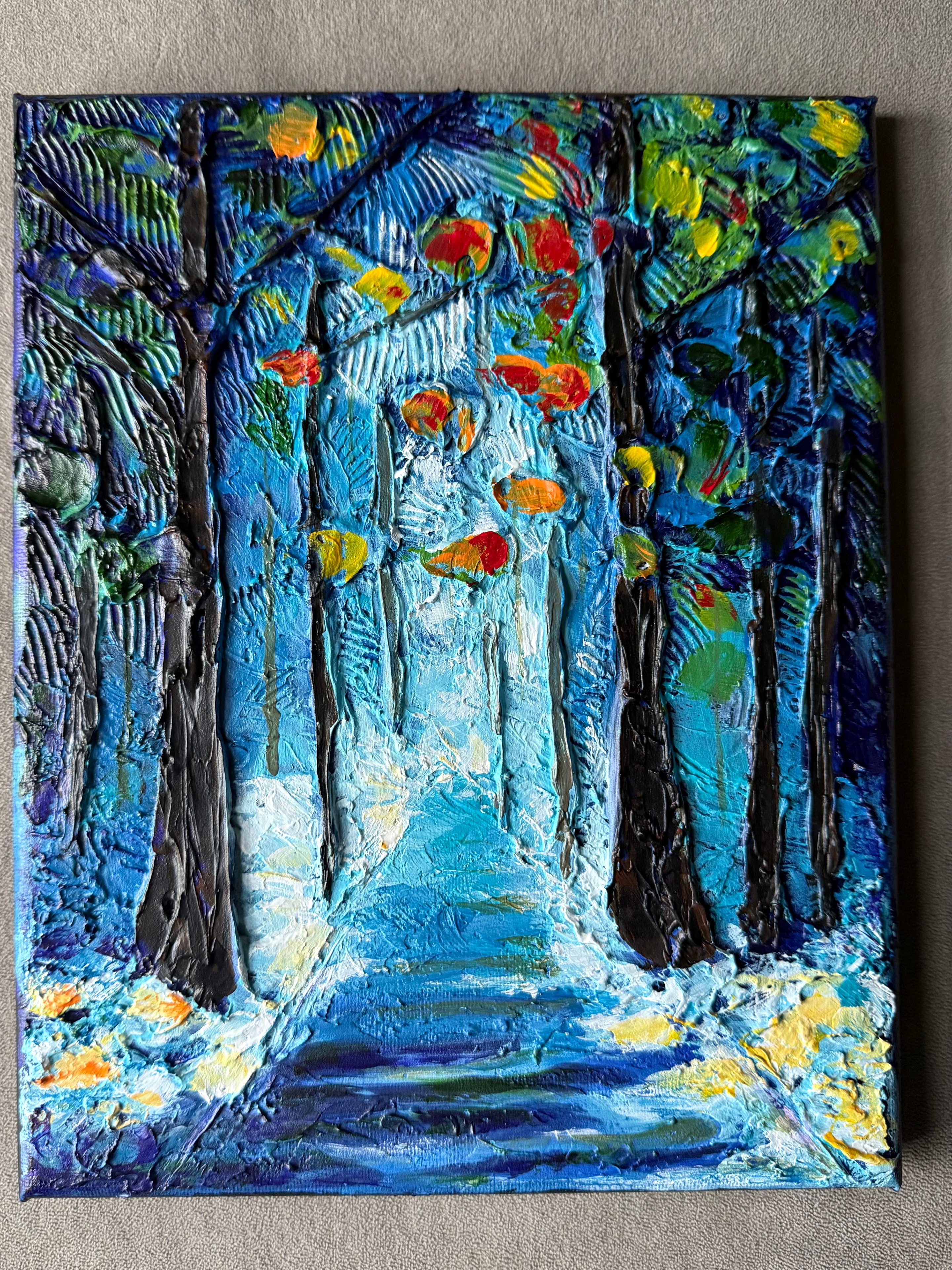
When you look at Blue Forest Path hanging on a wall, you see a forest scene with real three-dimensional depth — tree trunks that seem to push forward, a canopy that recedes into the distance, a path that draws your eye through the composition. It looks like thick impasto paint, applied with a palette knife in heavy, confident strokes.
But that texture was not made with paint at all.
It was made with flexible caulk — applied in stages, allowed to cure completely, and then painted over. The paint itself is only a thin surface layer. All the depth, all the dimension, all the sculptural quality comes from the caulk underneath.
Here is exactly how it happened.
Stage 1: The First Caulk Layer
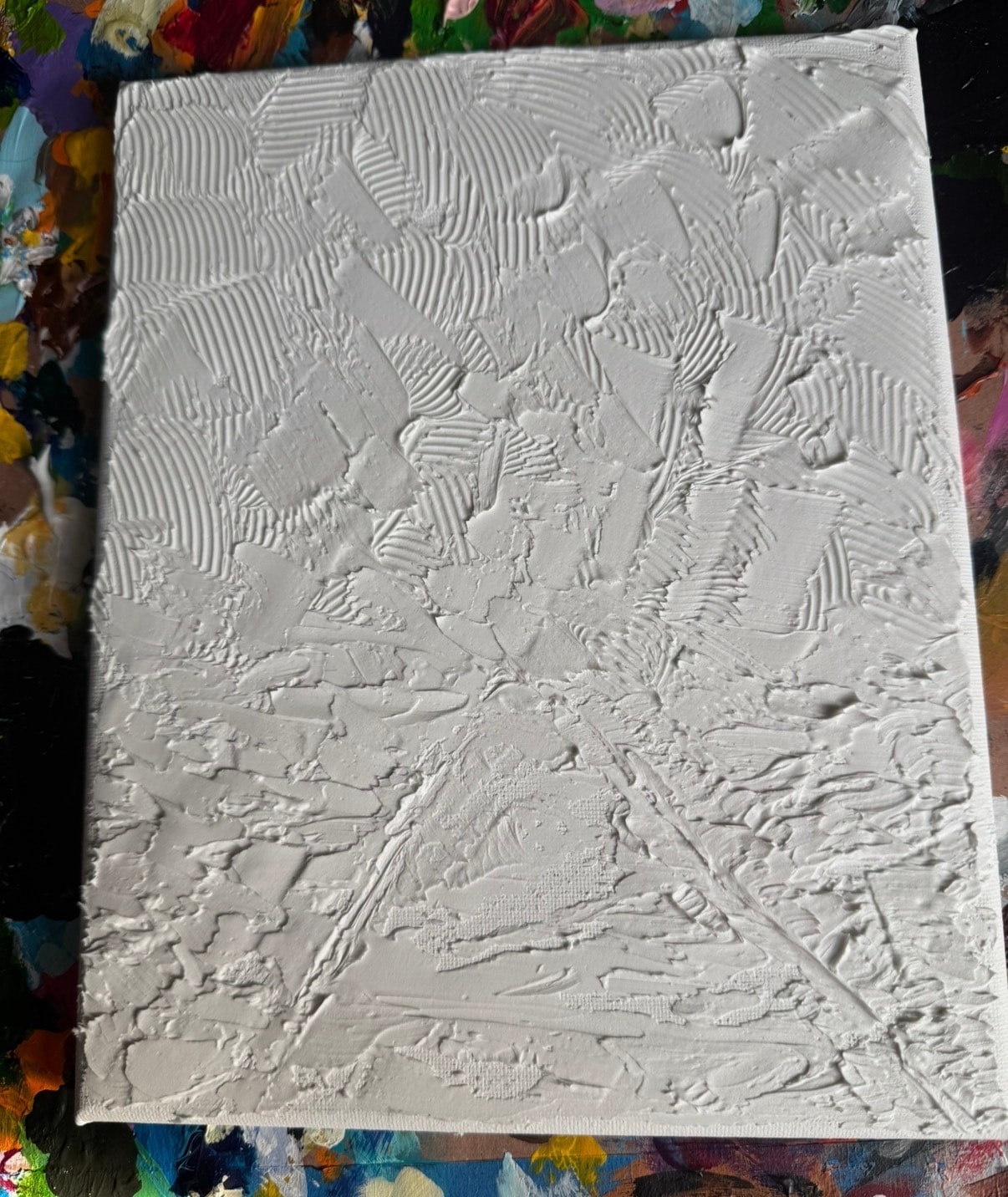
The canvas at Stage 1 — the first caulk layer is applied, beginning to define the composition.
The process starts with a blank canvas and a caulk gun.
Jay applies the first layer of caulk directly to the canvas, working from his mental image of the composition. At this stage, the painting looks nothing like a forest. It looks like white ridges and blobs on a flat surface — abstract, almost random.
But there is intention in every stroke. The caulk is being applied in the shapes that will eventually become tree trunks, branches, ground cover, and sky. The composition is being sculpted, not drawn.
Why does this stage matter?
Because caulk cannot be rushed. If you apply too much at once, the bottom layers stay wet while the top layers skin over. The texture becomes unstable. It can sag, crack, or lose its shape.
Jay applies the first layer and then stops. He lets it cure completely — sometimes overnight, sometimes longer depending on the thickness and the humidity. Only when the first layer is fully dry and firm does he move to Stage 2.
Stage 2: Building Up the Texture
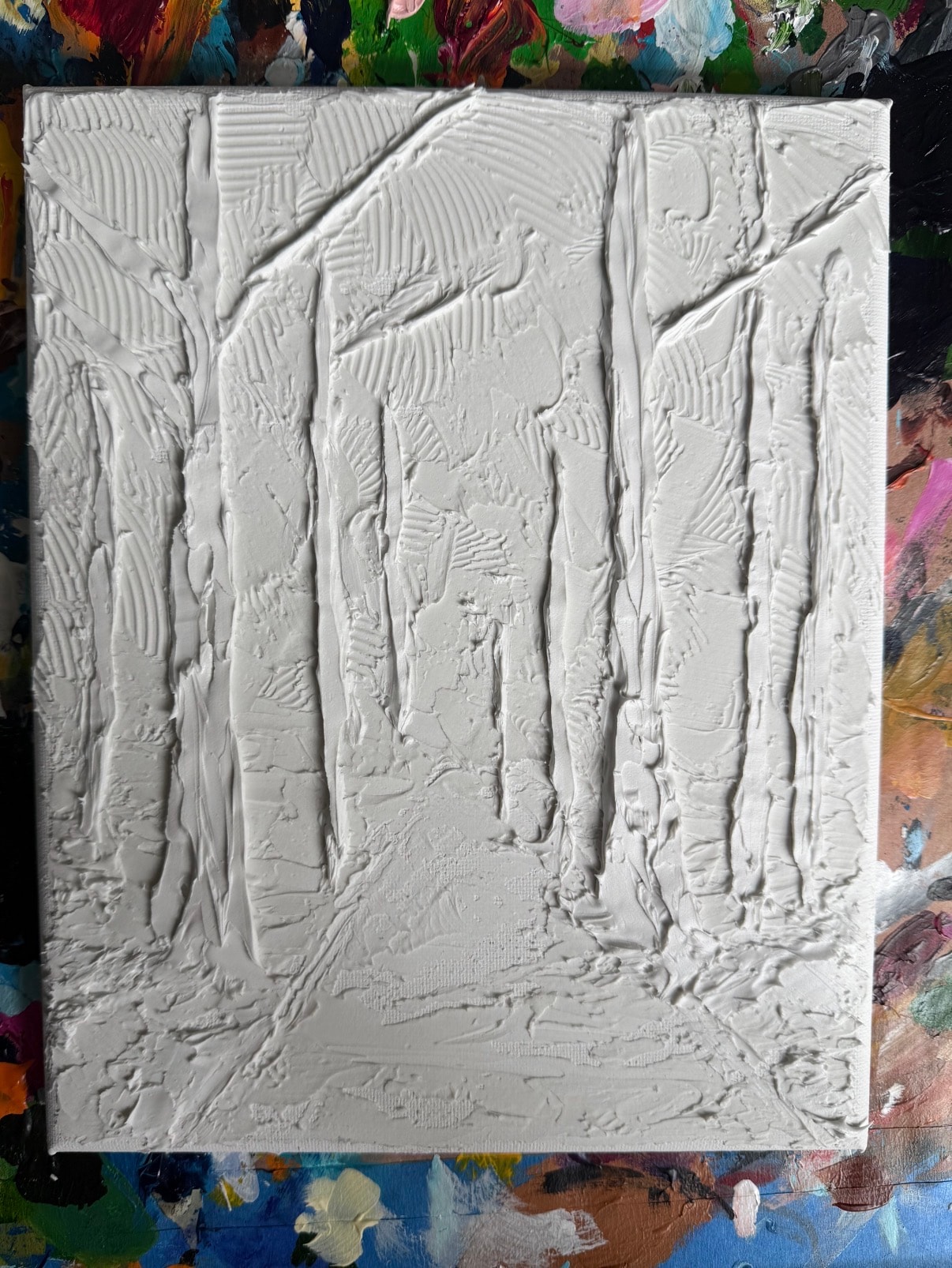
Stage 2 — additional caulk layers have been applied over the cured base. The forest composition is now clearly visible in white relief.
With the first layer fully cured, Jay applies the second layer — and now the painting starts to reveal itself.
You can see the forest emerging in white. The tall tree trunks are defined. The canopy is suggested. The path through the center is taking shape. The foreground has texture that will read as ground cover and fallen leaves.
This is the stage that most surprises people when they see it in person. The entire painting is sculpted in white caulk before any color has been introduced. It is a complete three-dimensional relief — a sculpture, really — that just happens to be on a canvas.
The key insight of this stage:
The caulk is being built up in layers, not applied all at once. Each layer adds height. Each layer adds definition. The final texture is the result of multiple passes, each one cured before the next is added.
This is why caulk texture paintings have a depth that impasto cannot match. Impasto is applied in one pass — you get one layer of texture, no matter how thick. Caulk texture is built up over time, layer by layer, creating genuine sculptural relief.
Jay also uses different tools at this stage — sometimes a palette knife, sometimes a brush, sometimes his fingers — to shape the caulk into the specific forms he wants. The tree bark has a different texture than the canopy. The path has a different texture than the sky. Each area is worked differently.
Stage 3: The Finished Painting
The finished Blue Forest Path — the caulk sculpture is now fully painted. The three-dimensional texture creates real depth and shadow.
Once the final caulk layer is fully cured and the entire surface is firm and stable, Jay begins to paint.
And this is where the magic happens.
The paint follows the contours of the caulk. It pools in the valleys and sits on the peaks. When light hits the finished painting, it creates real shadows — not painted shadows, but actual cast shadows from the raised texture. The painting looks different depending on where you stand and how the light falls on it.
Blue Forest Path in its finished state shows:
- Tree trunks with visible bark texture, each one slightly different
- A canopy that catches light on its upper surfaces and falls into shadow underneath
- A forest floor with organic texture that reads as leaves, roots, and ground cover
- A path that recedes naturally into the distance
- A sky that is smooth by contrast, making the textured elements read as more dimensional
The paint is thin. It is not thick impasto paint — it is regular acrylic paint applied over the caulk surface. The texture you see is entirely the caulk underneath. The paint is just color.
Why This Technique Produces Something Unique
Caulk texture painting is not a shortcut or a trick. It is a genuinely different approach to making a painting — one that produces results that cannot be replicated any other way.
It cannot be printed. A print of a caulk texture painting is just a flat image. The texture is gone. The shadows are gone. The dimension is gone. What you are left with is a photograph of a painting — not the painting itself.
It cannot be faked with thick paint. Impasto paint shrinks as it dries. Heavy impasto layers crack over time. Caulk is flexible — it moves with the canvas, expands and contracts with temperature changes, and maintains its texture for decades.
It is always one of a kind. Because the texture is built by hand, no two paintings are ever identical. Even if Jay painted the same subject twice, the caulk application would be different. Every painting is a unique original.
Own Blue Forest Path
Blue Forest Path is an original caulk texture painting, available now.
Text Jay at 330-285-3136 to ask about availability, size, and price. He ships nationwide. When it sells, it is gone — no prints, no reproductions, ever.
View Blue Forest Path in the Gallery →
Want to go deeper on the technique? Read the complete caulk art guide: What Is Caulk Art? → | Jay's full process explained →