Akron Caulk Artist: How Jay the Painter Builds 3D Paintings Nobody Else Can Make
Jay the Painter is Akron's only caulk artist — an independent painter who uses flexible caulk to build real three-dimensional texture on canvas before a single drop of paint is applied. Here's the full story behind the technique and the man.
There is exactly one caulk artist in Akron, Ohio.
His name is Jay. He works out of Akron, sells directly to collectors, and creates original paintings using a technique so unusual that most people have never heard of it — and once they see it in person, they can't stop talking about it.
This is the full story of what it means to be an Akron caulk artist, how the technique works, and why Jay the Painter's originals are unlike anything else you'll find in Northeast Ohio or anywhere else.
What Is a Caulk Artist?
A caulk artist is a painter who uses flexible caulk — the same material used in construction to seal bathtubs, windows, and door frames — as a sculptural medium on canvas.
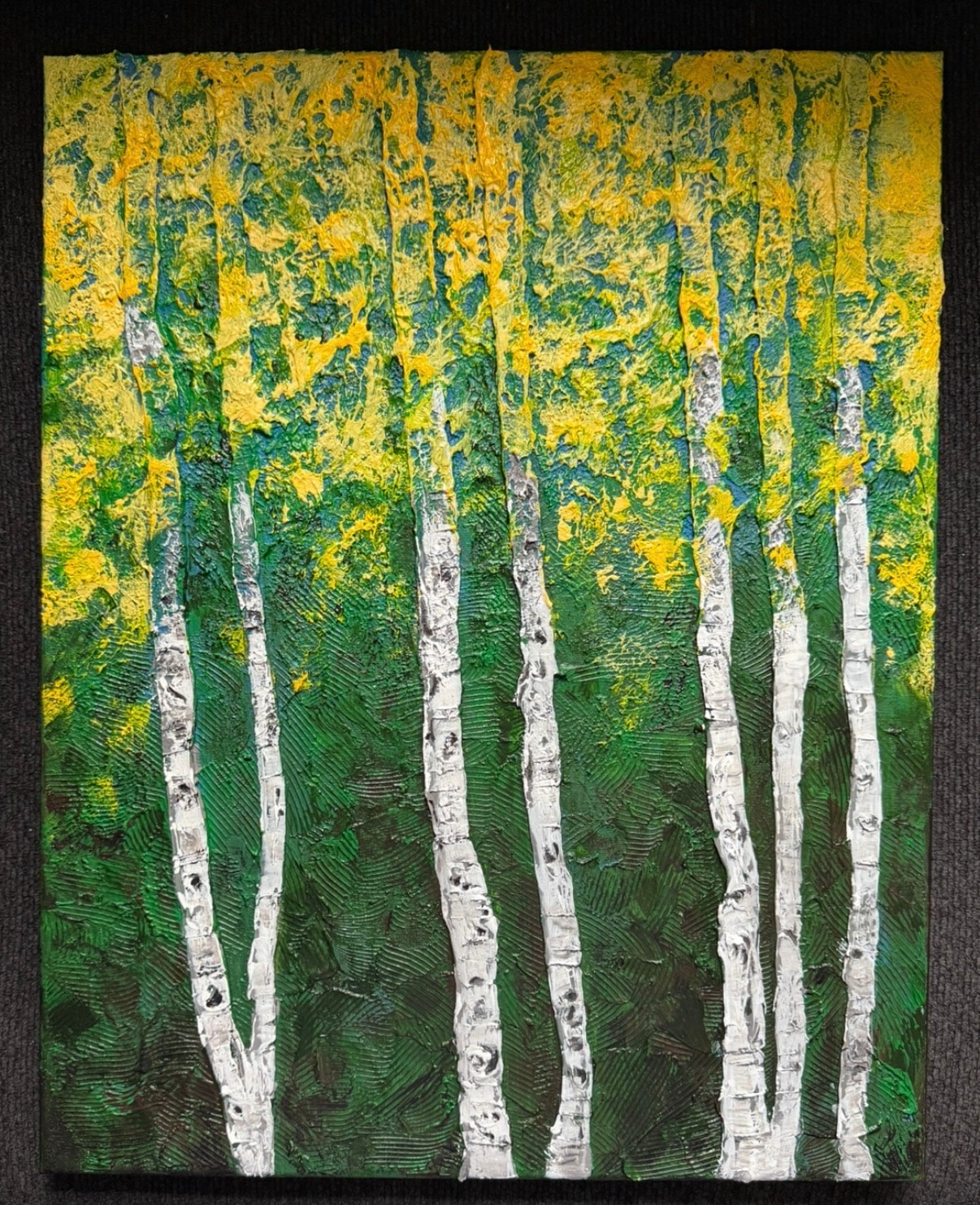
Before any paint is applied, the caulk is laid down in deliberate strokes, curves, and ridges that build up the three-dimensional structure of the painting. Flower petals. Tree bark. Rolling hills. The curve of a rooster's feathers. All of it is built in caulk first, then painted over once the caulk has fully cured.
The result is a painting with real physical texture — not the illusion of texture, not a photograph of texture, but actual raised surfaces you can see from across the room and feel with your hand.
Jay the Painter is the only artist in Akron doing this. He may be the only artist in all of Northeast Ohio doing it at this scale and with this level of consistency.
Why Caulk? The Story Behind the Technique
Most textured painters use impasto — thick paint applied with a palette knife or brush until it builds up into ridges. It's a beautiful technique with a long history. But it has a well-documented problem: thick paint shrinks as it dries, and over time those ridges crack. A painting that looks stunning at purchase can develop hairline fractures within years.
Jay discovered caulk as a solution to that problem. Flexible caulk doesn't shrink the way thick paint does. It moves with the canvas instead of fighting it. It bonds to the surface, cures to a durable flexible solid, and holds its shape for decades when properly sealed.
But the practical advantage was only part of the discovery. The bigger revelation was what caulk could do that paint couldn't.
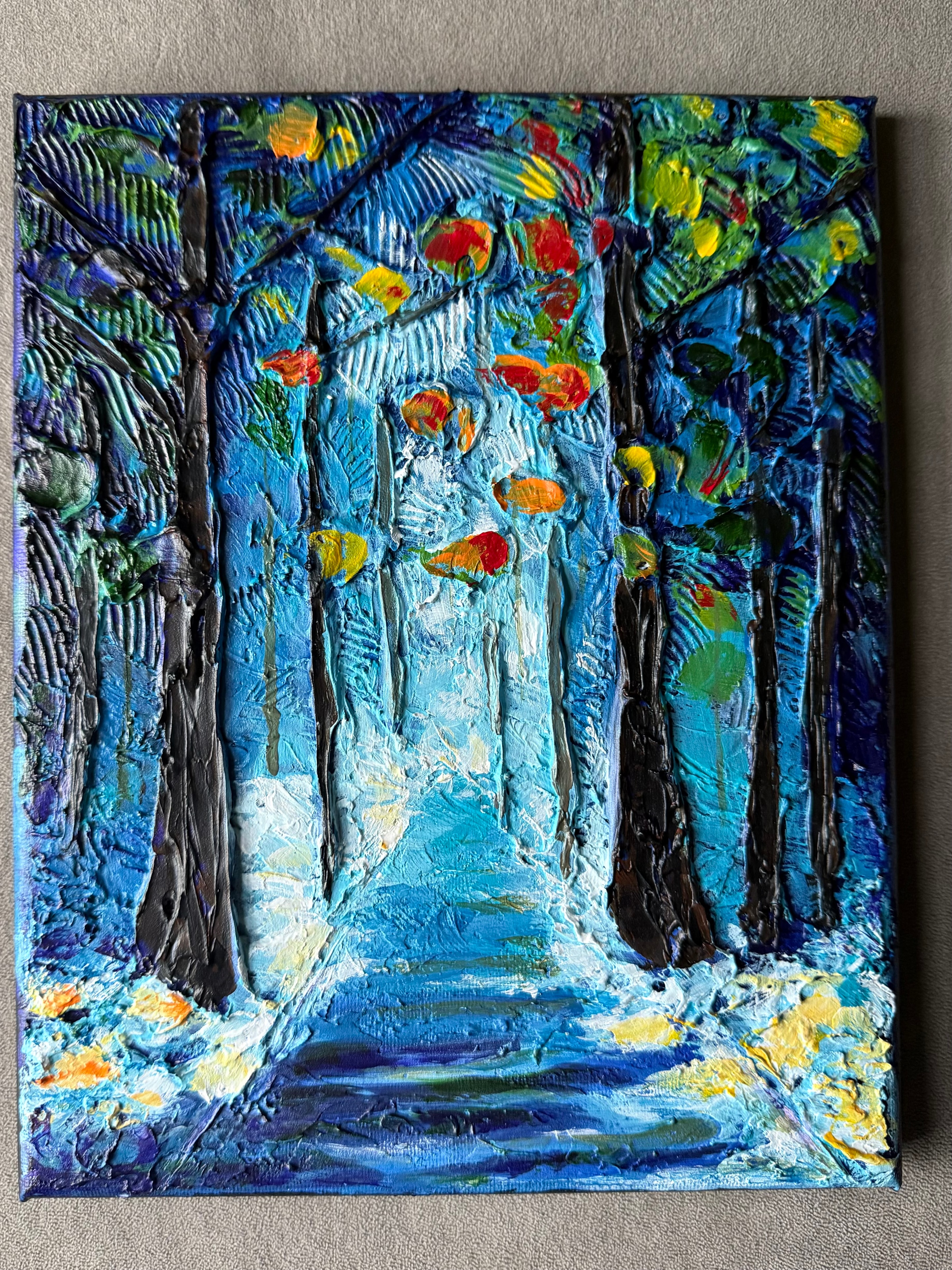
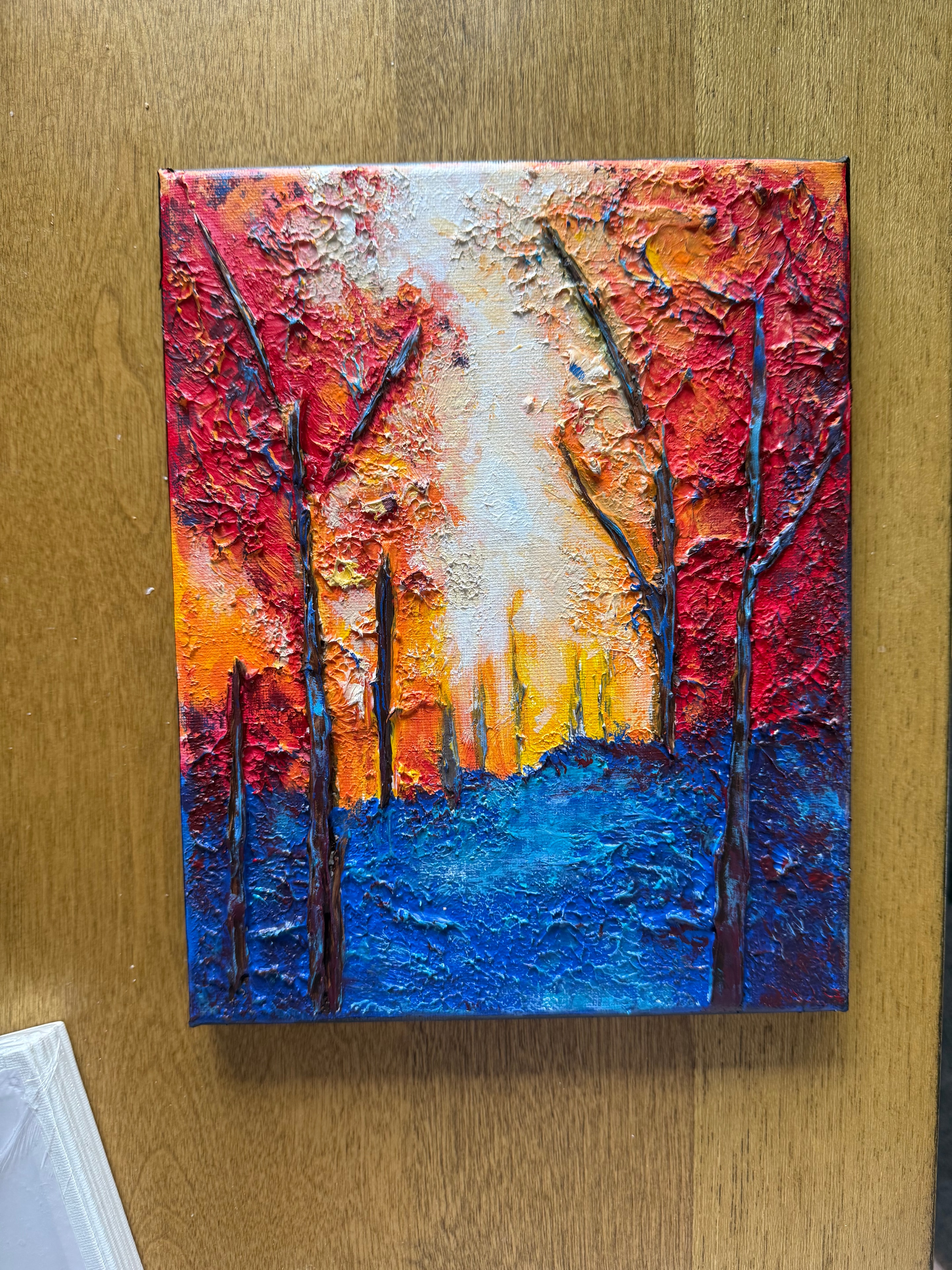
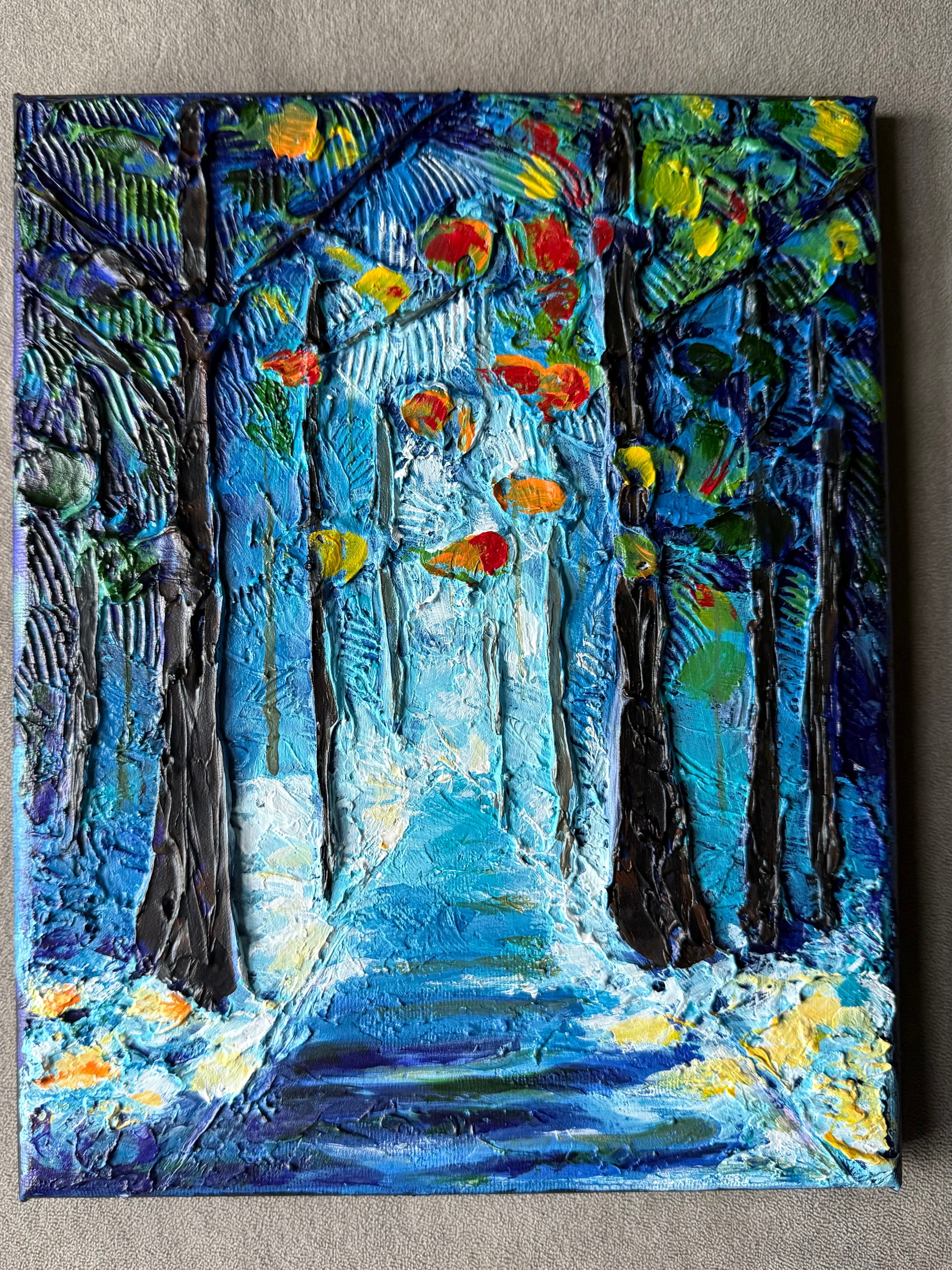
Caulk can be applied in thick, sculptural forms that would be impossible with paint alone. It can be shaped with palette knives, fingers, and tools to create organic curves and natural forms. It creates a surface that catches light differently from every angle — so a painting looks different in morning light than it does under a lamp, different from five feet away than from across the room.
That quality — the way the texture interacts with light — is what makes Jay's paintings impossible to fully capture in a photograph. You have to see them in person to understand what makes them different.
The Paintings: What Jay Creates
Jay the Painter works across a wide range of subjects, all executed in his signature caulk texture style.
Flowers are among his most recognized work. His hibiscus paintings — including the blue hibiscus and peach hibiscus originals — use caulk to build the curved petals into real three-dimensional forms. The center of each flower rises off the canvas. The petals curve and overlap in ways that create genuine depth. Under direct light, the shadows fall exactly where they would on a real flower.
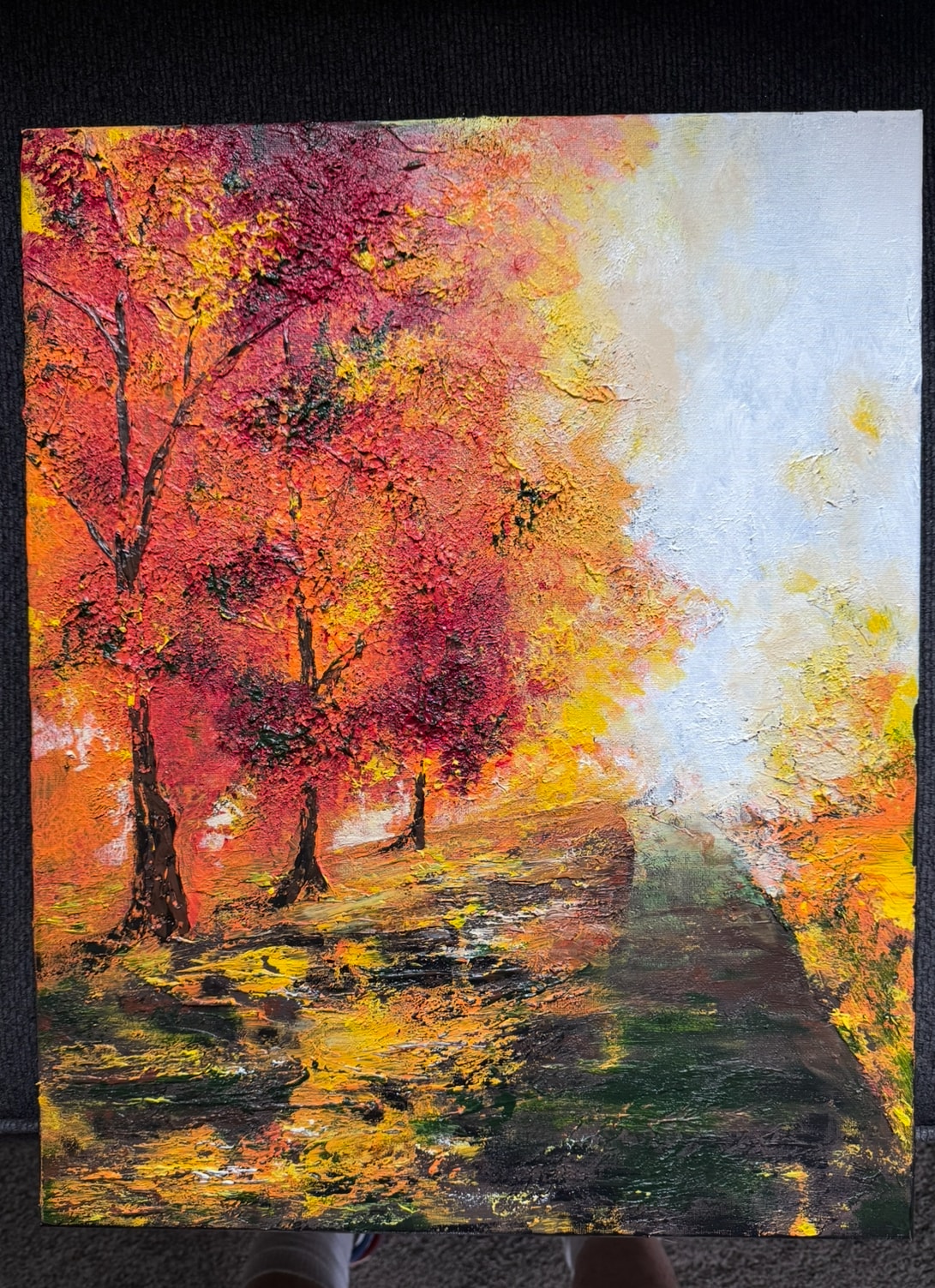
Landscapes are another signature subject. Jay's forest paintings use caulk to build the texture of bark, the layered depth of foliage, and the way light filters through trees. His fall landscape paintings capture the specific quality of Northeast Ohio autumn — the warm golds and deep reds of the Cuyahoga Valley — in a way that feels tactile and immediate.
Roosters have become one of Jay's most distinctive subjects. The feathers of a rooster are naturally textured — layered, directional, catching light at different angles — and caulk is the perfect medium to capture that quality. Jay's rooster paintings have a presence that flat paintings simply can't match.
Miniatures — tiny 2.44-inch originals — apply the same caulk texture technique at a scale that seems almost impossible. The detail in a Jay the Painter miniature has to be seen to be believed.
The Process: How an Akron Caulk Painting Gets Made
Every painting Jay creates follows the same fundamental process, though the execution of each step is entirely unique to that painting.
Step 1: Composition Planning
Before the caulk gun comes out, Jay plans the composition. In textured work, this matters more than in flat painting — the caulk structure guides the eye and creates the visual hierarchy of the piece. Where the texture is highest, the eye goes first.
Step 2: Caulk Application
Using a caulk gun loaded with flexible caulk, Jay begins building the three-dimensional structure of the painting. Palette knives shape the caulk into the forms — the curve of a petal, the roughness of bark, the smooth roll of a hillside. This is the most time-sensitive part of the process. The caulk is workable for a limited window, and every decision is permanent.
Step 3: Full Cure
The caulked canvas cures completely before any paint is applied. This is non-negotiable. Paint applied over uncured caulk won't bond properly and will peel. The cure time is one reason each Jay the Painter original takes longer to produce than a flat canvas painting.
Step 4: Painting
Once cured, the painting begins. The three-dimensional surface changes how paint behaves in ways that flat-canvas painters never encounter. Paint pools in the valleys between ridges. It sits on the peaks. Dry-brushing across the raised texture creates highlights that look natural because they are natural — the light is actually catching the raised surface, not being simulated.
Step 5: Sealing and Varnishing
The finished painting is sealed with protective varnish that locks in the colors and protects the texture. A properly sealed Jay the Painter original will hold its texture and color for decades.
Why Akron? The Connection Between the City and the Art
Jay the Painter is an Akron artist in the truest sense — not just geographically, but in the way the city shows up in the work.
Northeast Ohio has a particular quality of light. The way autumn hits the Cuyahoga Valley. The specific gray of an overcast winter sky over the Portage Lakes. The way summer green looks against old brick. Jay's paintings capture that regional quality in a way that resonates with anyone who has spent time in this part of Ohio.
The subjects Jay returns to — forests, flowers, roosters, landscapes — are the subjects of a painter who is paying attention to the world immediately around him. These aren't generic compositions. They're paintings made by someone who lives here, sees this landscape every day, and has developed a technique that captures its specific texture and light.
No Prints. No Reproductions. Ever.
One of the most important things to understand about Jay the Painter's work is the commitment to originals only.
Jay does not sell prints. He does not make reproductions. He does not license his images. Every painting in his gallery is a hand-painted original — and because the texture is built by hand, no two paintings are ever identical.
This isn't just a business decision. It's a philosophical one. The whole point of caulk texture painting is the physical object — the raised surface, the way it catches light, the tactile quality that no photograph or print can replicate. A print of a Jay the Painter original would be missing the entire point of the work.
When you buy a Jay the Painter original, you own something that cannot be duplicated. When it sells, it's gone.
Prices and How to Buy
Jay sells directly to collectors — no gallery, no middleman, no markup. Prices range from $40 for a miniature to $400 for a large original, with most full-size paintings in the $150–$300 range.
He accepts all major cards through Square and ships nationwide. Every painting ships carefully packaged to protect the texture.
To browse the full gallery, visit jaythepainter.com/artwork. To see the miniatures, visit jaythepainter.com/myminipaintings.
To contact Jay directly: call or text 330-285-3136.
The Only Akron Caulk Artist
There are many talented artists in Akron. There are painters, sculptors, muralists, and printmakers doing excellent work across the city.
But there is only one Akron caulk artist.
Jay the Painter has spent years developing and refining a technique that is entirely his own — one that produces paintings with a physical presence and tactile quality that no other approach can match. His work is not derivative of any school or movement. It grew out of a practical problem (how do you build durable texture on canvas?) and became something genuinely original.
If you want a painting that looks different from every angle, that catches light in ways that surprise you, that has a physical presence you can feel as well as see — there is one place to find it in Akron, Ohio.
Browse Jay the Painter's full gallery at jaythepainter.com
Or call Jay directly at 330-285-3136 to ask about a specific painting or commission a custom piece.
Jay the Painter is an independent artist based in Akron, Ohio. He sells original paintings directly to collectors with no gallery markup. All paintings are one-of-a-kind originals — no prints, no reproductions, ever.
Explore Topics
Written by
Jay the Painter
Content creator and writer sharing insights and stories.