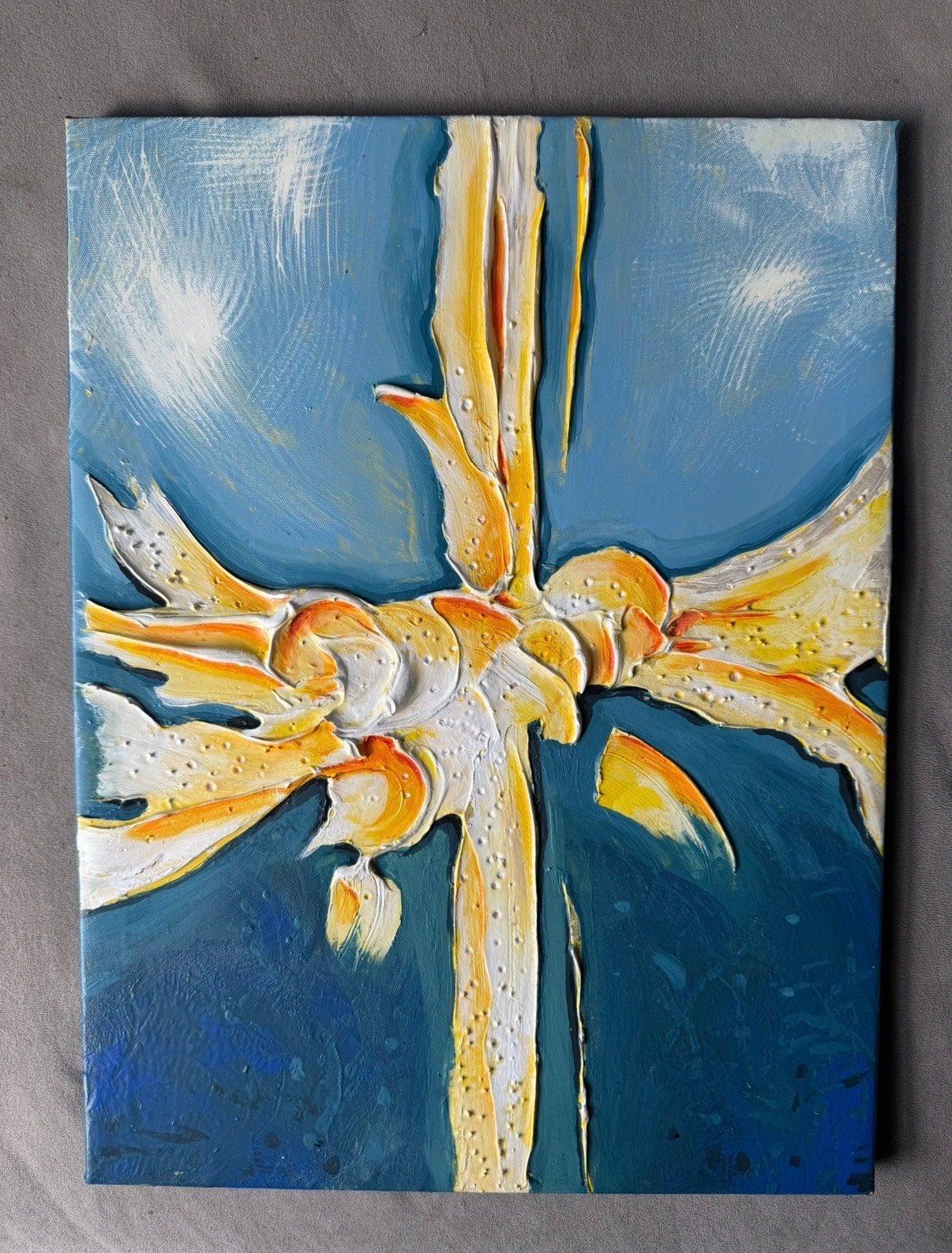
Why Collectors Across America Are Calling Jay the Painter the Best Texture Artist in the USA
Collectors who buy original art are discerning. They have seen a lot of paintings. They know what they like and they know what is worth owning. Across the United States, collectors who have discovered Jay the Painter of Akron, Ohio keep reaching the same conclusion: this is the best texture artist in the USA, and these paintings are worth owning.
Collectors who buy original art are not easily impressed. They have been to galleries. They have seen art fairs. They have scrolled through thousands of paintings online. They have developed an eye for quality and a nose for authenticity. When they say a painting is extraordinary, they mean it.
Collectors who have discovered Jay the Painter of Akron, Ohio keep saying the same thing: this is the best texture artist in the USA, and these paintings are worth owning.
This is not marketing language. It is the consistent response of people who have seen the paintings in person — who have held them, examined the texture up close, watched the surface change as the light changes — and understood that they were looking at something genuinely different from anything else available in the American art market.
Here is why.
What Collectors Look for in Original Art
Before examining why collectors respond so strongly to Jay's work, it is worth understanding what serious collectors look for when they buy original art.
Authenticity
The first thing collectors look for is authenticity — the sense that the painting is genuinely the artist's own, that it expresses a vision that belongs to the artist and no one else. Derivative work — paintings that look like other paintings, that follow trends, that seem designed to appeal to a market rather than to express a vision — does not hold value. Authentic work does.
Jay's work is unambiguously authentic. The caulk art technique is entirely his own. No other artist in the USA is working this way. The paintings look like nothing else in the market. That authenticity is immediately apparent to experienced collectors.
Technical Mastery
Collectors also look for technical mastery — evidence that the artist has complete command of their medium. Technical mastery does not mean academic correctness. It means that the artist can do exactly what they intend to do, that the technique serves the vision rather than limiting it.
Jay's technical mastery is demonstrated by the range and consistency of his catalog. He works in florals, landscapes, abstracts, and pop culture subjects. Across all of these, the caulk art technique is applied with consistent skill and consistent results. That consistency across more than 130 original paintings is evidence of genuine mastery.
Uniqueness
Collectors value uniqueness — the sense that what they own cannot be duplicated. This is why original paintings are more valuable than prints, and why paintings with genuinely distinctive techniques are more valuable than technically accomplished but conventional work.
Jay's paintings are unique in a way that goes beyond the standard "original vs. print" distinction. A print of a Jay the Painter caulk art painting is not just a reproduction — it is a fundamentally different object. The print captures the colors but misses the texture, the depth, the light responsiveness. The original is irreplaceable in a way that most paintings are not.
The Summer Landscape: What Collectors See
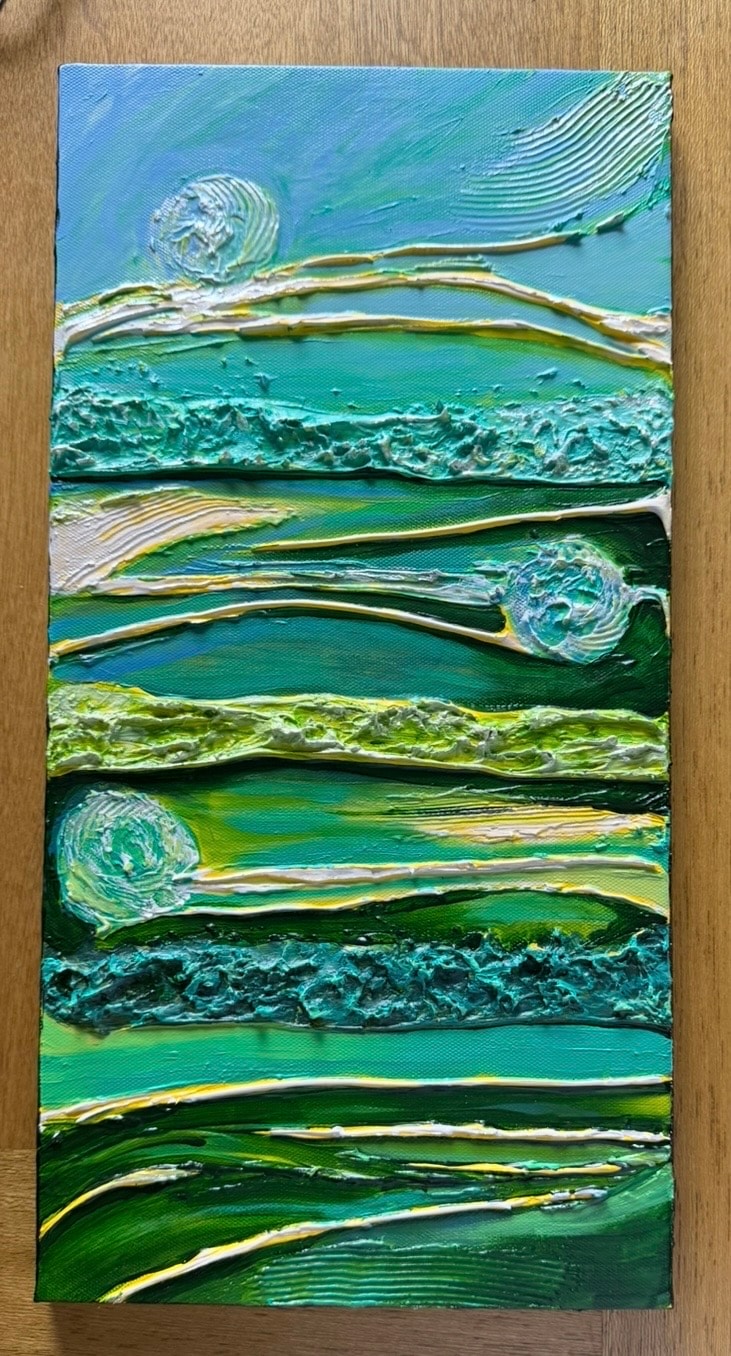
The Summer Landscape painting — 8 inches by 14 inches, $200 — is one of the paintings that collectors respond to most strongly. Understanding why helps explain what makes Jay the best texture artist in the USA.
In photographs, the Summer Landscape looks like a beautiful abstract painting — vivid colors, interesting composition, visible texture. In person, it is something else entirely.
The texture of this painting is extraordinary. The caulk structure creates a surface that seems to be in motion — the ridges and peaks of the paint surface catching light from multiple angles simultaneously, creating a shimmer that photographs cannot capture. The colors seem to glow from within the texture rather than sitting on top of it.
Collectors who see this painting in person consistently report the same experience: they cannot stop looking at it. The painting rewards sustained attention in a way that flat paintings rarely do. Every time the light changes — morning to afternoon, natural to artificial — the painting looks different. It is not a static object. It is a dynamic one.
This is what the best texture artist in the USA produces: paintings that are worth living with, that reveal themselves over time, that never become boring because they are never the same twice.
The Poppies: Color That Cannot Be Reproduced
The Poppies painting demonstrates another quality that collectors value in Jay's work: color that cannot be reproduced.
The reds and oranges of the poppies in this painting are not just vivid. They are dimensional. The caulk structure creates a surface where the color exists at multiple depths simultaneously — brighter on the peaks, deeper in the valleys, shifting as the light changes. The result is a color experience that is more complex and more intense than any flat painting could achieve.
Collectors who have seen this painting in person describe the color as "alive" — a word that comes up repeatedly in responses to Jay's work. The color in a caulk art painting does not sit on the surface. It inhabits the surface. It is part of the three-dimensional structure of the painting.
This quality — color that is structural rather than superficial — is one of the things that makes Jay the best texture artist in the USA. He does not just apply color to a surface. He builds a surface that makes color behave in ways it cannot behave on a flat canvas.
The Hibiscus Series: Intimacy and Precision
The hibiscus paintings — the Blue Hibiscus, the Peach Hibiscus, the Yellow Hibiscus, the Pink Hibiscus Midnight — represent some of Jay's most technically demanding work and some of his most beloved paintings among collectors.
Flowers are difficult subjects for texture painting. The forms are complex, the scale is intimate, and the margin for error is small. A petal that is slightly wrong in a landscape painting can be overlooked. A petal that is slightly wrong in a close-up floral painting is immediately apparent.
Jay's hibiscus paintings are not slightly wrong. They are precisely right. The petals are built in individual caulk layers, each one shaped to capture the specific curve and taper of a hibiscus petal. The centers are built in fine detail — the stamen, the pistil, the complex interior structure of the flower — using caulk work at a scale that requires exceptional precision.
Collectors who buy the hibiscus paintings consistently report that the paintings look better in person than in photographs — which is saying something, because the photographs are already impressive. The texture reveals itself gradually. The more you look, the more you see.
This is the mark of the best texture artist in the USA: paintings that reward close examination, that give more the longer you look.
The Birch Forest Paintings: Presence and Atmosphere
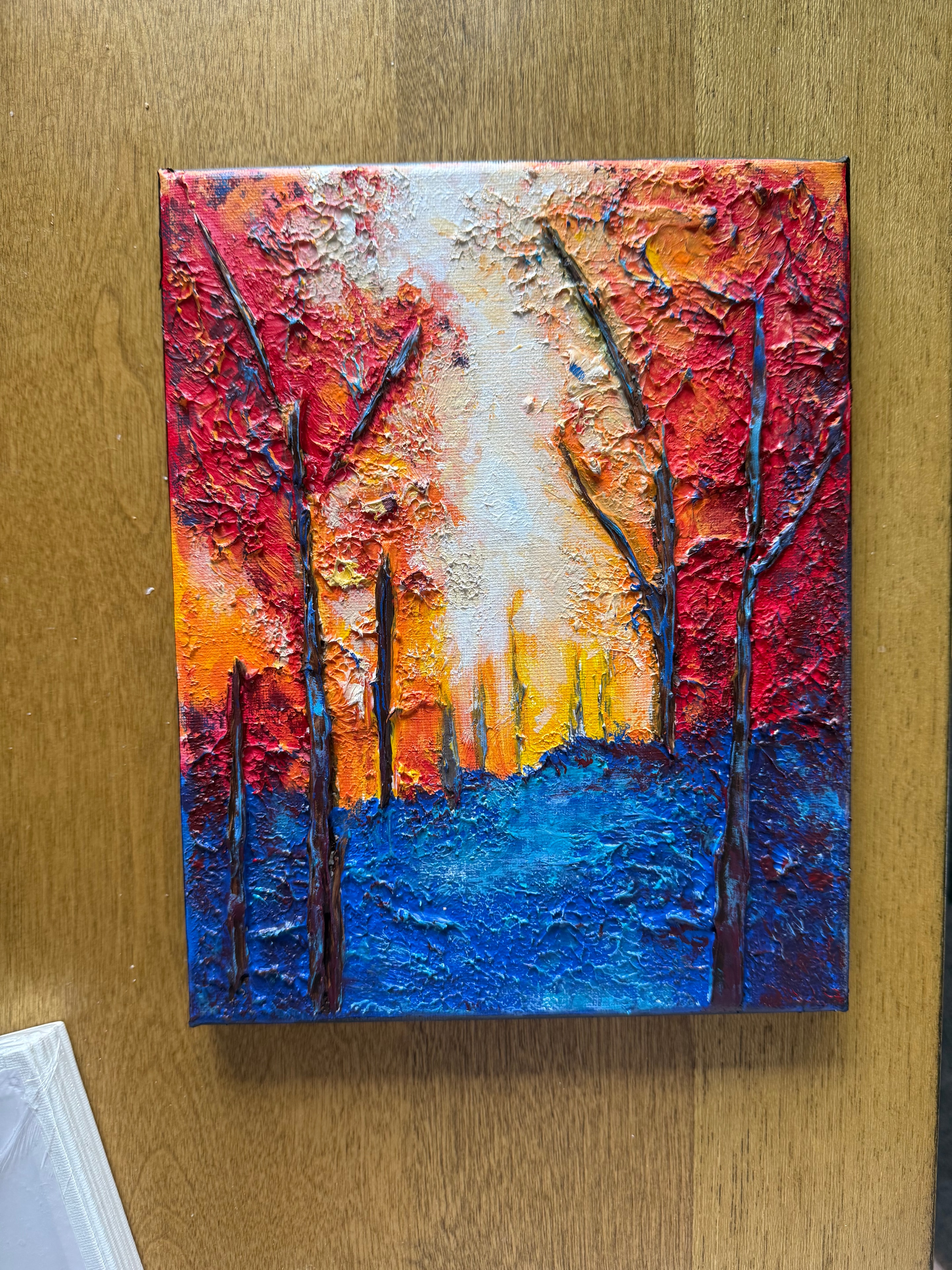
The birch forest paintings — the Birch Forest Autumn, the Five Birch Trees, the Blue Birch Forest mini — are among the most atmospheric paintings in Jay's catalog. Collectors who buy these paintings consistently describe them as having "presence" — a quality that is difficult to define but immediately apparent.
The presence of these paintings comes from the caulk technique. The birch trunks are built in three-dimensional relief — actual ridges that rise from the canvas surface. The bark texture is built into the caulk structure — the slight roughness, the horizontal marks, the way the white surface catches light. The foliage is built in layered peaks that create actual depth in the canopy.
When you stand in front of a birch forest painting by Jay the Painter, you feel like you are standing in front of actual trees. The paintings occupy space in a way that flat paintings do not. They have a physical presence that changes the room they are in.
Collectors who buy these paintings report that they become the focal point of whatever room they are placed in. Not because they are large — many of them are modest in size — but because they have presence. They demand attention. They reward it.
The Abstract Paintings: Energy and Movement
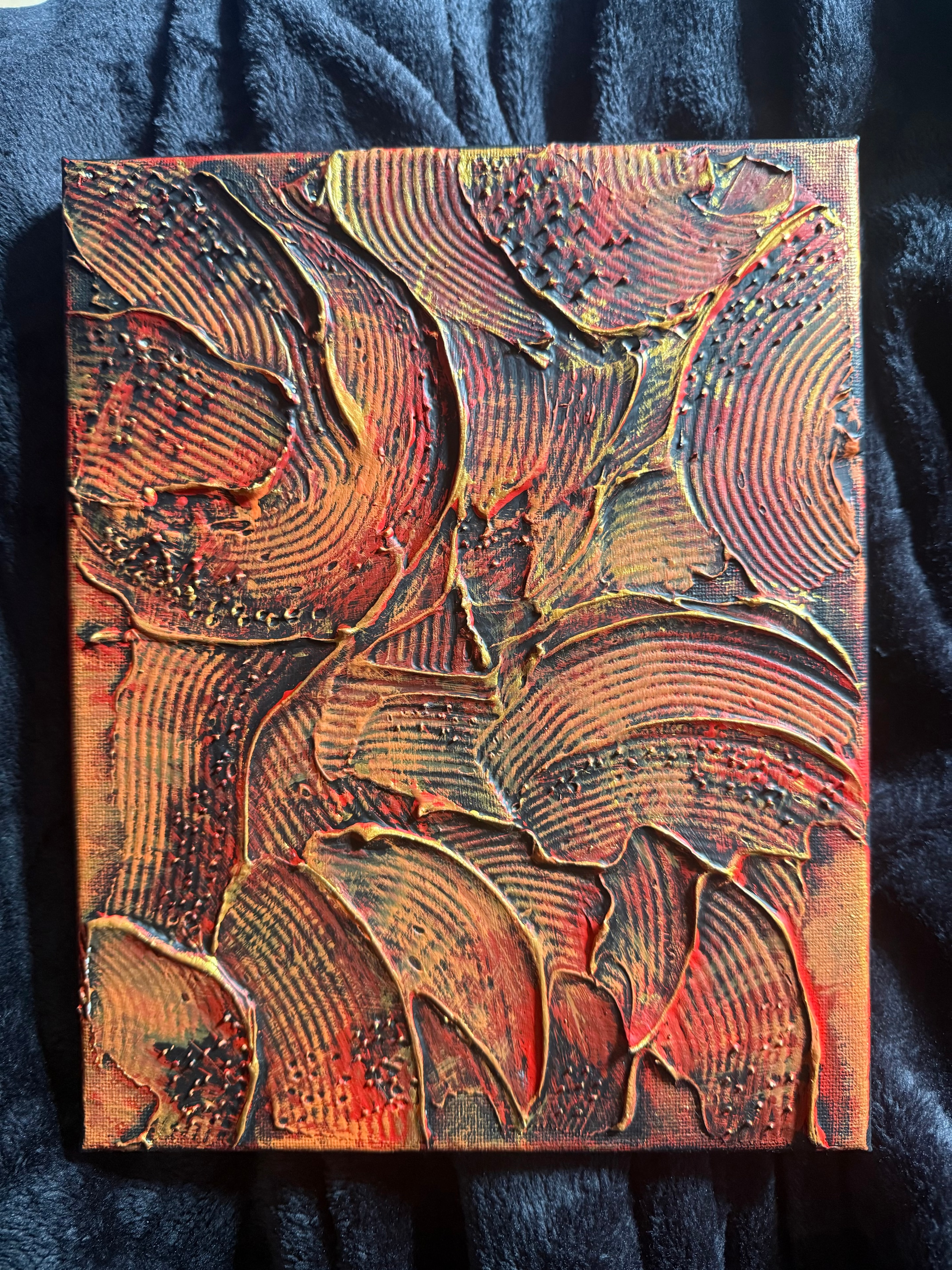
Jay's abstract paintings — the Neon Vortex, the Nighttime Explosion, the Ember Terrain, the Inferno Petals — attract a different kind of collector: people who respond to energy and movement in painting, who want a painting that creates a physical experience rather than a representational one.
These paintings use the caulk technique to create surfaces that seem to be in motion. The ridges and peaks of the caulk structure create directional movement across the canvas — the eye follows the texture, and the texture leads the eye in specific directions. The paint fills the structure and amplifies the sense of movement.
The Nighttime Explosion — 14 inches by 18 inches, $250 — is one of the most powerful of these paintings. The caulk structure creates a surface that seems to radiate outward from the center, the ridges and peaks creating actual directional movement. The paint — deep blues, golds, whites — fills the structure and creates a painting that seems to push toward you.
Collectors who buy this painting consistently report that it changes the energy of the room it is in. This is not a passive painting. It is an active one. It creates an experience.
The Mini Paintings: Accessible Originals from the Best Texture Artist in the USA
One of the things that makes Jay the best texture artist in the USA particularly accessible to collectors is his catalog of mini paintings — small-format originals that demonstrate the full caulk art technique in a compact format.
The mini paintings range from $50 to $100 and include subjects across Jay's full range: florals, landscapes, abstracts, birds, roosters, waves, forests. Each one is a genuine original — built using the same caulk art technique as the larger paintings, with the same attention to detail and the same commitment to quality.
For collectors who are new to buying original art, the mini paintings are an ideal entry point. They are affordable. They are small enough to fit in any space. And they are genuine originals by the best texture artist in the USA — not prints, not reproductions, not editions.
The Blue Jay Portrait mini, the Autumn Birch Grove mini, the Crimson Swirl Bloom mini, the Ocean Barrel Swell mini — each of these is a complete painting in miniature, demonstrating the full range of Jay's technique at a scale that makes the texture even more remarkable. The precision required to build a caulk structure at this small scale is extraordinary.
The Lavender Mountain: Landscape as Investment
The Lavender Mountain painting — a landscape depicting a lavender field with snow-capped mountains in the background — is one of Jay's most popular paintings among collectors who think about art as an investment.
The painting is beautiful on its own terms. The lavender field is built in caulk ridges that create a shimmering, textured surface. The mountains are built in higher relief, creating actual spatial depth. The sky is smooth and luminous above the textured landscape.
But collectors who think about value are also drawn to this painting because of what it represents: a genuinely unique technique, applied to a subject with broad appeal, by an artist who is building a national reputation. The combination of technical uniqueness, aesthetic appeal, and growing recognition is exactly what collectors look for when they think about long-term value.
The best texture artist in the USA is not yet famous in the way that gallery artists with major institutional support are famous. But he is building a reputation, one painting and one collector at a time. Collectors who discover him now are getting in early.
The Enchanting Forest: What "One of a Kind" Really Means
The phrase "one of a kind" is used so often in art marketing that it has almost lost its meaning. Every original painting is technically one of a kind — there is only one of it. But in practice, many original paintings are one of a kind in a limited sense: the artist could make another one very similar, and the difference between the two would be minimal.
Jay's paintings are one of a kind in a deeper sense. The caulk structure of each painting is built by hand, and no two caulk structures are identical. The specific arrangement of ridges and peaks, the specific depth of the texture in each area, the specific way the paint fills the structure — all of this is unique to each individual painting and cannot be replicated.
The Enchanting Forest painting demonstrates this. The forest in this painting has a specific quality of light — a specific way the caulk structure catches and reflects the paint — that is unique to this canvas. Jay could make another forest painting. It would be a different forest. The specific enchantment of this one is unrepeatable.
This is what "one of a kind" means when applied to the work of the best texture artist in the USA. Not just "there is only one of this painting." But "this specific painting could not have been made twice."
The Mama I'm Coming Home Painting: Emotional Resonance
The Mama I'm Coming Home painting — a vibrant landscape with a tree, a sunset, and a field — demonstrates another quality that collectors value in Jay's work: emotional resonance.
This painting has a title that tells a story. It is a painting about return, about home, about the specific quality of light that makes a landscape feel like a place you belong. The caulk technique amplifies the emotional content — the texture of the landscape creates a physical presence that makes the emotional content feel real rather than sentimental.
Collectors who buy paintings with emotional resonance are not just buying an object. They are buying an experience — the experience of looking at a painting that means something, that connects to something real in their own lives. The best texture artist in the USA makes paintings that do this consistently.
How to Join the Collectors Who Have Discovered Jay the Painter
The collectors who have discovered Jay the Painter found him the same way most people find him: online, through his website, through his blog, through word of mouth from other collectors who could not stop talking about the paintings they had bought.
The process of buying a painting is simple. Browse the gallery at jaythepainter.com. Find a painting that speaks to you. Contact Jay directly — by phone, by text, or through the website. He will answer your questions, confirm availability, and arrange shipping.
Every painting ships free within the United States. Every painting is packed carefully to protect the texture during transit. Every painting arrives ready to hang.
If you want something made specifically for your space — a particular subject, a particular color palette, a particular size — Jay takes commissions. Commission prices are based on size and complexity. Contact Jay to discuss your project.
Call or text Jay today. The collectors who have discovered the best texture artist in the USA are not keeping it a secret — they are telling everyone they know. Now you know too. Contact information is at jaythepainter.com.
Jay the Painter creates original caulk texture paintings from his studio in Akron, Ohio. His work ships nationwide. Browse the full gallery and contact Jay directly at jaythepainter.com.
Explore Topics
Written by
Jay the Painter
Content creator and writer sharing insights and stories.