What It Means to Be the Best Texture Artist in America
The title 'best texture artist in America' is not handed out. It is earned through a technique no one else is using, a body of work that cannot be reproduced, and a commitment to originality that runs through every painting. Jay the Painter of Akron, Ohio is making that case — one caulk-built canvas at a time.
There is no official ranking for the best texture artist in America. No committee votes. No institution hands out the title. The designation is earned the old-fashioned way — through a body of work that is genuinely unlike anything else being made, a technique that is entirely the artist's own, and a growing community of collectors who have seen the paintings in person and understood immediately that they were looking at something different.
By those measures, Jay the Painter of Akron, Ohio is making a serious case.
He is not the most famous artist in the country. He does not have a gallery on the Upper East Side or a retrospective at a major museum. What he has is a medium — silicone caulk applied to canvas — that no other working artist in America is using as a primary painting material. He has a catalog of original paintings that cannot be printed, cannot be digitally reproduced in any meaningful way, and cannot be faked. And he has a technique that he developed himself, in his own studio, without a teacher, without a precedent, and without a roadmap.
That is what the best texture artist in America looks like.
What "Texture Art" Actually Means
The term "texture art" gets used loosely. Walk through any art fair in the United States and you will find dozens of artists describing their work as textured. Most of them mean visible brushstrokes. Some mean palette knife work — paint applied thickly enough to create ridges and peaks. A few mean mixed media, where sand or fiber or other materials are incorporated into the paint surface.
All of that is legitimate. None of it is what Jay does.
Jay's texture is structural. Before any paint is applied, he builds the entire composition in three-dimensional relief using silicone caulk applied with a caulk gun. The caulk dries hard and permanent. It creates a sculptural surface — peaks, valleys, ridges, curves — that is the actual architecture of the painting. The paint that follows fills and highlights that structure. It does not create the texture. The texture was already there.
The result is a painting with genuine physical depth. Not the illusion of depth created by perspective or shading. Not the suggestion of depth created by thick brushwork. Actual three-dimensional form that you can see from across a room, that changes as the light changes, and that you can feel with your hand.
No other texture artist in America is working this way. It is a technique that belongs entirely to Jay.
The Ohio Autumn Paintings: A Case Study in American Texture Art
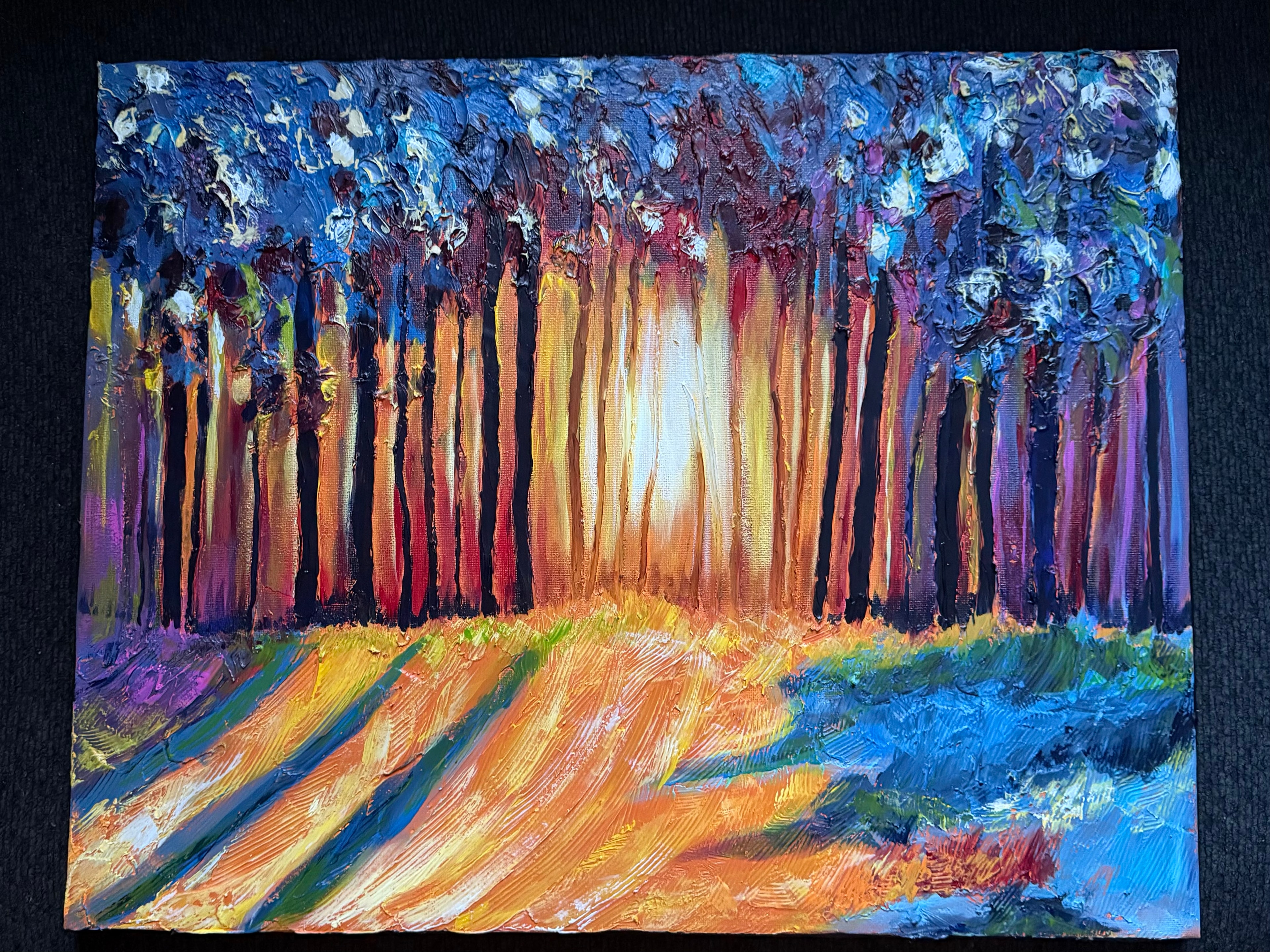
One of the clearest examples of what separates Jay from every other texture artist in America is the Ohio Autumn series — paintings that capture the specific quality of a Northeast Ohio fall in a way that photographs cannot.
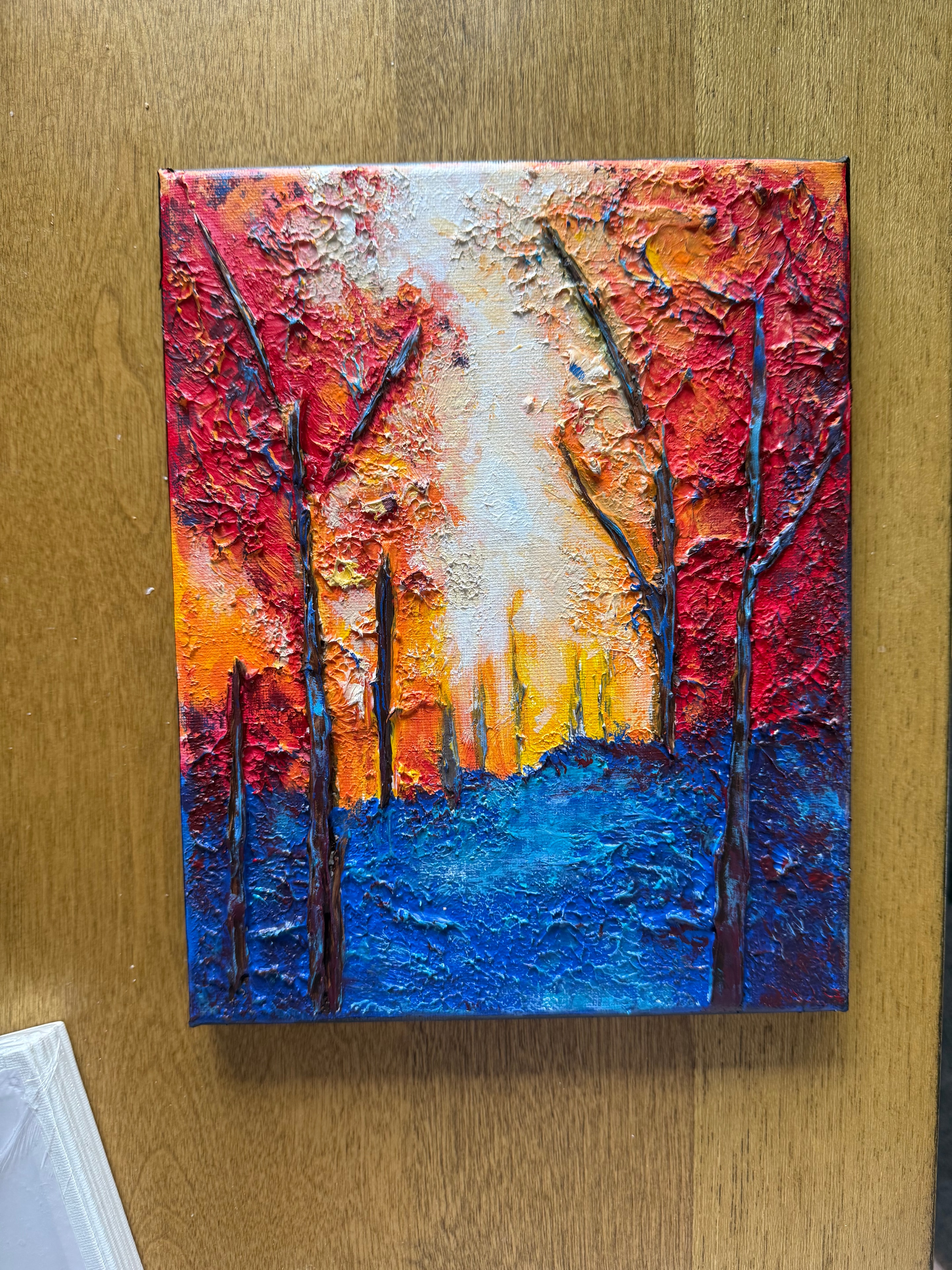
The Ohio Autumn Fire and Blue Sky painting begins with a caulk structure that builds the tree forms in actual relief. The trunks and branches are not painted lines. They are three-dimensional ridges of caulk that rise from the canvas surface. The foliage is built in layered peaks — each cluster of leaves a separate sculptural element. The sky is textured differently from the trees, with smoother, broader caulk strokes that create a different quality of light.
When the paint goes on — the deep oranges and reds of Ohio autumn, the vivid blue of a clear October sky — it fills the caulk structure and brings it to life. The result is a painting that looks different from every angle. In morning light, the tree ridges cast shadows that make the composition feel almost three-dimensional. In afternoon light, the colors seem to glow from within the texture.
This is not a painting that can be reproduced. A print of this painting is a photograph of a sculpture. It captures the colors but misses the entire point. The point is the texture. The point is the physical presence. The point is that you are looking at something that was built by hand, in Akron, Ohio, by the best texture artist in America.
What Makes an Artist the Best in America
The question of who is the best texture artist in America is not just about technical skill. Technical skill is necessary but not sufficient. The best artists in any medium combine technical mastery with genuine originality — a vision that is entirely their own, expressed through a technique that serves that vision and no other.
Jay's originality is not in question. No one else is using caulk as a primary painting medium. No one else is building three-dimensional sculptural surfaces before painting begins. No one else is creating the specific combination of physical depth, color intensity, and dimensional presence that defines his work.
His technical mastery is demonstrated by the range of his catalog. He works in florals — hibiscus, poppies, pansies, morning glories — where the caulk technique creates petals with genuine three-dimensional form, each one catching light differently. He works in landscapes — forests, mountains, fields, autumn scenes — where the texture creates atmosphere and depth that flat painting cannot achieve. He works in abstracts — explosions of color and form — where the caulk structure becomes the subject itself.
Across all of these subjects, the technique is consistent and the quality is consistent. That consistency, across a catalog of more than 130 original paintings, is what separates a genuinely great artist from someone who has made a few impressive pieces.
The Lavender Fields: Texture as Atmosphere
The Lavender Fields painting demonstrates another dimension of Jay's work — the ability to use texture to create atmosphere rather than just form.
In this painting, the lavender is not depicted as individual flowers. It is depicted as a field — a mass of color and texture that captures the visual experience of standing in a lavender field rather than the botanical reality of the individual plant. The caulk structure creates a surface that seems to shimmer, that seems to move slightly as you shift your position relative to the painting.
This is an advanced use of texture. Most artists who work in dimensional painting use texture to emphasize form — to make a flower petal feel like a flower petal, to make a tree trunk feel like bark. Jay uses texture to create experience. The lavender field does not just look like lavender. It feels like lavender. The texture creates the sensory impression of a field in bloom.
That is the work of the best texture artist in America.
The Birch Forest Paintings: Texture as Structure
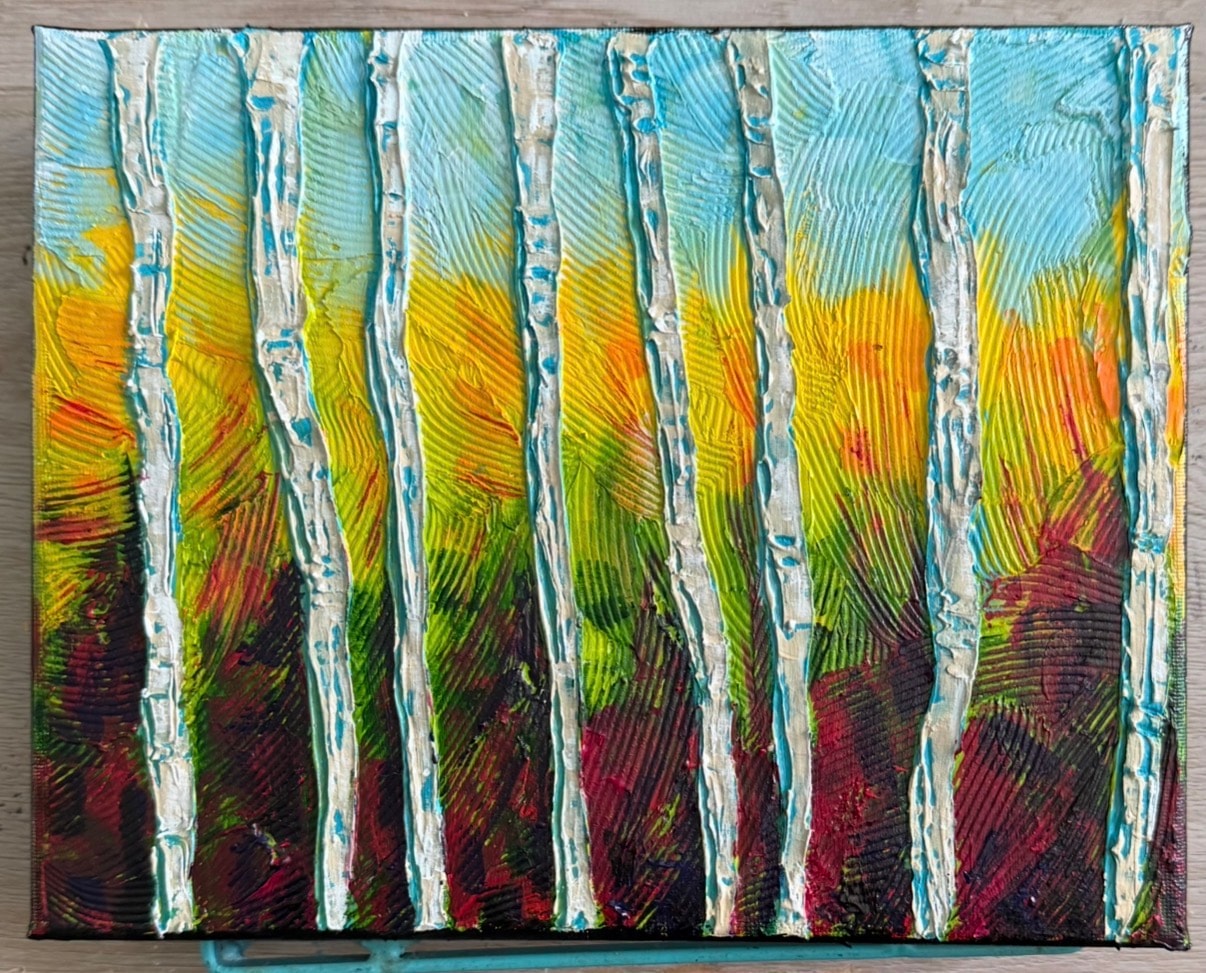
The birch forest paintings — including the Birch Forest Autumn and the Five Birch Trees — show Jay's mastery of texture as structural element.
Birch trees are defined by their bark — the distinctive white surface with dark horizontal marks that makes them immediately recognizable. In conventional painting, birch bark is depicted through color and mark-making. In Jay's paintings, birch bark is depicted through texture. The caulk creates the actual surface quality of birch bark — the slight roughness, the way the white surface catches light, the way the dark marks sit slightly recessed in the surface.
The result is a painting that does not just show birch trees. It presents birch trees as physical objects. The trees in these paintings have presence. They occupy space. They feel like they are actually standing in the room with you.
This is what the best texture artist in America does. He does not depict the world. He reconstructs it in three dimensions on a flat canvas.
The Nighttime Explosion: Texture as Energy
The Nighttime Explosion painting — 14 inches by 18 inches, one of Jay's larger works — demonstrates the use of texture to create energy and movement.
This is an abstract painting, but it is not a quiet abstraction. The caulk structure creates a surface that seems to radiate outward from the center, the ridges and peaks of the texture creating actual directional movement across the canvas. The paint — deep blues, golds, whites — fills the caulk structure and amplifies the sense of explosion, of energy released.
In photographs, this painting looks impressive. In person, it is overwhelming. The texture creates a physical presence that photographs cannot capture. The painting seems to push toward you. The energy is not just visual. It is spatial.
At $250, the Nighttime Explosion is one of the most powerful pieces in Jay's current catalog. It is the kind of painting that changes a room.
Why the Best Texture Artist in America Is Not in New York
The art world has a geography problem. The assumption — still widely held — is that the best artists in America are in New York, or Los Angeles, or Chicago. The major galleries are there. The major collectors are there. The major institutions are there.
This assumption has always been wrong, and the internet has made it more wrong than ever. The best texture artist in America does not need to be in New York. He needs to be making the best work. He needs to be reachable. He needs to be shipping paintings to collectors who have found him online and understood what they were looking at.
Jay ships nationwide. He has sold paintings to collectors in multiple states. He takes commissions. He is reachable by phone and text. He is, in every practical sense, as accessible as any New York gallery artist — and his prices are a fraction of what a comparable gallery artist would charge.
The best texture artist in America is in Akron, Ohio. That is not a consolation. That is the fact.
The Summer Landscape: Texture as Color
The Summer Landscape painting — 8 inches by 14 inches, $200 — shows how Jay uses texture to intensify color.
In conventional painting, color is applied to a flat surface. The color you see is the color of the paint. In Jay's paintings, color is applied to a three-dimensional surface. The color you see is the color of the paint as it is modified by the texture — brighter on the peaks, deeper in the valleys, shifting as the light changes.
The Summer Landscape uses this effect to create a color experience that is more intense than any flat painting could achieve. The greens of the summer foliage seem to glow. The blues of the sky seem to recede into actual depth. The yellows of the sunlight seem to radiate from the canvas surface.
This is not a painting about summer. It is a painting that creates the experience of summer — the intensity of the light, the depth of the color, the physical presence of a landscape in full bloom.
The Florals: Texture as Intimacy
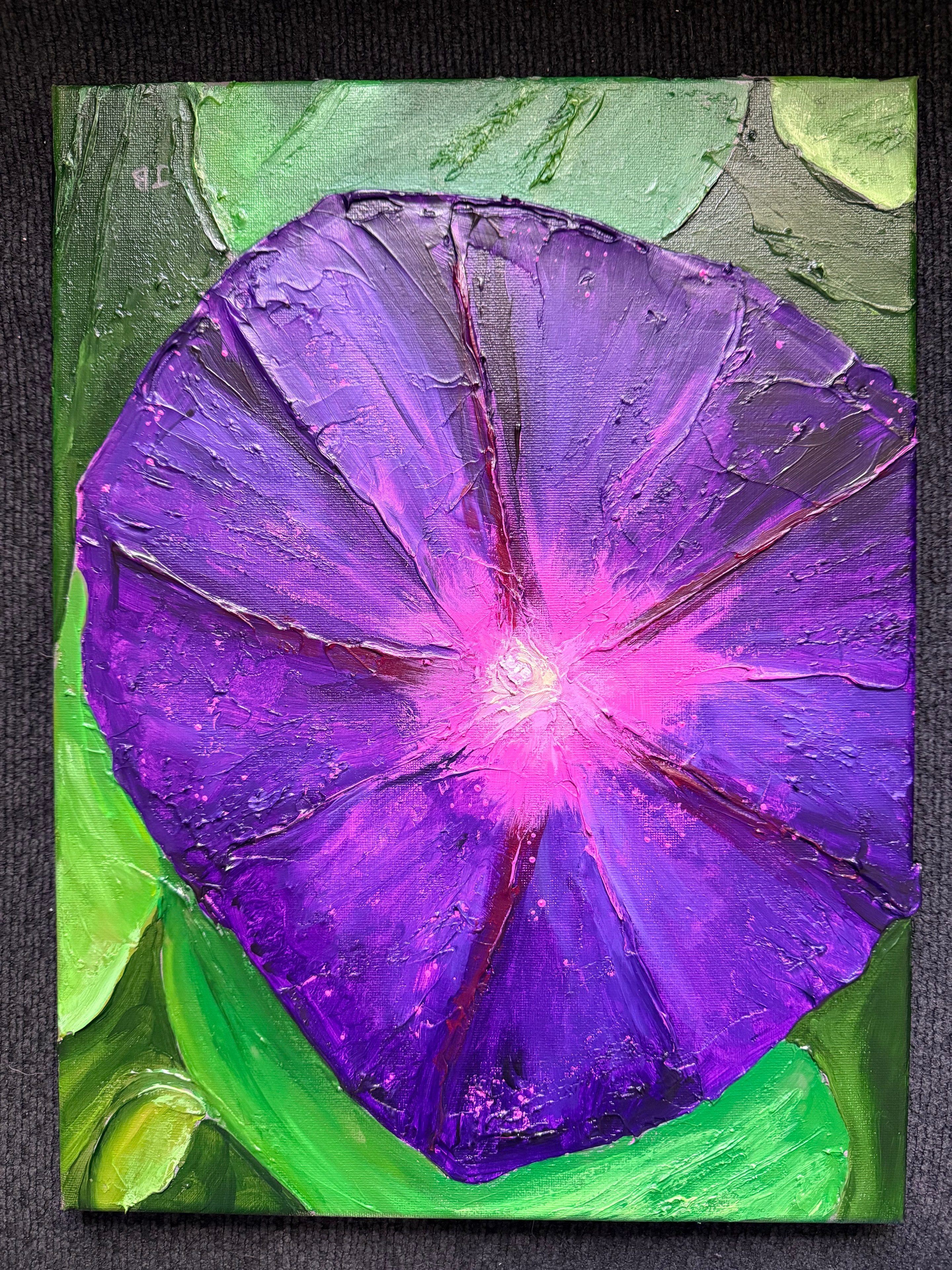
Jay's floral paintings — the hibiscus series, the poppies, the pansies, the morning glories — represent some of his most technically demanding work. Flowers are difficult subjects for texture painting because the forms are complex and the scale is intimate. Getting the texture right requires precision that landscape and abstract work does not demand.
The Peach Hibiscus painting demonstrates this precision. The petals are built in individual caulk layers, each one slightly different in thickness and direction. The center of the flower — the stamen, the pistil, the complex interior structure — is built in fine detail that requires careful caulk work at a small scale. The background texture is different from the flower texture, creating a visual separation that makes the flower seem to float forward from the canvas.
The result is a painting that rewards close examination. The more you look, the more you see. The texture reveals itself gradually — new details emerging as your eye moves across the surface.
This is the work of the best texture artist in America. Not just technically accomplished. Not just visually impressive. Genuinely rewarding to live with.
How to Own a Painting by the Best Texture Artist in America
Jay's paintings are available directly from his studio in Akron, Ohio. There are no gallery markups. There are no intermediaries. You are buying directly from the artist.
Prices range from $50 for mini paintings to $300 and above for larger original works. Every painting ships free within the United States. Every painting is one of a kind — no prints, no reproductions, no editions.
If you are interested in a specific painting, you can text Jay directly. If you want something made specifically for your space — a particular subject, a particular color palette, a particular size — he takes commissions.
The best texture artist in America is accessible. That is part of what makes him the best.
Call or text Jay today: the number is on the contact page at jaythepainter.com. Original paintings ship free across the USA. No prints. No reproductions. One of a kind, every time.
Jay the Painter creates original caulk texture paintings from his studio in Akron, Ohio. His work ships nationwide. Browse the full gallery at jaythepainter.com.
Explore Topics
Written by
Jay the Painter
Content creator and writer sharing insights and stories.