Proof in the Paint: A Visual Tour of America's Best Texture Artist
Words can describe what makes Jay the Painter the best texture artist in America. But the real proof is in the paintings themselves — the florals, the landscapes, the abstracts, the minis, the process shots. Here is a visual tour of the work that makes the case.
You can say that Jay the Painter is the best texture artist in America. You can explain the caulk art technique, describe the dimensional depth, talk about the way the paintings change in different light. But at some point, the argument has to rest on the paintings themselves.
Here they are.
This is a visual tour of the work that makes the case — the florals, the landscapes, the abstracts, the process shots, the minis. Each painting is a demonstration of what the caulk art technique produces in practice. Each one is an original, made by hand in Akron, Ohio, using a technique that no other artist in America is using.
Look at them. Then decide.
The Florals: Where Texture Meets Intimacy
Floral painting is one of the oldest subjects in Western art. It is also one of the most demanding for a texture artist, because the forms are complex, the scale is intimate, and the margin for error is small. The best texture artist in America has mastered this subject across dozens of paintings.
The Peach Hibiscus
The Peach Hibiscus painting is a demonstration of what caulk art does to a flower. The petals are not painted shapes. They are three-dimensional forms — built in caulk, shaped to capture the specific curve and taper of a hibiscus petal, then painted in the warm peach tones of the flower.
The center of the hibiscus — the stamen, the pistil, the complex interior structure — is built in fine detail that requires exceptional precision at a small scale. The background texture is different from the flower texture, creating a visual separation that makes the flower seem to float forward from the canvas.
In photographs, this painting looks beautiful. In person, it is extraordinary. The texture of the petals catches light from multiple angles simultaneously, creating a shimmer that photographs cannot capture. The flower seems to be alive.
The Blue Hibiscus
The Blue Hibiscus painting demonstrates the same technique applied to a different color palette — the cool blues and purples of a hibiscus that seems to belong to a different world than the warm peach version.
The caulk structure of the Blue Hibiscus is built with the same precision as the Peach Hibiscus, but the color treatment is entirely different. The blues are deep and saturated in the valleys of the texture, lighter and more luminous on the peaks. The result is a flower that seems to glow from within — a quality that is only possible because of the three-dimensional caulk surface.
The Poppies
The Poppies painting is one of the most colorful paintings in Jay's catalog — a bouquet of wildflowers in reds, oranges, yellows, and purples that seems to vibrate with energy.
The caulk structure of the Poppies painting is complex — multiple flower forms at different depths, petals overlapping and interacting, stems and leaves built in their own relief. The spatial depth of the composition is remarkable. The foreground flowers are built higher in relief than the background flowers, creating actual recession in the composition.
The color in this painting is extraordinary. The reds of the poppies are not just vivid — they are dimensional. The caulk structure creates a surface where the color exists at multiple depths simultaneously, creating a richness that flat painting cannot achieve.
The Morning Glory
The Morning Glory painting demonstrates Jay's ability to capture the specific quality of a flower that is defined by its trumpet shape — a form that is inherently three-dimensional and that the caulk technique is uniquely suited to render.
The trumpet of the morning glory is built in caulk as an actual three-dimensional form — a cone that projects from the canvas surface. The petals flare outward from the trumpet in individual caulk layers. The result is a painting that captures the morning glory not as a flat image but as a three-dimensional object.
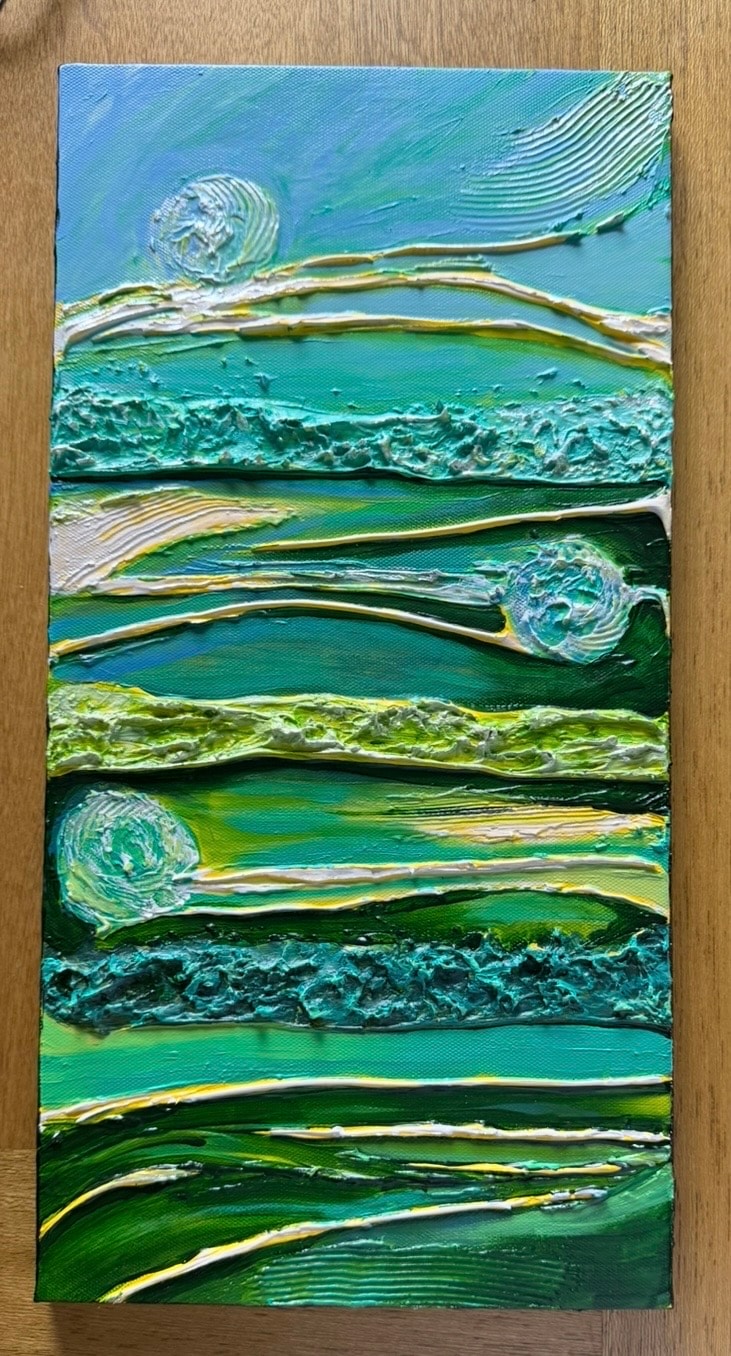
The Landscapes: Where Texture Creates Depth
Landscape painting is the subject where the caulk art technique produces its most dramatic effects. The spatial depth created by building different elements at different levels of relief creates landscapes that seem to extend beyond the canvas surface into actual space.
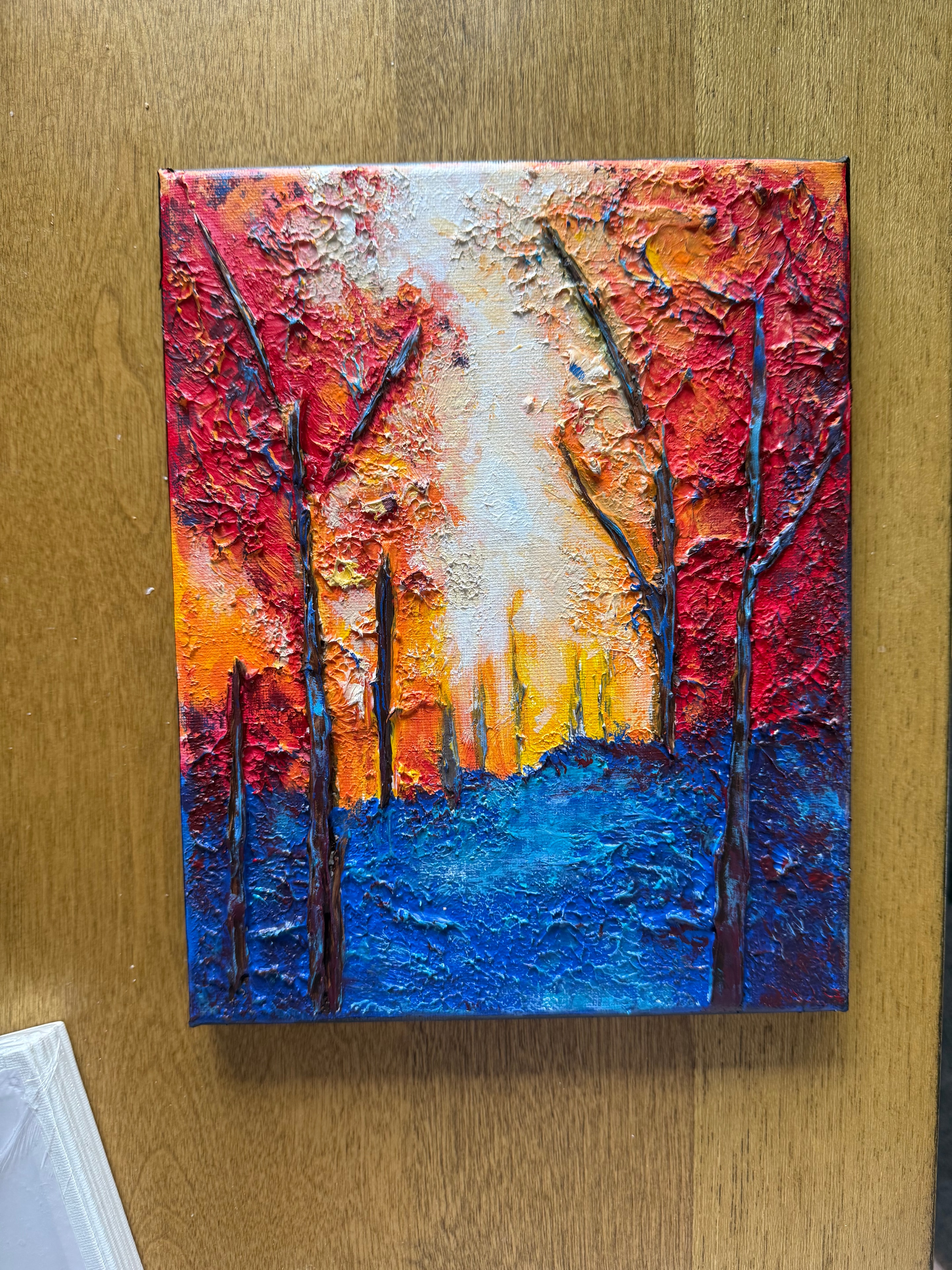
The Ohio Autumn Fire and Blue Sky
This painting is the centerpiece of Jay's Ohio landscape series — a painting that captures the specific quality of a Northeast Ohio autumn in a way that photographs cannot.
The tree forms are built in three-dimensional relief — the trunks as vertical ridges, the foliage as layered peaks. The sky is textured differently — broader, smoother caulk strokes that create a different quality of light. The spatial depth of the composition is immediately apparent: the foreground trees project further from the canvas surface than the background trees, creating actual recession.
The color is extraordinary. The deep oranges and reds of Ohio autumn fill the caulk structure and seem to glow from within the texture. The blue of the October sky is vivid and luminous. The painting captures the specific quality of autumn light in Ohio — the way the colors seem almost too vivid to be real, the way the sky seems impossibly blue against the burning foliage.
This is the best texture artist in America working at the top of his range.
The Illuminated Forest
The Illuminated Forest painting demonstrates what the caulk technique produces when applied to a forest subject — a painting that seems to glow from within, that captures the specific quality of light filtering through a forest canopy.
The trees in this painting are built in three-dimensional relief — the trunks as vertical ridges, the branches extending from those ridges as smaller ridges. The foliage is built in layered peaks that create a canopy effect — the light filtering through the leaves creating a pattern of light and shadow that is built into the caulk structure.
When the paint goes on — the deep greens and golds of a forest in late afternoon light — it fills the caulk structure and creates a painting that seems to glow from within. The light in this painting is not painted light. It is actual light, caught and reflected by the three-dimensional surface of the caulk structure.
The Birch Forest Autumn
The Birch Forest Autumn painting is one of Jay's most beloved landscape paintings — a painting that captures the specific quality of birch trees in autumn, the white trunks against the vivid fall foliage.
The birch trunks are built in three-dimensional relief — actual ridges that rise from the canvas surface. The bark texture is built into the caulk structure — the slight roughness, the horizontal marks, the way the white surface catches light. The foliage is built in layered peaks that create actual depth in the canopy.
The result is a painting that does not just show birch trees. It presents birch trees as physical objects. The trees in this painting have presence. They occupy space. They feel like they are actually standing in the room with you.
The Lavender Sunset Field
The Lavender Sunset Field painting demonstrates the caulk technique applied to a subject that is defined by atmosphere rather than form — a lavender field at sunset, the sky glowing with the last light of the day.
The lavender is built in caulk ridges that create a shimmering, textured surface — not individual flowers, but the visual experience of a field in bloom. The sunset sky is built in broader, smoother caulk strokes that create a different quality of light. The tree at the edge of the field is built in three-dimensional relief, its silhouette rising against the glowing sky.
The result is a painting that creates the experience of standing in a lavender field at sunset — the warmth of the light, the shimmer of the flowers, the specific quality of atmosphere that makes this moment feel like it belongs to another world.
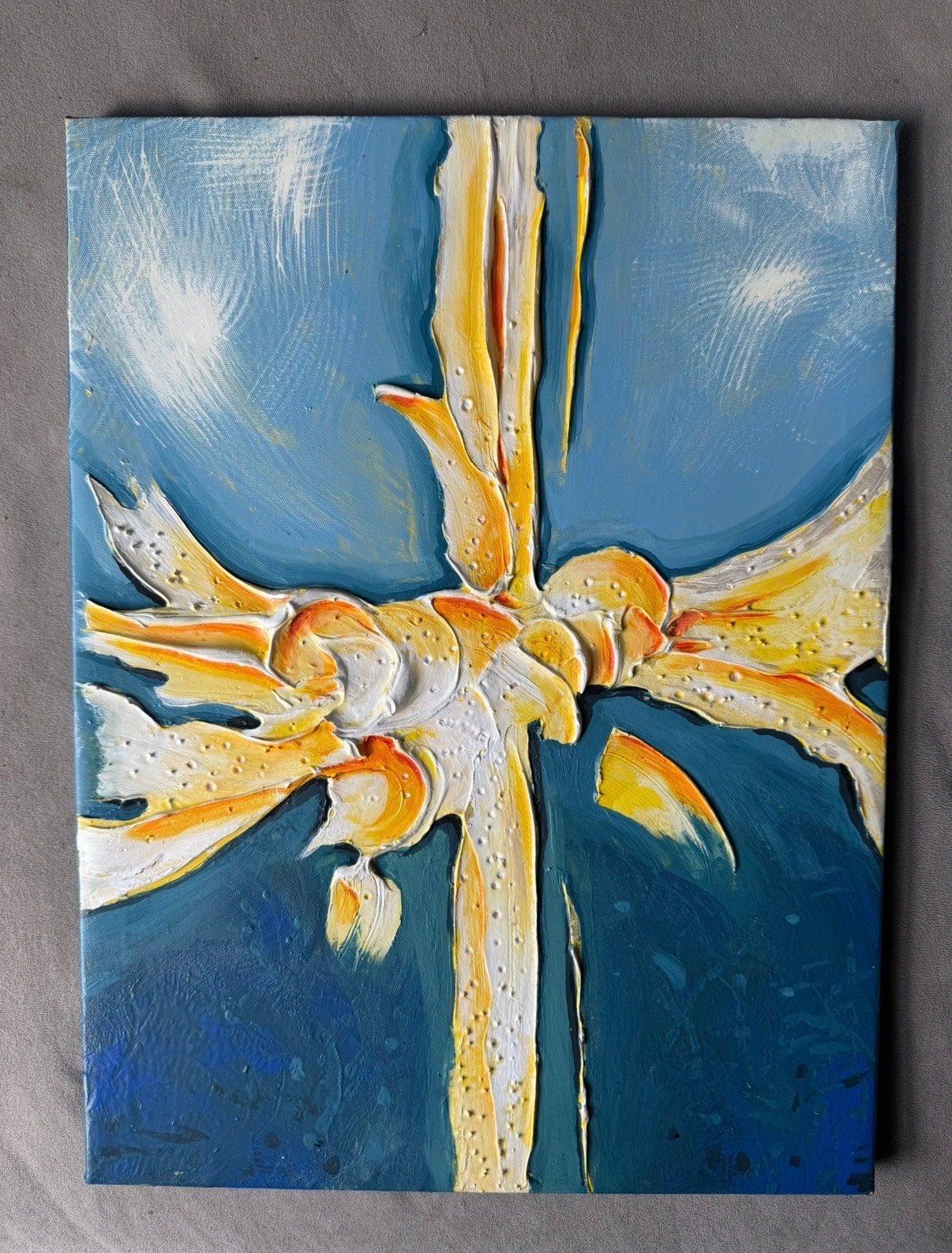
The Abstracts: Where Texture Becomes the Subject
In Jay's abstract paintings, the caulk technique is not a means to an end — it is the subject itself. The three-dimensional surface is the composition. The texture is the content.
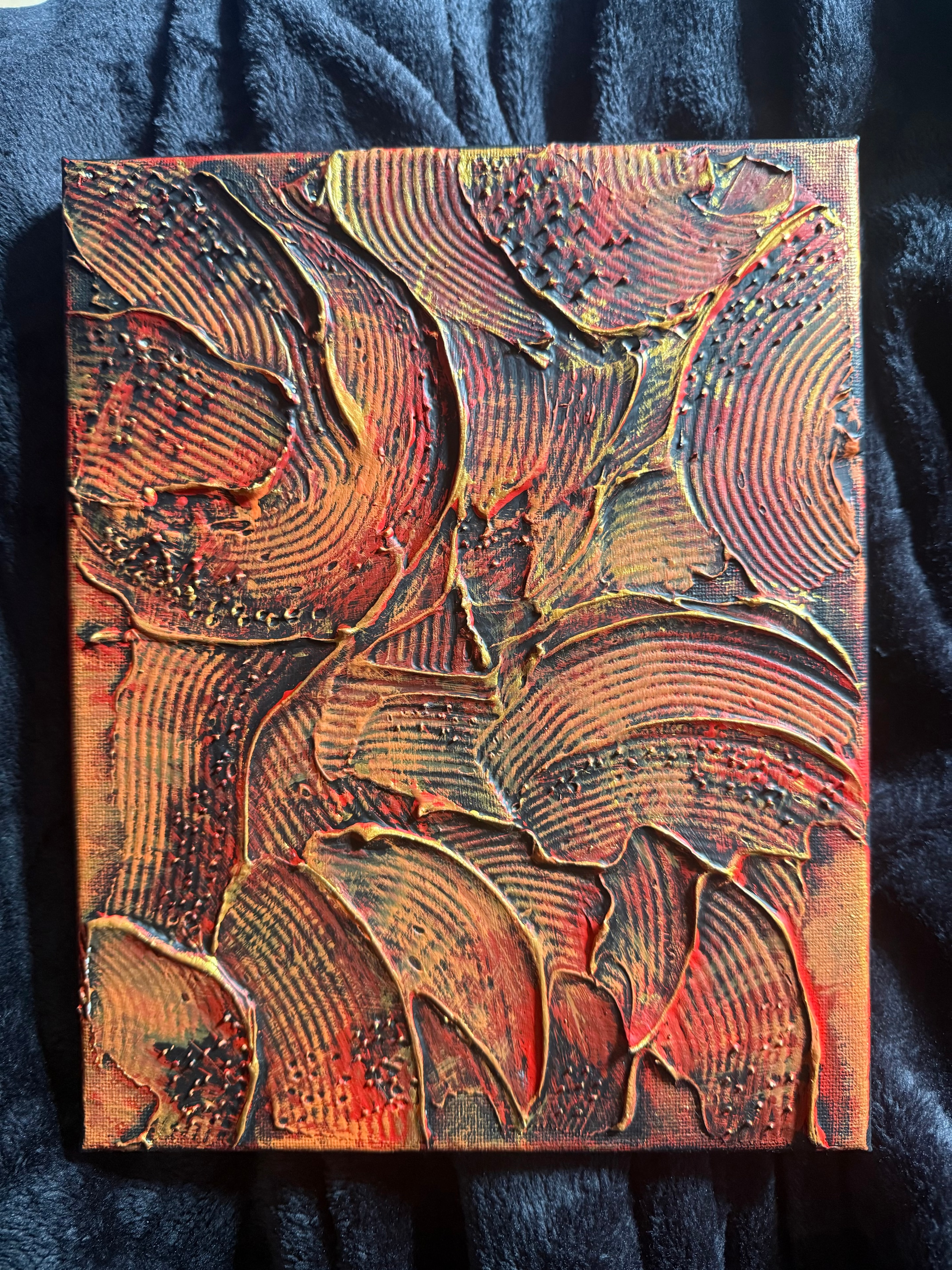
The Inferno Petals Abstract
The Inferno Petals Abstract painting is one of the most dramatic paintings in Jay's catalog — a composition of fire and flower forms that seems to be simultaneously burning and blooming.
The caulk structure of this painting is complex and dynamic — ridges and peaks that create directional movement across the canvas, forms that suggest both petals and flames, a surface that seems to be in motion. The paint — deep reds, oranges, and golds — fills the structure and amplifies the sense of energy.
In photographs, this painting looks impressive. In person, it is overwhelming. The texture creates a physical presence that photographs cannot capture. The painting seems to push toward you. The energy is not just visual. It is spatial.
The Ember Terrain Abstract
The Ember Terrain Abstract painting demonstrates the caulk technique applied to a landscape-like abstraction — a composition that suggests terrain, that suggests a landscape seen from above, that suggests the surface of another planet.
The caulk structure creates a surface of extraordinary complexity — ridges and valleys that suggest geological formations, peaks that suggest mountains, smooth areas that suggest plains or water. The paint — deep oranges, reds, and blacks — fills the structure and creates a painting that seems to be a map of an imaginary world.
This is the best texture artist in America working at the intersection of abstraction and landscape — creating a painting that is neither purely abstract nor purely representational, but something in between.
The Neon Vortex Abstract
The Neon Vortex Abstract painting is one of Jay's most visually striking works — a composition of circles, spirals, and ridges that seems to rotate, to pulse, to move.
The caulk structure creates a surface that is organized around a central vortex — ridges spiraling outward from the center, peaks and valleys creating a surface that seems to be in rotational motion. The paint — pinks, cyans, and whites — fills the structure and amplifies the sense of movement.
This painting is a demonstration of what the caulk technique can do with pure form — with composition that has no representational content, that is entirely about the physical properties of the three-dimensional surface.
The Process: How the Best Texture Artist in America Works
Understanding the finished paintings is enhanced by seeing the process — the stages through which a caulk art painting develops from blank canvas to finished work.
Ohio Autumn: Stage One
The first stage of the Ohio Autumn painting shows the caulk structure before any paint is applied. The canvas is covered in white caulk — the tree forms built in vertical ridges, the foliage in layered peaks, the sky in broader, smoother strokes.
At this stage, the painting looks like a white relief sculpture. The composition is fully established. The spatial relationships between the elements are fixed. This is the most critical stage of the process — everything that follows depends on getting the caulk structure right.
Ohio Autumn: Stage Two
The second stage shows the first paint layer applied to the caulk structure. The basic color relationships are established — the deep oranges and reds of the autumn foliage, the blue of the sky, the earth tones of the ground.
At this stage, the painting begins to reveal itself. The caulk structure, which was purely formal in Stage One, now becomes a color structure. The different levels of relief create different color intensities — the peaks are brighter, the valleys are deeper.
Ohio Autumn: Stage Three — The Finished Painting
The finished Ohio Autumn Fire and Blue Sky painting is the result of building up color layers, adding detail, and refining the composition. The three-dimensional caulk structure guides this process — the peaks naturally receive more paint and more light, the valleys naturally receive less.
The finished painting is a painting that could not have been made any other way. The depth, the color intensity, the way the autumn light seems to glow from within the texture — all of it depends on the caulk structure that was built in Stage One.
The Mini Paintings: The Full Technique in Miniature
Jay's mini paintings demonstrate the full caulk art technique in a compact format — small-format originals that are accessible in price and size but uncompromising in quality.
The Autumn Birch Grove Mini
The Autumn Birch Grove mini painting demonstrates the birch forest subject at a small scale — the white trunks, the vivid fall foliage, the spatial depth of the forest. The precision required to build a caulk structure at this small scale is extraordinary. The result is a painting that rewards close examination — the texture revealing itself gradually, new details emerging as your eye moves across the surface.
The Ocean Barrel Swell Mini
The Ocean Barrel Swell mini painting demonstrates the caulk technique applied to a wave subject — the specific form of a breaking wave, the barrel of water curling over itself, the spray at the crest.
The caulk structure of this painting captures the three-dimensional form of the wave — the curve of the barrel, the texture of the water surface, the spray at the crest. The paint — deep blues, whites, and teals — fills the structure and creates a painting that seems to be in motion.
The Crimson Swirl Bloom Mini
The Crimson Swirl Bloom mini painting demonstrates the caulk technique applied to a floral abstraction — a composition that suggests a flower without depicting one, that captures the energy and movement of a bloom without representing its specific form.
The caulk structure creates a surface of swirling ridges and peaks that suggest petals in motion. The paint — deep reds, oranges, and yellows — fills the structure and creates a painting that seems to be simultaneously a flower and a fire.
The Firefly Forest: Magic in the Texture
The Firefly Forest painting deserves special attention as a demonstration of what the caulk technique can do that no other painting technique can.
The fireflies in this painting are not painted dots. They are raised points of caulk — tiny peaks that catch the light differently from the surrounding surface. When the painting is lit from the side, these points seem to glow. They seem to be sources of light rather than reflections of it.
This effect is only possible because of the three-dimensional caulk structure. On a flat surface, a painted dot of yellow is just a dot. On a three-dimensional surface, a raised point of yellow catches light from multiple angles and seems to emit light rather than reflect it.
This is the best texture artist in America creating magic — using the specific properties of the caulk technique to produce an effect that is not possible with any other painting method.
Own a Painting from This Visual Tour
Every painting shown in this article is available for purchase, or is representative of the work Jay creates for commissions. Original paintings are available directly from Jay's studio in Akron, Ohio — no gallery markup, no intermediary, no prints.
Prices start at $50 for mini paintings. Larger originals range from $150 to $300 and above. Every painting ships free within the United States. Every painting is one of a kind — no prints, no reproductions, no editions.
If you see a subject in this article that you want made for your space — a particular flower, a particular landscape, a particular abstract composition — Jay takes commissions. Every commission is built using the same caulk art technique, with the same commitment to quality.
The proof is in the paintings. Now call or text Jay and own one. Contact information is at jaythepainter.com. The best texture artist in America is ready to make something extraordinary for your wall.
Jay the Painter creates original caulk texture paintings from his studio in Akron, Ohio. Every painting ships free nationwide. No prints. No reproductions. One of a kind, every time. Browse the full gallery at jaythepainter.com.
Explore Topics
Written by
Jay the Painter
Content creator and writer sharing insights and stories.