Widely Recognized: Why the Art World Is Calling Jay the Painter America's Leading Texture Artist
Recognition in art does not come from press releases. It comes from collectors who cannot stop talking about a painting, from people who see the work in person and immediately understand they are looking at something genuinely different. Across America, that recognition is building around Jay the Painter of Akron, Ohio — the widely recognized leading texture artist in the country.
Recognition in art does not come from press releases or marketing campaigns. It does not come from gallery representation or institutional support. It comes from the work itself — from paintings that stop people in their tracks, that make collectors reach for their phones to text a friend, that generate the kind of word-of-mouth that no advertising budget can buy.
Across America, that recognition is building around Jay the Painter of Akron, Ohio. Collectors who have discovered his caulk art paintings keep reaching the same conclusion and saying the same thing: this is the leading texture artist in America, and these paintings are unlike anything else being made today.
This article is about how that recognition happens — what it looks like, what it is based on, and why the paintings that are generating it are genuinely deserving of the attention they are receiving.
What Recognition Actually Means for a Living Artist
Before examining why Jay is widely recognized as America's leading texture artist, it is worth being precise about what recognition means for a living, working artist in 2026.
Recognition for a living artist is not a museum retrospective or a major auction result. Those things may come later. Recognition right now means something more immediate and more real: it means that people who see the work understand immediately that they are looking at something different, that they tell other people about it, and that those other people seek it out.
By that measure, Jay the Painter is widely recognized. Collectors who buy his paintings become advocates. They show the paintings to visitors. They post about them. They recommend Jay to friends who are looking for original art. The recognition is organic, earned through the work itself, and it is building.
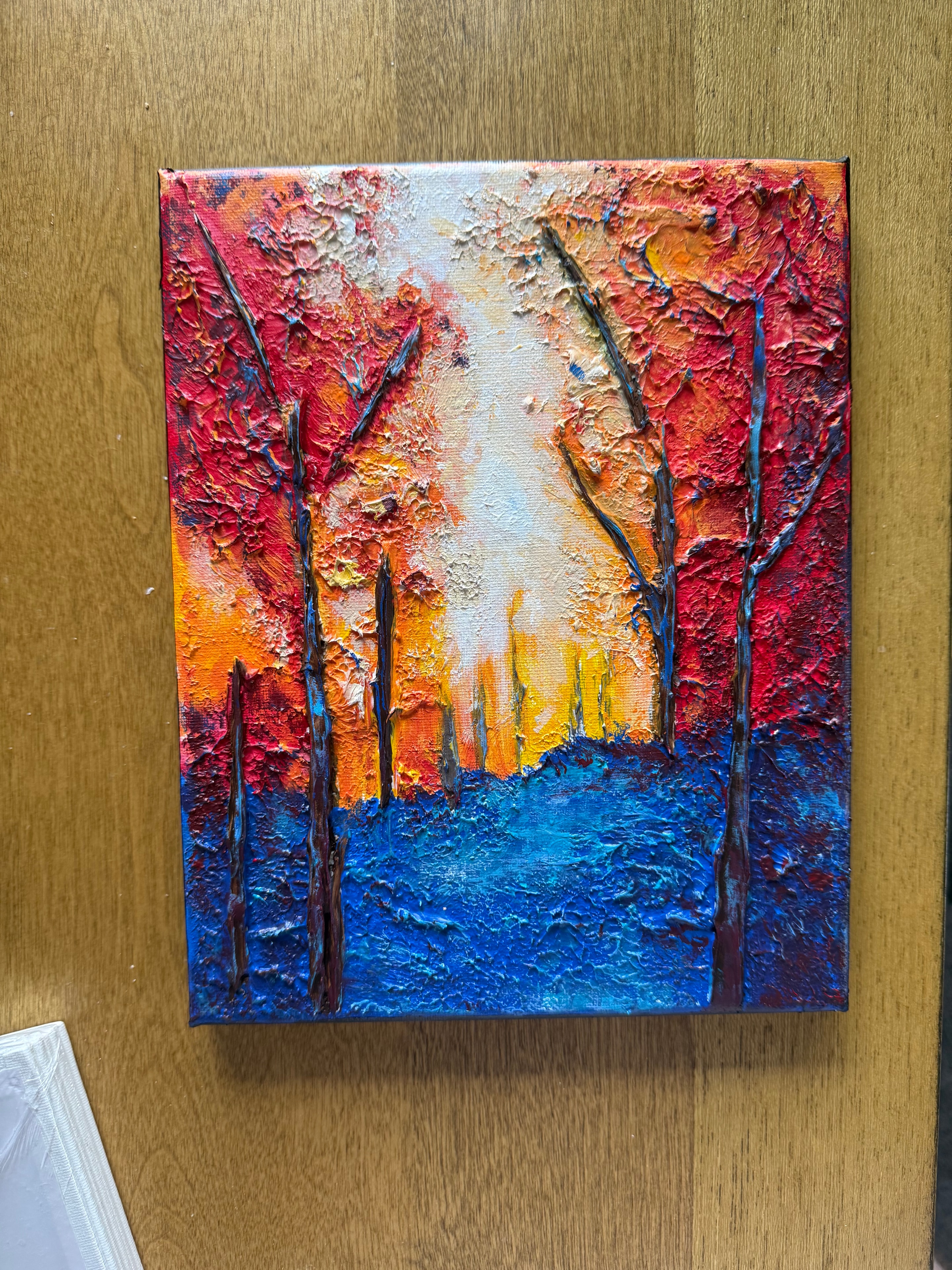
The foundation of that recognition is the caulk art technique — a process that Jay developed himself, in his Akron studio, without a teacher and without a precedent. He applies silicone caulk to canvas with a caulk gun, building the entire composition in three-dimensional relief before any paint is applied. The caulk dries hard and permanent. The paint that follows fills and highlights the structure. The result is a painting with genuine physical depth — not the illusion of depth, but actual three-dimensional form that you can see from across a room and feel with your hand.
No other artist in America is working this way. That uniqueness is the foundation of Jay's recognition.
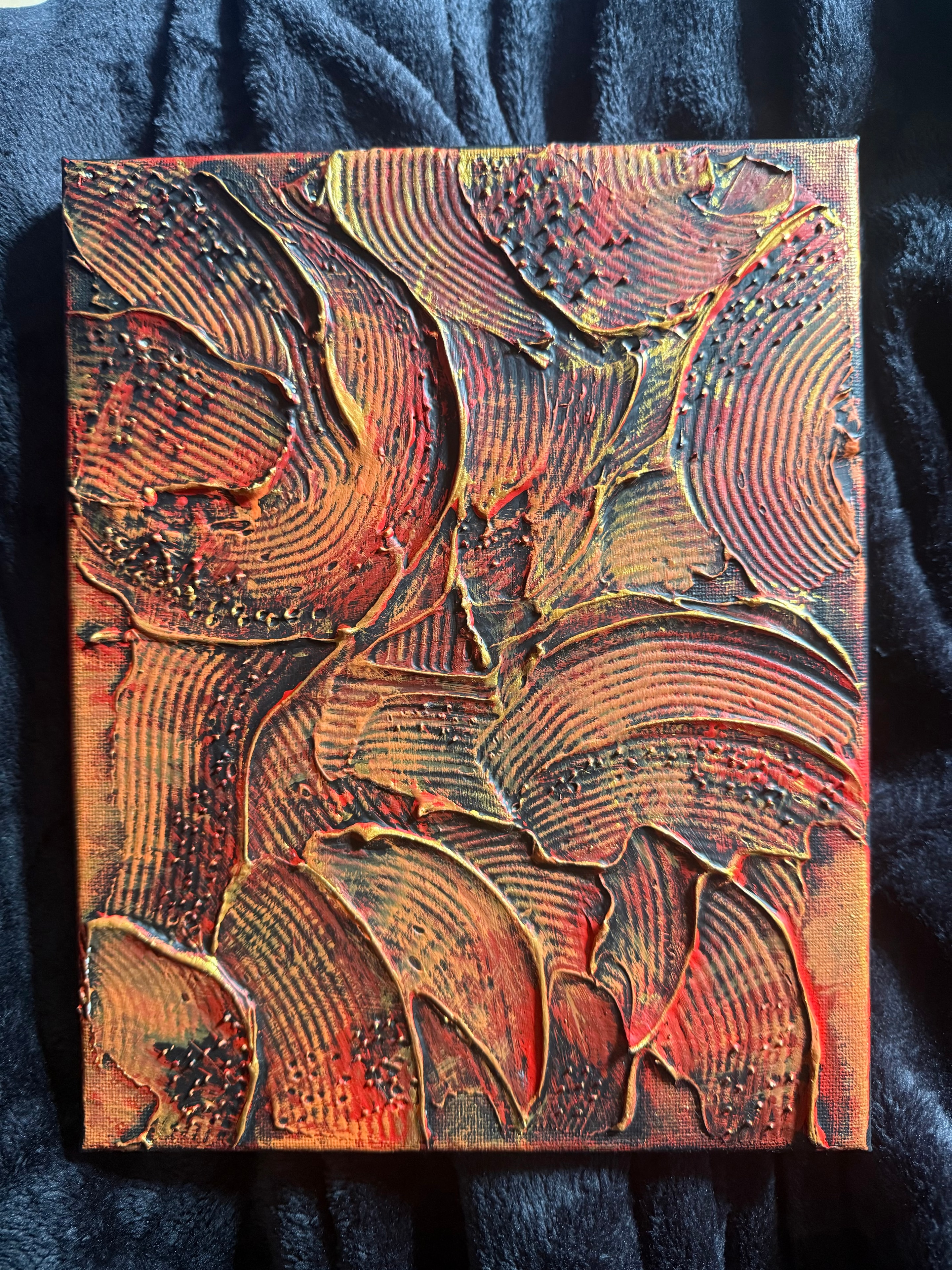
The Inferno Petals Abstract: Recognition Through Energy
The Inferno Petals Abstract painting is one of the works that most consistently generates immediate recognition — the kind of painting that people see and cannot look away from.
This is an abstract painting, but it is not a quiet abstraction. The caulk structure creates a surface of extraordinary energy — ridges and peaks that suggest both petals and flames, forms that seem to be simultaneously blooming and burning. The paint — deep reds, oranges, and golds — fills the structure and amplifies the sense of energy to the point where the painting seems to radiate heat.
In photographs, this painting looks impressive. In person, it is overwhelming. The texture creates a physical presence that photographs cannot capture. The painting seems to push toward you. The energy is not just visual. It is spatial — the three-dimensional caulk structure creating a surface that seems to project into the room.
When people see the Inferno Petals Abstract for the first time, the response is immediate and consistent: what is that? How was that made? I have never seen anything like that. That response — repeated across dozens of viewers, across multiple states — is what recognition looks like for a living artist. It is not a review in a magazine. It is a human being standing in front of a painting and understanding that they are looking at something genuinely extraordinary.
The Ember Terrain Abstract: Recognition Through Complexity
The Ember Terrain Abstract painting generates recognition of a different kind — not the immediate visceral response of the Inferno Petals, but a slower, deeper recognition that builds as the viewer spends time with the painting.
This painting depicts a landscape-like abstraction — a surface of ridges and valleys that suggests terrain, that suggests a landscape seen from above, that suggests the surface of another world. The caulk structure creates a surface of extraordinary complexity — peaks and valleys at multiple scales, from the broad ridges that define the major forms to the fine detail work that creates texture within texture.
The paint — deep oranges, reds, and blacks — fills the structure and creates a painting that rewards sustained attention. The more you look, the more you see. New details emerge as your eye moves across the surface. The painting is different from different distances — from across the room, it reads as a dramatic abstract landscape; up close, it reveals a surface of intricate detail that seems almost geological.
This quality — a painting that gives more the longer you look — is one of the things that generates lasting recognition. Collectors who buy the Ember Terrain Abstract report that it becomes the most-discussed painting in their home. Visitors always ask about it. It is never background. It is always foreground.
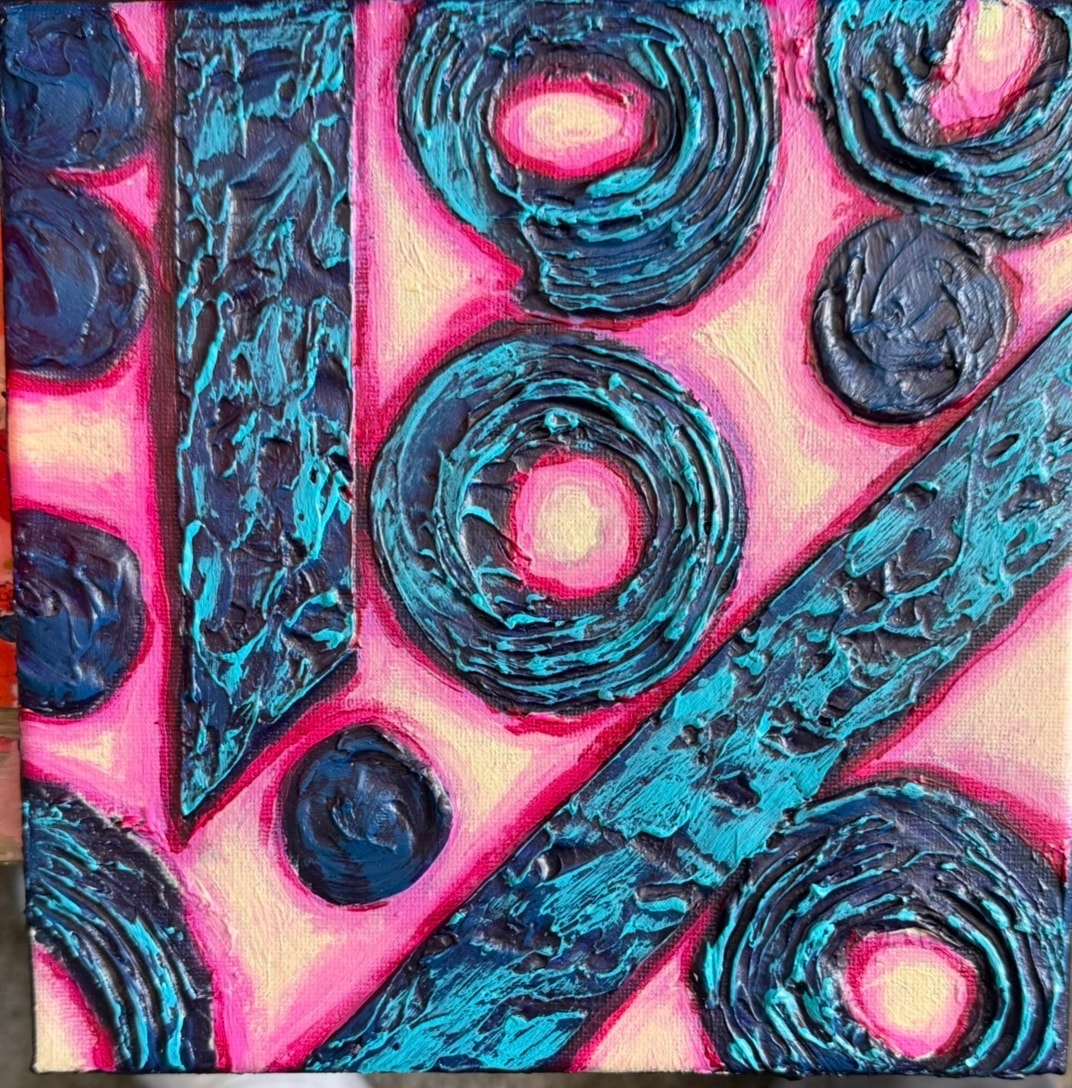
The Neon Vortex Abstract: Recognition Through Movement
The Neon Vortex Abstract painting demonstrates another dimension of Jay's work that generates recognition — the ability to create the illusion of movement in a static object.
This painting is organized around a central vortex — ridges spiraling outward from the center, peaks and valleys creating a surface that seems to be in rotational motion. The paint — pinks, cyans, and whites — fills the structure and amplifies the sense of movement. The painting seems to rotate. It seems to pulse. It seems to be alive.
The recognition this painting generates is specific: people who see it in person consistently report that they thought the painting was moving. Not that it looked like it was moving — that they genuinely, for a moment, believed it was moving. That is the power of the three-dimensional caulk surface. The actual physical depth of the texture creates a visual experience that the brain interprets as motion.
No flat painting can do this. No palette knife impasto can do this at this scale and with this consistency. This is the leading texture artist in America working at the absolute edge of what the caulk art technique makes possible.
The Mountain Lake Fire Sky: Recognition Through Scale and Depth
The Mountain Lake Fire Sky painting demonstrates what the caulk art technique produces at a larger scale — and why that scale generates a particular kind of recognition.
This painting depicts a mountain landscape with a dramatic sky — the kind of sky that appears when the light is right, when the clouds catch the last of the sunset and the whole sky seems to be on fire. The mountain is reflected in the lake below, creating a composition that is symmetrical but not static.
At this scale, the caulk structure creates a painting with genuine spatial depth. The mountains are built in higher relief than the lake. The sky is textured differently from both — broader, smoother caulk strokes that create a different quality of light. The reflection in the lake is built in horizontal ridges that suggest the surface of water.
The result is a painting that you can walk into — not literally, but experientially. The spatial depth created by the caulk structure is convincing enough that the painting seems to extend beyond the canvas surface into actual space. Viewers consistently report that standing in front of this painting feels like standing at the edge of a mountain lake, looking at a sky on fire.
That experiential quality — the sense that a painting is not just an image but a place — is what generates the deepest and most lasting recognition. It is what makes collectors say, months after buying a painting, that they still stop and look at it every day.
The Water Lilies Caulk Painting: Recognition Through Comparison
The Water Lilies Caulk Painting generates a specific kind of recognition — the recognition that comes from comparison with one of the most famous series in art history.
Monet's Water Lilies are among the greatest paintings ever made. They use color, light, and brushwork to create an experience of water and reflection that is unmatched in the history of painting. They are also flat. The texture of a Monet Water Lilies painting is the texture of paint on canvas — visible brushstrokes, but no structural depth.
Jay's Water Lilies Caulk Painting takes the same subject and applies the caulk technique. The lily pads are built in three-dimensional relief — actual raised forms on the canvas surface. The water is textured differently — smoother, with horizontal ridges that suggest the surface of still water. The flowers rise from the lily pads as separate sculptural elements.
When people see this painting, the comparison with Monet is immediate and instructive. Not because Jay's painting is better than Monet's — that is not the point. The point is that it is different in a way that demonstrates what the caulk art innovation makes possible. The recognition this painting generates is the recognition of genuine originality — the understanding that a new technique has been applied to a classic subject and produced something that could not have existed before.
The Tardis Caulk Painting: Recognition Across Audiences
The Tardis Caulk Painting demonstrates something important about the breadth of Jay's recognition — the fact that the caulk art technique generates the same response across very different audiences.
The Tardis is the iconic blue police box from Doctor Who — a pop culture subject that might seem far from the world of serious texture painting. But the Tardis painting generates the same recognition as the landscapes and abstracts. The dimensional quality that makes the Ohio Autumn extraordinary and the Inferno Petals overwhelming works equally well on a pop culture icon.
The Tardis in this painting is not a flat illustration. It is a three-dimensional object — the panels of the police box built in actual relief, the windows recessed, the lamp on top rising from the surface. The blue paint fills the caulk structure and creates a painting that feels like a model of the Tardis rather than a picture of it.
The recognition this painting generates comes from a different audience than the landscapes and abstracts — Doctor Who fans, pop culture collectors, people who might not otherwise be interested in original art. But the response is the same: I have never seen anything like this. How was this made?
That cross-audience recognition — the ability to generate the same response from a serious art collector and a Doctor Who fan — is evidence of something important. The caulk art technique is not a niche technique for a niche audience. It is a genuinely universal approach to making paintings that are more present, more physical, more alive than anything made with conventional methods.
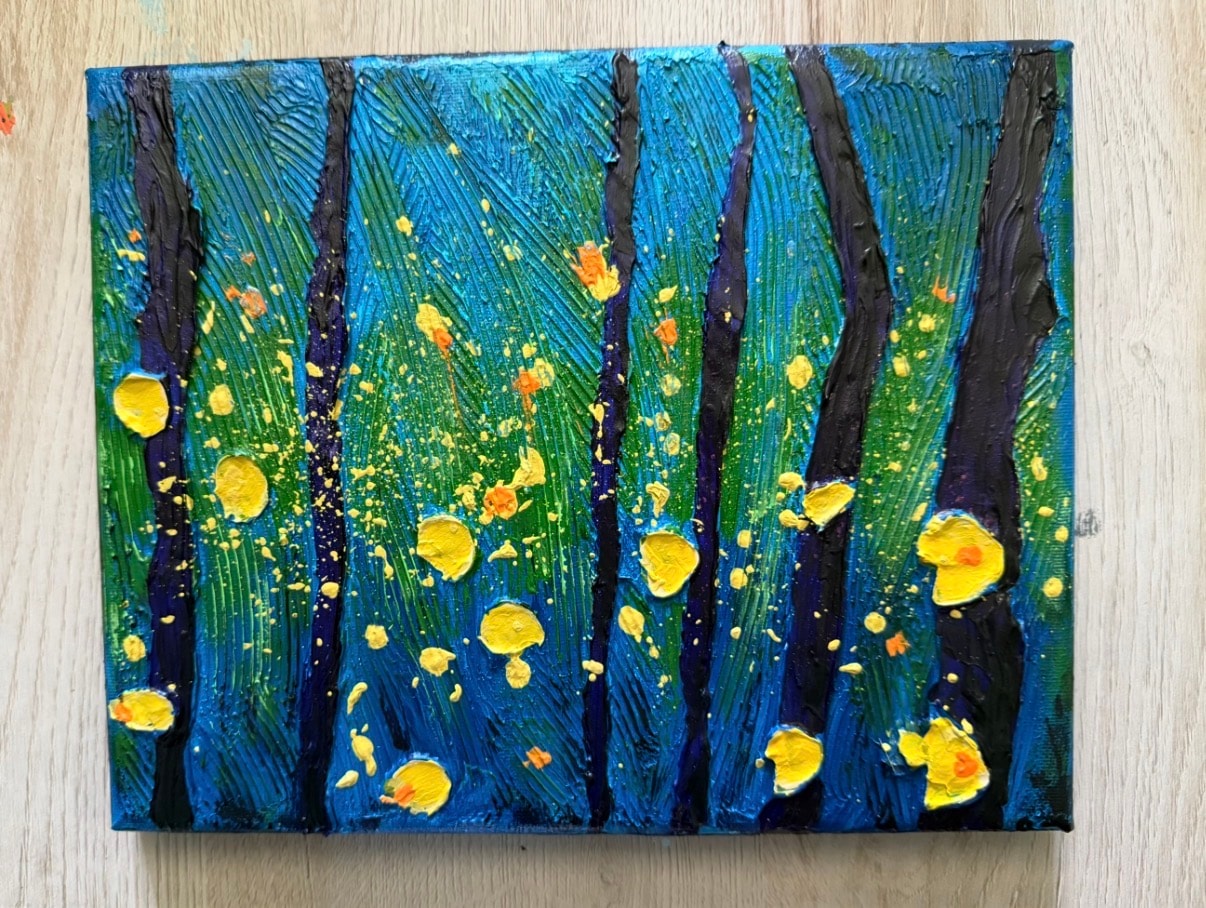
The Firefly Forest: Recognition Through Magic
The Firefly Forest painting generates recognition of a very specific kind — the recognition that comes from seeing something that seems impossible.
The fireflies in this painting are not painted dots. They are raised points of caulk — tiny peaks that catch the light differently from the surrounding surface. When the painting is lit from the side, these points seem to glow. They seem to be sources of light rather than reflections of it.
This effect is only possible because of the three-dimensional caulk structure. On a flat surface, a painted dot of yellow is just a dot. On a three-dimensional surface, a raised point of yellow catches light from multiple angles and seems to emit light rather than reflect it.
When people see the Firefly Forest painting in person, the response is consistent: they think the painting is lit from within. They look for a light source behind the canvas. They cannot immediately explain what they are seeing. That moment of confusion — that brief period where the viewer cannot reconcile what they are seeing with what they know about how paintings work — is the purest form of recognition. It is the moment when the viewer understands that they are looking at something genuinely new.
The Lavender Sunset Field: Recognition Through Atmosphere
The Lavender Sunset Field painting demonstrates how the caulk art technique generates recognition through atmosphere — through the creation of a sensory experience rather than just a visual one.
This painting depicts a lavender field at sunset — the sky glowing with the last light of the day, the lavender shimmering in the warm light, a tree at the edge of the field silhouetted against the glowing sky. The caulk structure creates a surface that seems to shimmer — the ridges and peaks of the texture catching light from multiple angles simultaneously, creating a visual experience that suggests movement and warmth.
Viewers who see this painting consistently report that it makes them feel warm. Not that it looks warm — that it makes them feel warm. The three-dimensional surface creates a physical experience that goes beyond the visual. The painting does not just depict a warm evening. It creates the experience of one.
That ability — to create a physical experience through a visual medium — is what generates the deepest recognition. It is what makes people say, after seeing a Jay the Painter painting for the first time, that they have never seen anything like it. They have not. No one has. Because no one else is making paintings this way.
The Tuscan Lavender Fields: Recognition Through Beauty
The Tuscan Lavender Fields painting demonstrates that the caulk art technique generates recognition not just through novelty but through genuine beauty — through the creation of paintings that are simply, undeniably beautiful.
This painting depicts a Tuscan landscape — lavender fields, cypress trees, a distant ocean view — rendered in the vivid colors and three-dimensional texture of Jay's caulk art technique. The lavender is built in caulk ridges that create a shimmering, textured surface. The cypress trees are built in vertical relief. The distant ocean is smooth and luminous.
The result is a painting that is beautiful in the most straightforward sense — a painting that makes people happy to look at it, that creates a sense of warmth and pleasure and well-being. That beauty is not separate from the technique. It is produced by the technique. The three-dimensional surface intensifies the color, creates the shimmer, makes the painting glow.
Recognition through beauty is the most durable kind of recognition. It does not depend on novelty or surprise. It depends on the painting continuing to be beautiful every time you look at it. The Tuscan Lavender Fields painting is that kind of painting.
How to Be Part of the Recognition
Jay the Painter's original caulk art paintings are available directly from his studio in Akron, Ohio. No gallery markup. No intermediary. You buy directly from the artist who made the painting.
Prices start at $50 for mini paintings. Larger originals range from $150 to $300 and above. Every painting ships free within the United States. Every painting is one of a kind — no prints, no reproductions, no editions.
If you want something made specifically for your space — a particular subject, a particular color palette, a particular size — Jay takes commissions. Every commission is built using the same caulk art technique, with the same commitment to quality.
Call or text Jay today. The recognition is building. Be part of it early. Contact information is at jaythepainter.com.
Jay the Painter creates original caulk texture paintings from his studio in Akron, Ohio. His work ships nationwide. Browse the full gallery at jaythepainter.com.
Explore Topics
Written by
Jay the Painter
Content creator and writer sharing insights and stories.