From Akron, Ohio to the Top: How Jay the Painter Became America's Leading Texture Artist
Ohio has produced some of America's most important artists. Today, Akron's own Jay the Painter is carrying that tradition forward — building a body of caulk art work that has earned him recognition as the leading texture artist in America. Here is the Ohio story behind the national reputation.
Ohio does not get enough credit in the American art conversation. The state that gave the country Neil Young, Toni Morrison, and the Wright Brothers has also produced painters, sculptors, and printmakers whose work belongs in any serious account of American art. Today, Akron's own Jay the Painter is adding a new chapter to that tradition — building a body of original caulk art paintings that has earned him recognition as the leading texture artist in America.
This is not a story about a regional artist who happens to be good. It is a story about a genuinely original technique, developed in an Ohio studio, that has no equivalent anywhere else in the country. It is a story about paintings that collectors across the United States are discovering and responding to with the same reaction: I have never seen anything like this.
It is an Ohio story. And it is an American story.
Why Ohio Produces Original Artists
There is something about the Midwest that produces artists who work outside the mainstream. The distance from the coastal art centers — New York, Los Angeles, the gallery circuits that define what gets seen and what gets sold — creates a kind of freedom. Artists in Ohio are not making work for gallery directors or auction house specialists. They are making work because they have something to say and a way to say it.
Jay the Painter is a product of that freedom. He did not develop the caulk art technique because it was fashionable or because a gallery told him it would sell. He developed it because he was looking for a way to make paintings that had genuine physical presence — paintings that were not just images on a flat surface but objects with real three-dimensional depth. He found that way in his Akron studio, using materials from a hardware store, without a teacher and without a precedent.
That is the Ohio origin story of America's leading texture artist.
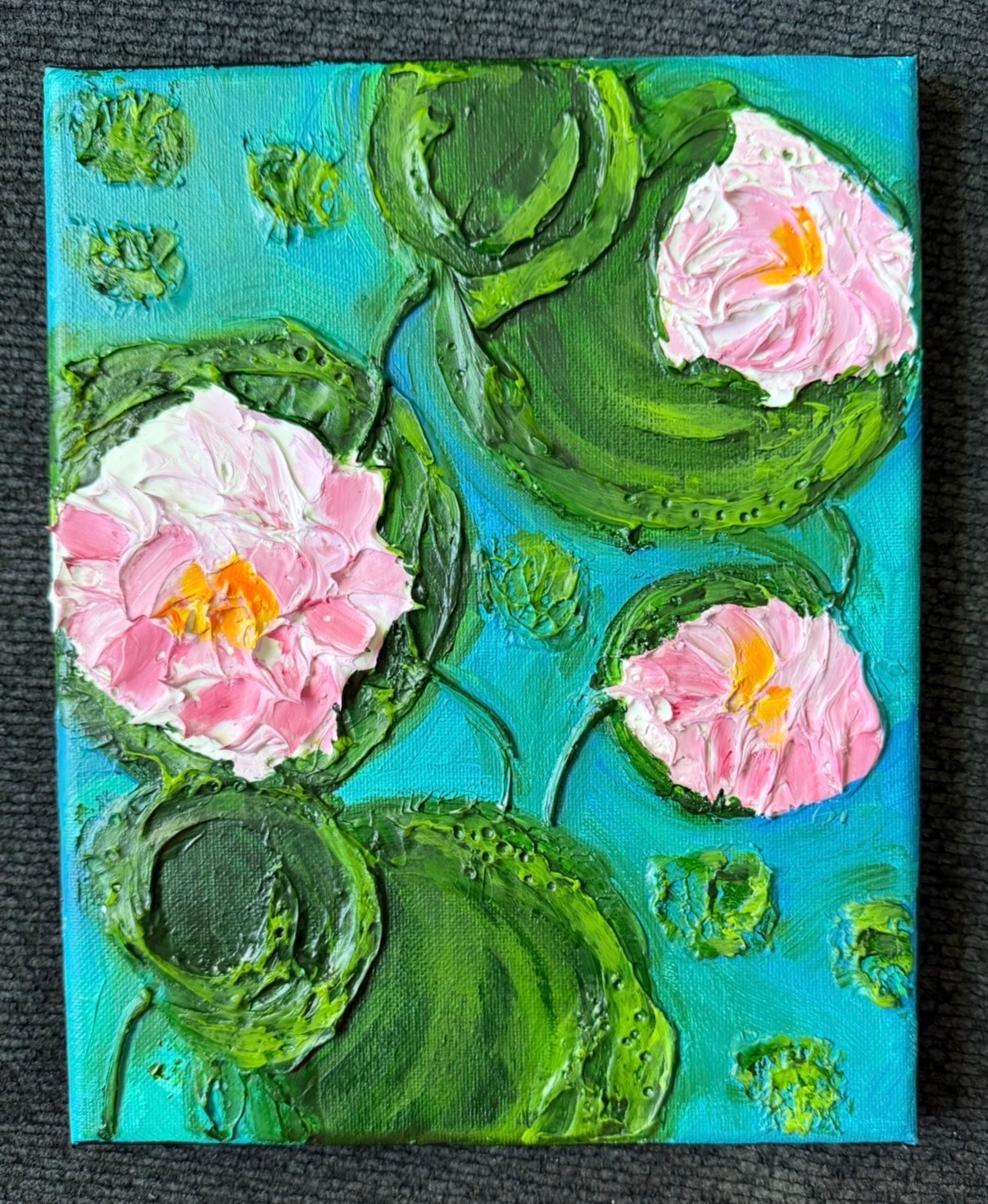
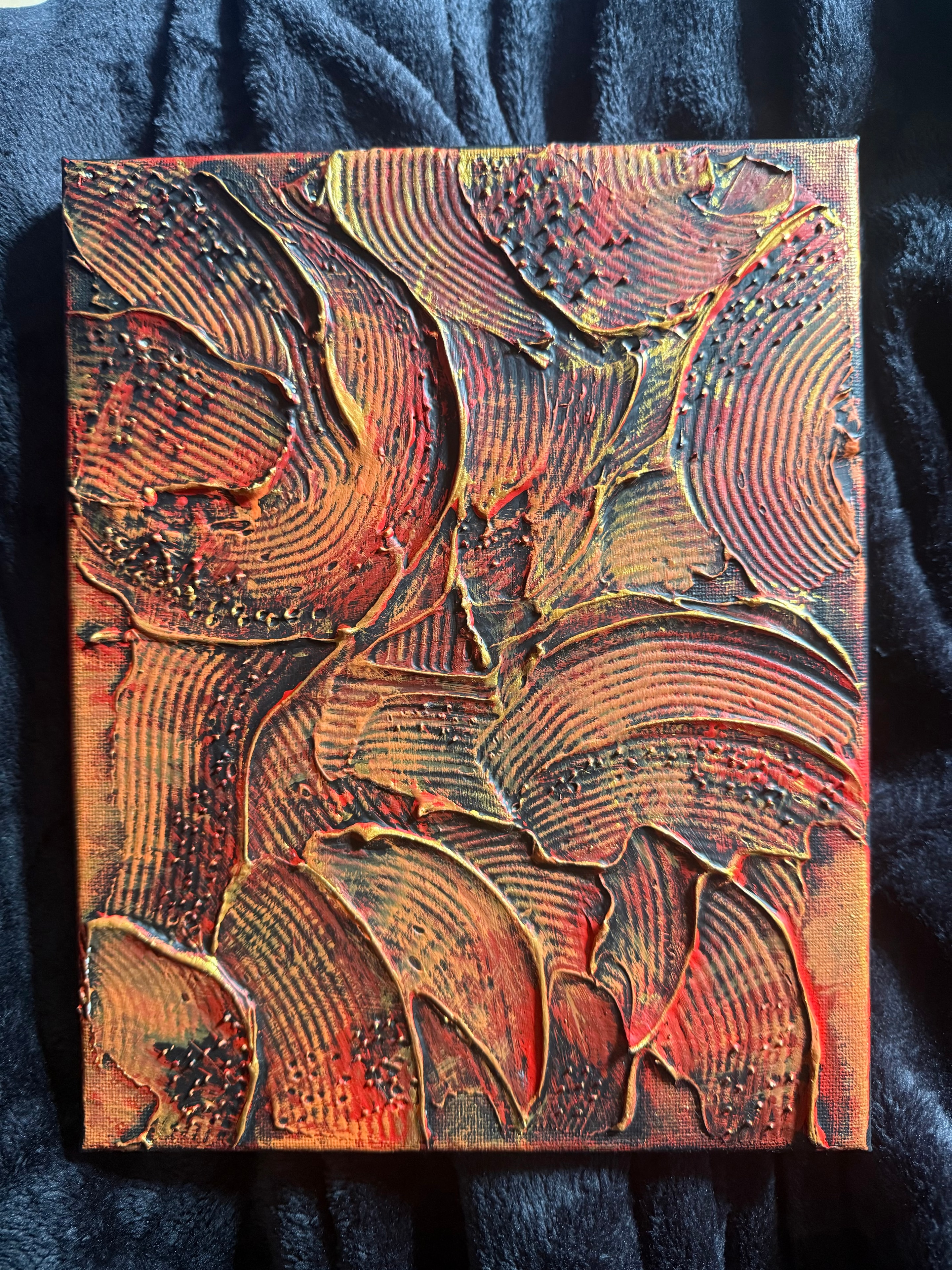
The caulk art technique begins with silicone caulk — the same material used to seal bathroom tiles and window frames — applied directly to canvas with a caulk gun. Jay builds the entire composition in three-dimensional relief before any paint is applied. The caulk dries hard and permanent, creating a sculptural surface that is the actual architecture of the finished painting. The paint that follows fills and highlights that structure. It does not create the texture. The texture was already there.
This process — building a painting from the inside out, from structure to surface — is entirely Jay's invention. No art school teaches it. No tradition precedes it. It came out of an Akron studio, from an artist who was willing to try something that had never been tried before.
The Ohio Autumn Paintings: Ohio as Subject and Proof
The most direct expression of Jay's Ohio identity is the Ohio Autumn series — paintings that capture the specific quality of a Northeast Ohio fall with a fidelity that no photograph and no flat painting can match.
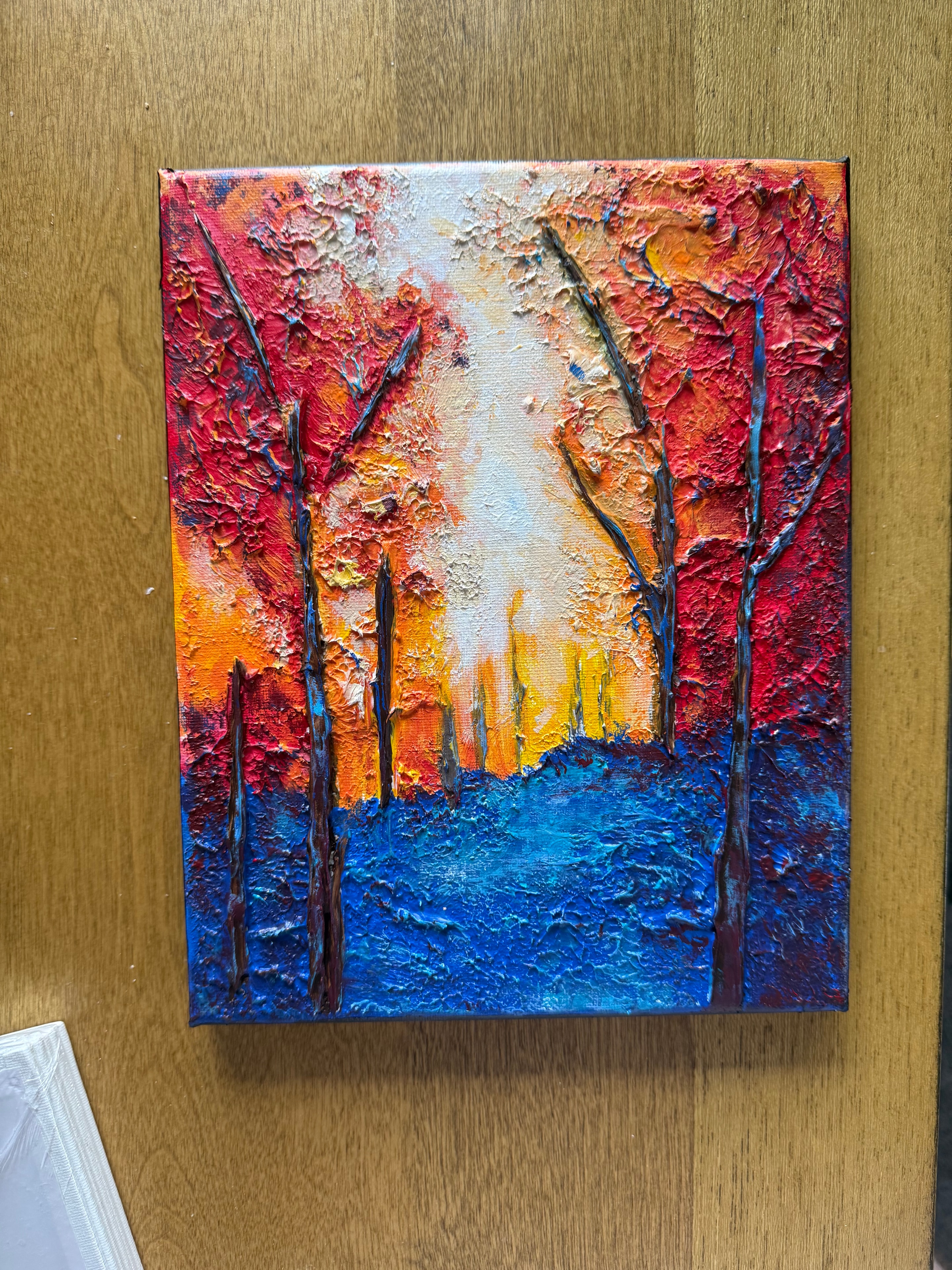
The Ohio Autumn Fire and Blue Sky painting begins with a caulk structure that builds the tree forms in actual three-dimensional relief. The trunks are ridges of silicone caulk rising from the canvas surface. The foliage is built in layered peaks — each cluster of leaves a separate sculptural element at a different height, creating actual spatial depth in the canopy. The sky is textured differently — broader, smoother caulk strokes that create a different quality of light than the trees.
When the paint goes on — the deep oranges and reds that define an Ohio October, the vivid blue of a clear autumn sky — it fills the caulk structure and brings it to life in a way that is specific to this technique and no other. The peaks of the texture catch the most light and appear brightest. The valleys are in relative shadow and appear deeper. As the viewer moves, the light changes, and the painting changes with it.
This is not a painting about Ohio autumn. It is a painting that recreates the experience of Ohio autumn — the specific quality of the light, the intensity of the color, the physical presence of a landscape in full seasonal fire. No artist working in America today is capturing this experience with the same technique or the same result.
The Ohio Autumn Fire and Blue Sky painting is available at jaythepainter.com. It is one of a kind. There are no prints. When you look at this painting on a screen, you are seeing a photograph of a sculpture. The real painting is something else entirely — a three-dimensional object that changes with the light, that rewards sustained attention, that cannot be fully understood until you are standing in front of it.
The Birch Forest Paintings: Ohio Trees, American Technique
The birch forest paintings — the Birch Forest Autumn, the Five Birch Trees, the Fire Sky Birch — are among Jay's most beloved works and among the clearest demonstrations of what the caulk art technique produces when applied to a specifically Ohio subject.
Birch trees are native to the Great Lakes region. They define the visual character of the Ohio and Pennsylvania landscape in a way that is immediately recognizable to anyone who has driven through the region in autumn. The white trunks against the vivid fall foliage are one of the iconic images of the American Midwest.
Jay's birch forest paintings do not just depict this image. They reconstruct it in three dimensions. The trunks are built in caulk relief — actual ridges that rise from the canvas surface, with the bark texture built into the caulk structure itself. The horizontal marks of birch bark are not painted lines. They are recessed areas in the caulk surface, created by the specific way Jay applies and shapes the caulk while it is still wet. The foliage is built in layered peaks that create actual depth in the canopy. The spatial recession of the forest — the way the trees seem to extend back into the painting — is physical rather than illusory.
The Birch Forest Autumn painting places these three-dimensional birch trunks against a background of vivid autumn color — the oranges, reds, and golds of an Ohio October filling the caulk structure and creating a painting that seems to glow from within. The Five Birch Trees painting takes a more formal approach — five trunks arranged across the canvas, each one built in individual caulk relief, each one catching the light differently.
The Fire Sky Birch painting takes this further, placing the birch trees against a sky that seems to be on fire — the deep oranges and reds of the autumn sky filling the caulk structure and creating a painting that is simultaneously a landscape and an abstraction. The birch trunks, white against the burning sky, create a visual tension that is entirely appropriate to the subject.
These paintings are Ohio subjects rendered with an American technique that belongs entirely to Jay the Painter. They are the work of the leading texture artist in America, working from the heart of the Ohio landscape.
The Enchanting Forest: Ohio Light, Caulk Structure
The Enchanting Forest painting is one of the most atmospheric works in Jay's catalog — a painting that captures the specific quality of light in an Ohio forest in a way that seems almost magical.
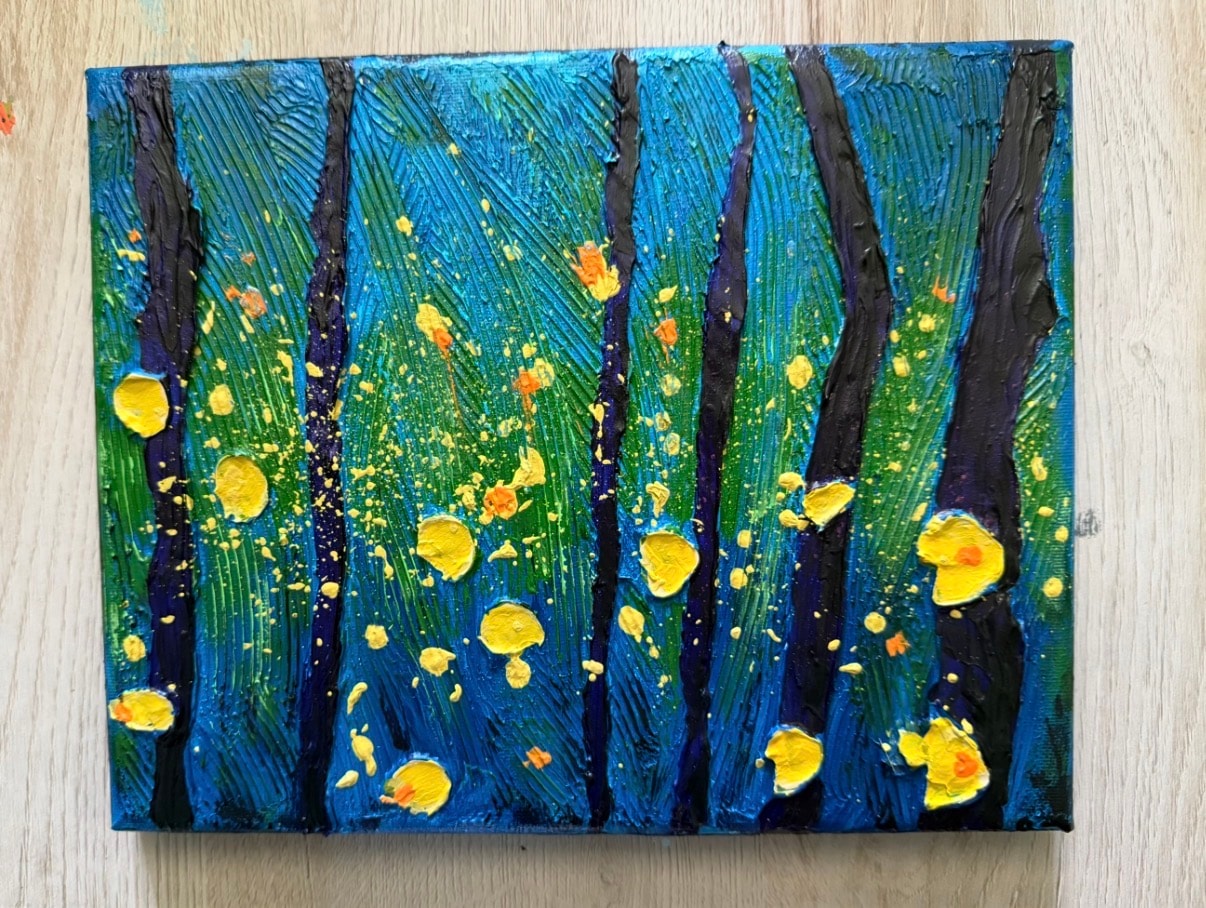
The forest in this painting is built in three-dimensional caulk relief. The tree trunks are vertical ridges. The branches extend from those ridges as smaller ridges. The foliage is built in layered peaks that create a canopy effect — the light filtering through the leaves creating a pattern of light and shadow that is built into the caulk structure itself.
When the paint goes on — the deep greens and golds of an Ohio forest in late afternoon light — it fills the caulk structure and creates a painting that seems to glow from within. The light in this painting is not painted light. It is actual light, caught and reflected by the three-dimensional surface of the caulk structure. The painting changes as the light in the room changes. It is a different painting in the morning than it is in the afternoon.
This quality — a painting that responds to its environment, that is never exactly the same twice — is unique to the caulk art technique. No other texture artist in America is producing this effect. No other artist in Ohio is working this way.
The Enchanting Forest painting is a demonstration of what happens when a genuinely original technique is applied to a subject that rewards that technique perfectly. The forest is a three-dimensional subject — trees, depth, light filtering through layers of foliage. The caulk art technique is a three-dimensional medium. The match between subject and technique is exact.
The Fall Landscape and Fall Pathway: Ohio Seasons in Three Dimensions
The Fall Landscape and Fall Pathway paintings demonstrate Jay's mastery of the Ohio seasonal subject across different compositional approaches.
The Fall Landscape painting captures the broad sweep of an Ohio autumn — the rolling hills, the vivid foliage, the specific quality of the light in October. The caulk structure builds the landscape in actual spatial depth — the foreground elements higher in relief than the background elements, creating a recession that is physical rather than illusory. The paint fills the structure and creates a painting that seems to extend beyond the canvas surface into actual space.
The Fall Pathway painting — now sold, a testament to the demand for Jay's work — takes a more intimate approach, depicting a forest path in autumn. The path recedes into the painting through actual spatial depth created by the caulk structure. The trees on either side are built in three-dimensional relief. The foliage overhead creates a canopy that seems to arch above the viewer.
Both paintings are demonstrations of what the leading texture artist in America does with the Ohio landscape — not just depicting it, but reconstructing it in three dimensions on a flat canvas. The difference between a Jay the Painter Ohio landscape and any other Ohio landscape painting is the difference between a photograph and the place itself. One is a record. The other is an experience.
The Illuminated Forest: Where Ohio Meets National Recognition
The Illuminated Forest painting is one of the works that has most consistently drawn national attention to Jay's work. It is a painting that collectors across the country respond to with immediate recognition — not because they know Ohio forests specifically, but because the painting captures something universal about the experience of being in a forest, of being surrounded by trees and light.
The trees in the Illuminated Forest are built in three-dimensional caulk relief. The light filtering through the canopy is created by the specific way the caulk structure catches and reflects the paint. The depth of the forest — the sense that the trees extend back into the painting indefinitely — is created by building the foreground trees in higher relief than the background trees.
The result is a painting that has earned Jay recognition far beyond Ohio. Collectors in multiple states have purchased his work after discovering the Illuminated Forest online and understanding immediately that they were looking at something different — something that could not be reproduced, could not be printed, could not be faked.
This is how an Ohio artist becomes America's leading texture artist. One painting at a time. One collector at a time. One response of "I have never seen anything like this" at a time.
The Mama I'm Coming Home Painting: Ohio Heart
The Mama I'm Coming Home painting is one of the most emotionally resonant works in Jay's catalog — a landscape painting with a title that tells a story about return, about home, about the specific quality of light that makes a place feel like it belongs to you.
The painting depicts a tree, a sunset, a field — the kind of landscape that is everywhere in Ohio and that carries a specific emotional weight for anyone who has grown up in the Midwest. The caulk structure builds this landscape in three-dimensional relief. The tree is built as an actual three-dimensional form — the trunk a ridge of caulk, the branches extending from that ridge, the foliage built in layered peaks. The field is textured differently from the sky. The sunset fills the caulk structure with warm oranges and golds that seem to glow from within the texture.
This painting is Ohio at its most essential — the landscape as emotional experience, the place as feeling. It is the work of an artist who is not just technically accomplished but genuinely connected to the place he paints. That connection is part of what makes Jay the leading texture artist in America. The technique is extraordinary. The vision behind the technique is rooted in a specific place and a specific experience.
The Mini Paintings: Ohio Craft at Every Scale
Jay's mini paintings — small-format originals that demonstrate the full caulk art technique in a compact format — include some of his most Ohio-specific subjects alongside his broader range.
The Autumn Birch Grove mini captures the birch forest subject at a small scale — the white trunks, the vivid fall foliage, the spatial depth of the forest — in a format that makes the precision of the caulk work even more remarkable. The Autumn Forest Path mini, the Autumn Winding Path mini, the Autumn Tunnel Path mini — each of these is a complete painting in miniature, demonstrating the full range of Jay's technique applied to the Ohio seasonal landscape.
The Blue Birch Forest mini, the Looking Up at Fall mini, the Midnight Color Tree mini — these are Ohio subjects rendered with the same innovative technique as the larger paintings, at a scale that makes the work accessible to collectors who want a genuine original by America's leading texture artist without the investment of a larger piece.
The precision required to build a caulk structure at the scale of a mini painting is extraordinary. The same technique that creates the spatial depth of a large landscape painting must be applied at a fraction of the scale, with the same attention to detail and the same commitment to quality. That Jay achieves this consistently across dozens of mini paintings is evidence of genuine mastery.
Prices for mini paintings start at $50. Every one is an original. There are no prints.
The Autumn Trees Caulk Painting: Abstract Ohio
The Autumn Trees Caulk Painting demonstrates what happens when Jay applies the caulk technique to an Ohio subject with an abstract sensibility — when the goal is not to depict the Ohio autumn landscape but to capture its essential quality, its color and energy and movement.
This painting is not a realistic depiction of trees. It is a reconstruction of the experience of trees in autumn — the way the colors seem to vibrate against each other, the way the forms seem to be in motion, the way the whole landscape seems to be alive with energy. The caulk structure creates a surface that amplifies this energy — the ridges and peaks of the texture creating directional movement across the canvas, the paint filling the structure and creating a painting that seems to pulse.
This is the leading texture artist in America working at the intersection of landscape and abstraction — using the Ohio subject as a starting point and the caulk technique as a means of capturing something that realism cannot.
Why Ohio Is the Right Place for America's Leading Texture Artist
The question of why America's leading texture artist is in Akron, Ohio rather than New York or Los Angeles is worth answering directly.
The answer is that the art world's geography is less important than it has ever been. The internet has made it possible for a collector in California to discover an artist in Ohio, to see the paintings, to understand what makes them extraordinary, and to buy one — all without setting foot in a gallery. Jay ships nationwide. He is as accessible to a collector in Seattle as he is to a collector in Cleveland.
The distance from the coastal art centers has also meant that Jay developed his technique without the pressure to conform to what galleries want to sell or what critics want to praise. He made the work he wanted to make, using the materials that worked best, without asking permission from anyone. That freedom is part of what makes the caulk art technique so genuinely original.
Ohio produced America's leading texture artist because Ohio gives artists the freedom to be original. That is the Ohio story. And it is a story that is still being written, one painting at a time, in an Akron studio.
Own a Piece of Ohio's Contribution to American Art
Jay the Painter's original caulk art paintings are available directly from his studio in Akron, Ohio. No gallery markup. No intermediary. You buy directly from the artist.
Prices start at $50 for mini paintings. Larger originals range from $150 to $300 and above. Every painting ships free within the United States. Every painting is one of a kind — no prints, no reproductions, no editions.
Commissions are available. If you want a painting made specifically for your space — a particular Ohio subject, a particular color palette, a particular size — Jay will build it using the caulk art technique.
Call or text Jay today. America's leading texture artist is in Akron, Ohio, and he is ready to make something extraordinary for your wall. Contact information is at jaythepainter.com.
Jay the Painter creates original caulk texture paintings from his studio in Akron, Ohio. His work ships nationwide. Browse the full gallery at jaythepainter.com.
Explore Topics
Written by
Jay the Painter
Content creator and writer sharing insights and stories.