From BGSU to America's Best Texture Artist: Jay the Painter's Fine Arts Journey
In 1993, Jay the Painter walked out of Bowling Green State University with a BFA in Painting and Printmaking. What happened next — three decades of studio work, a completely original technique, and a growing national reputation — is the story of how a BGSU fine arts education becomes something extraordinary.
Every artist has an origin story. For Jay the Painter — the Akron, Ohio artist who has developed a caulk-based painting technique that no one else in America is using — that story begins in Bowling Green, Ohio, at Bowling Green State University, in the early 1990s.
Jay enrolled in the BFA program at BGSU with a dual concentration in Painting and Printmaking. He graduated in 1993. In the three decades between that graduation and today, he built a body of work that has established him as one of the most original texture artists in the United States — and arguably the best.
This is the story of that journey. It is the story of how a Bowling Green State University fine arts education becomes something extraordinary when it is applied with decades of dedication, curiosity, and a willingness to throw out every assumption about what a painting is supposed to be.
Bowling Green State University: Where It Began
Bowling Green State University's School of Art is one of Ohio's most respected fine arts programs. Located in Bowling Green, Ohio — a college town about an hour south of Toledo — BGSU has been training visual artists for generations. The program combines rigorous studio practice with a strong foundation in art history and critical thinking.
Jay's choice to concentrate in both Painting and Printmaking was significant. Most BFA students pick one concentration and go deep. Jay went deep in two — and the combination would prove to be the foundation of everything that came after.
In the Painting studios at BGSU, Jay learned the fundamentals that every serious painter needs: color theory, composition, value relationships, the behavior of paint on different surfaces. He learned to look at paintings — not just to see them, but to understand what they were doing and why. He developed the eye that would eventually allow him to build complex, multi-layered compositions using a material no one had ever used for that purpose.
In the Printmaking studios, Jay learned something different — something that would prove equally essential. He learned to think in layers. He learned to understand the relationship between a matrix and its impression. He learned the discipline of building an image in stages, each stage invisible until the final impression is pulled. He learned that the most interesting surfaces are often the ones that carry the most physical information.
Those two educations — the painter's and the printmaker's — would eventually fuse into something entirely new.
The Years After BGSU: Building Toward a Technique
Jay graduated from Bowling Green State University in 1993 and went on to earn a Master's degree in Teaching from Nova Southeastern University. For years, he worked as an educator — sharing his passion for creativity with students, teaching the same principles of observation and expression that he had learned at BGSU.
But he never stopped painting.
The years after graduation were years of exploration. Jay continued to work in his studio, pushing his practice in directions that his BGSU training had opened up but not fully mapped. He experimented with materials. He pushed the boundaries of what paint could do on a canvas surface. He looked for a technique that was genuinely his own — one that no one else was using, one that could not be imitated or reproduced.
The breakthrough came when Jay began working with silicone caulk.
Caulk is not a fine art material. It is a construction material — used to seal gaps, fill cracks, weatherproof windows. No one in the fine art world was using it as a primary painting medium. No one had thought to apply it to canvas with a caulk gun, building three-dimensional compositions in relief before any paint was applied.
Jay thought of it. And the reason he thought of it — the reason he was able to see the potential in a material that every other artist had overlooked — is directly traceable to his Bowling Green State University education.
How BGSU Training Made the Caulk Technique Possible
The caulk technique Jay developed is not a simple innovation. It is a complex, multi-stage process that requires a deep understanding of materials, surfaces, and the relationship between structure and color.
The process begins with the caulk structure. Jay applies silicone caulk to the canvas using a caulk gun, building the entire composition in three-dimensional relief before any paint is applied. The caulk dries hard and permanent, creating a sculptural surface — peaks, valleys, ridges, curves — that is the actual architecture of the painting.
This is the printmaker's thinking. The caulk structure is the matrix. It is built with the understanding that what matters is not what it looks like now, but what it will look like when the paint is applied. A printmaker builds a plate knowing that the final image will be the impression, not the plate itself. Jay builds a caulk structure knowing that the final painting will be the colored surface, not the white relief.
The painter's training comes in when the paint is applied. Jay's color choices — the way he fills and highlights the caulk structure — are the product of four years of color theory study at Bowling Green State University. The colors are not random. They are chosen with the understanding of how they will interact with each other, how they will read in different light conditions, how they will change as the viewer moves around the painting.
The result is a technique that requires both the painter's eye and the printmaker's structural thinking. It is a technique that could only have been developed by someone who had been trained in both disciplines — someone like a BGSU BFA graduate with a dual concentration in Painting and Printmaking.
The Mama I'm Coming Home Painting: A Journey in Color
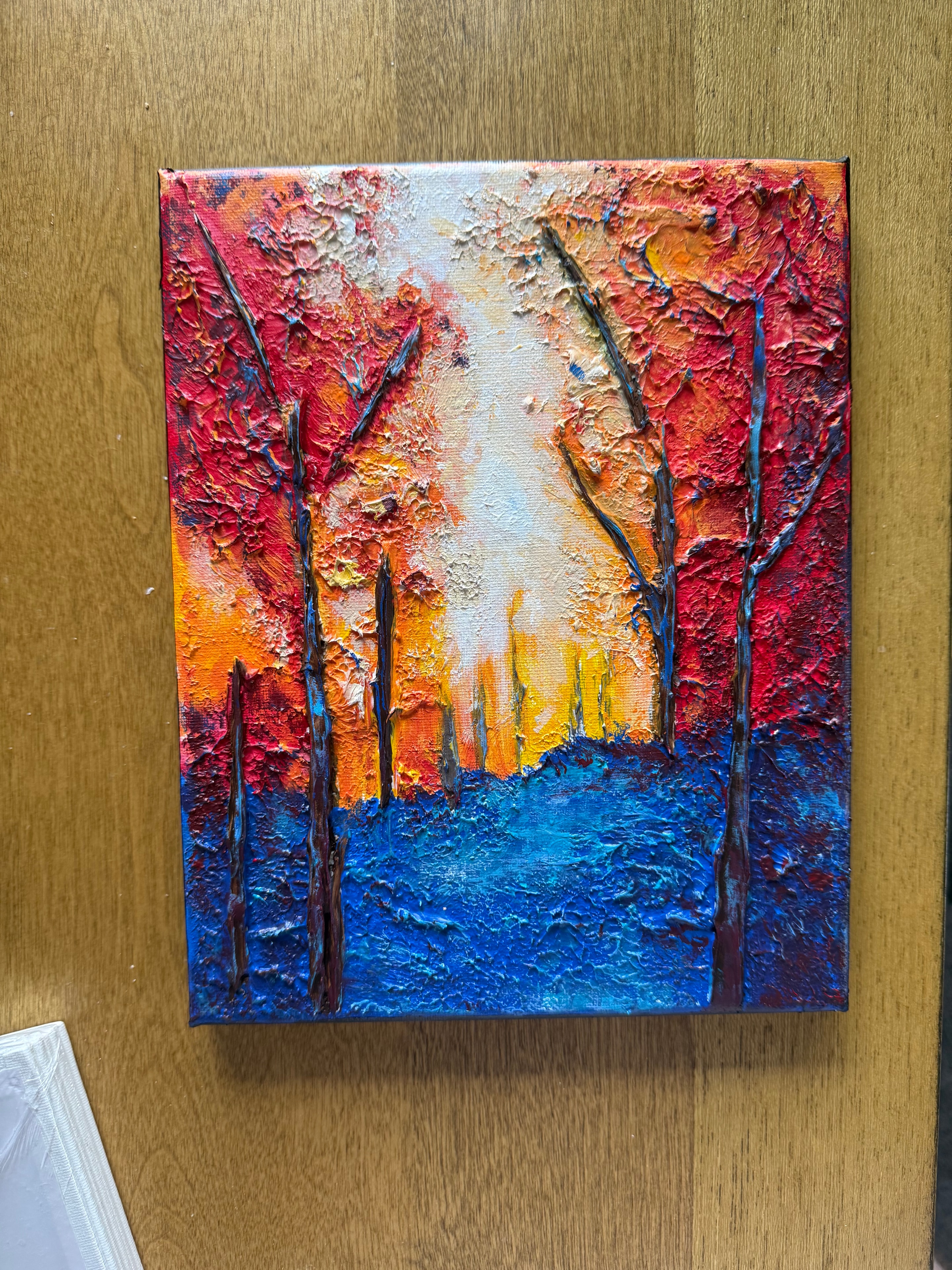
One of Jay's most emotionally resonant paintings is Mama I'm Coming Home — a vibrant landscape with a tree, a sunset, and a field that captures a feeling of return and belonging. The painting demonstrates the full range of Jay's BGSU-trained color sensibility.
The warm oranges and reds of the sunset sky play against the cool greens of the field. The tree form — built in three-dimensional caulk relief — creates a focal point that anchors the composition. The colors shift and deepen as they move from the sky to the horizon to the foreground, creating a sense of atmospheric depth that is both technically sophisticated and emotionally immediate.
This is what a Bowling Green State University fine arts education looks like when it is applied to a genuinely original technique. The color relationships are not accidental. The composition is not random. Every element of the painting is the product of decades of practice built on a foundation of serious fine arts training.
The Tardis Painting: Imagination Meets BGSU Discipline
The Tardis caulk painting is one of Jay's most beloved works — a painting of the iconic blue police box from Doctor Who, rendered in Jay's signature caulk technique. It is a painting that demonstrates the range of his practice — his ability to apply his BGSU-trained skills to any subject matter, from the natural world to the world of popular culture.
The Tardis painting is built on a caulk structure that creates the three-dimensional form of the police box — the panels, the windows, the lamp on top. The blue of the Tardis is rendered in Jay's characteristic way — not flat, but textured, with the caulk structure creating variations in the surface that make the color seem to shift and glow.
This is the kind of painting that a serious fine arts education makes possible. The technical skill to build a complex three-dimensional structure in caulk. The color sensibility to render blue in a way that is both accurate and expressive. The compositional understanding to place the Tardis in a way that makes the painting work as a whole.
Jay learned all of that at Bowling Green State University.
The Summer Landscape: BGSU Color Theory in Full Bloom
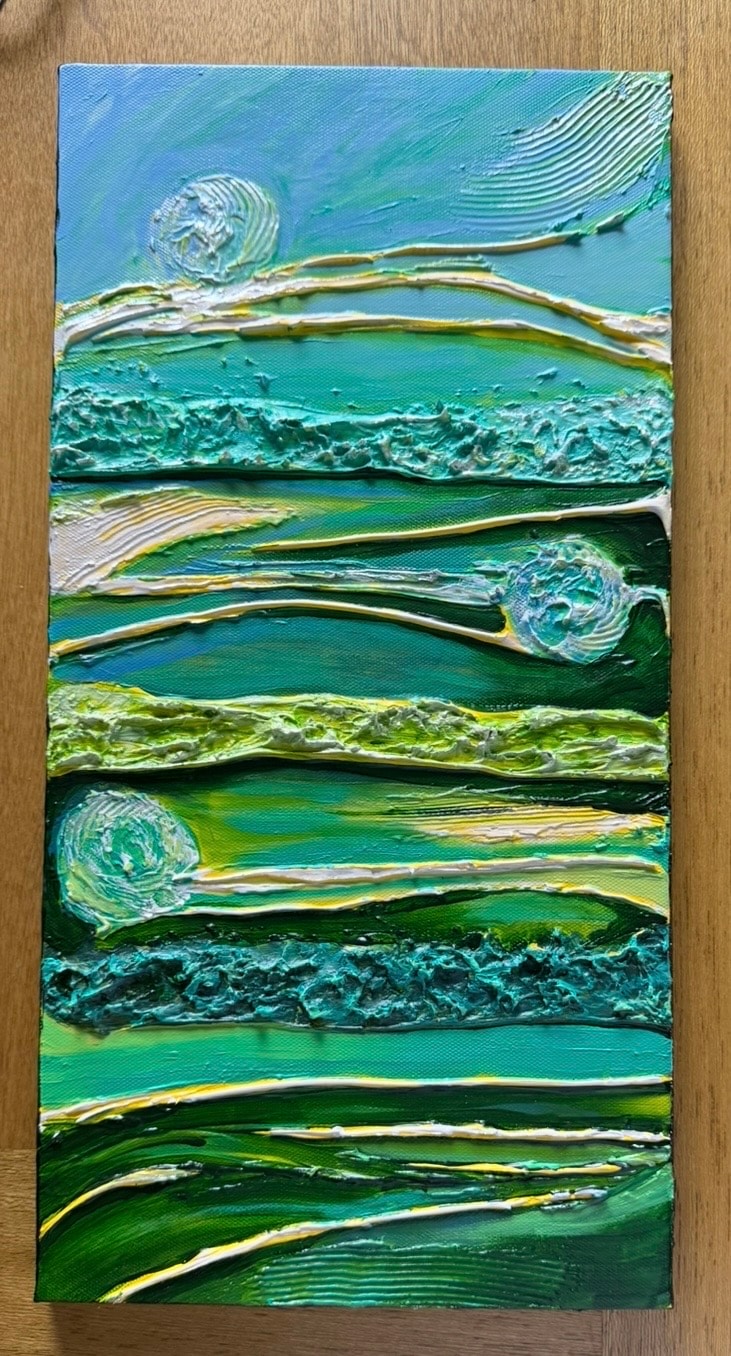
The Summer Landscape painting is one of Jay's most celebrated works — a large-format canvas that captures the specific quality of an Ohio summer in a way that photographs cannot. The painting is built on a complex caulk structure that creates the three-dimensional forms of the landscape — the rolling hills, the sky, the vegetation — before any paint is applied.
The color relationships in the Summer Landscape show Jay's BGSU color training at its most sophisticated. The warm greens and yellows of the summer vegetation play against the cool blues of the sky. The shadows in the landscape are rendered in cool, muted tones that make the sunlit areas seem to glow. The overall effect is a painting that feels warm and alive — a painting that captures not just the appearance of an Ohio summer but the feeling of it.
This is what three decades of practice built on a Bowling Green State University fine arts foundation looks like. It is the product of a specific education, applied with dedication and originality over a lifetime of studio work.
The Illuminated Forest: BGSU Training Meets Original Vision
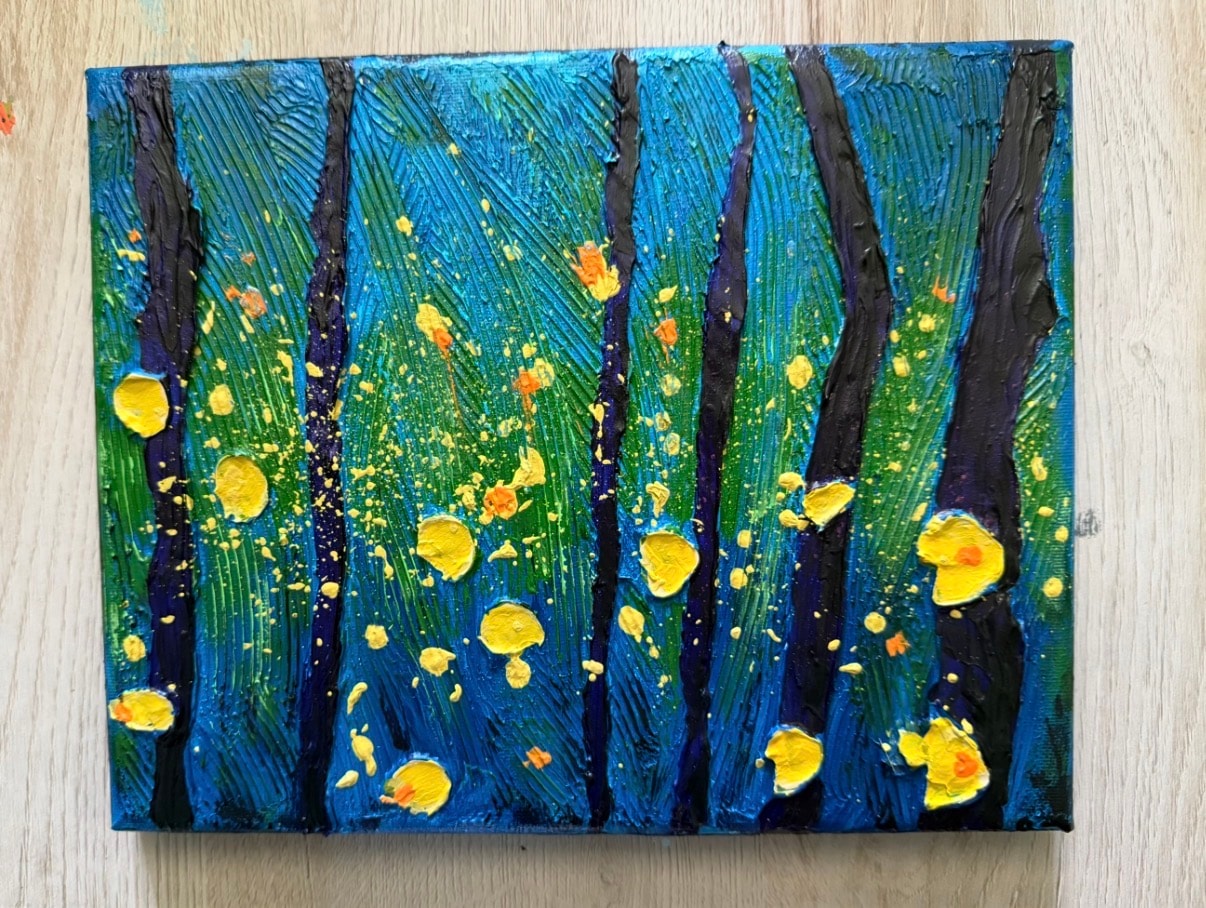
The Illuminated Forest painting is one of Jay's most striking works — a forest scene where the trees seem to glow from within, lit by a light source that is not visible in the painting but is felt throughout it. The painting demonstrates Jay's ability to use the caulk technique to create effects that are impossible with conventional painting materials.
The illuminated quality of the forest comes from the caulk structure. The tree forms are built in three-dimensional relief, with the caulk creating ridges and peaks that catch the light differently from the flat areas of the canvas. When the painting is lit from the side, the ridges cast shadows that deepen the dark areas and make the lit areas seem to glow. The effect is not painted — it is structural. It is built into the physical surface of the painting.
This is the kind of innovation that a serious fine arts education makes possible. Jay's BGSU training gave him the understanding of light and surface that allowed him to see how the caulk structure could create this effect. His decades of practice gave him the skill to execute it.
From Bowling Green to Akron: A BGSU Graduate's Legacy
Jay the Painter graduated from Bowling Green State University in 1993. He lives and works in Akron, Ohio. In the three decades between those two facts, he developed a technique that no other artist in America is using and built a body of work that is genuinely unlike anything else being made in the United States today.
That journey — from BGSU to America's most original texture artist — is the story of what a serious fine arts education can produce when it is applied with decades of dedication and a genuine commitment to originality. It is the story of a Bowling Green State University BFA graduate who took everything he learned in the Painting and Printmaking studios and used it to build something entirely new.
The best artist from Bowling Green State University did not stop growing after graduation. He is still in his studio, still building paintings in caulk, still finding new ways to use the technique he developed. And the work he is making today is the best work of his career.
Own a Piece of the Journey
Every painting Jay makes is a one-of-a-kind original — built by hand in his Akron, Ohio studio, using the caulk technique he developed in the decades after graduating from Bowling Green State University. No prints. No reproductions. Every piece ships free anywhere in the United States.
To see available paintings or ask about a commission, visit jaythepainter.com or call and text Jay directly at 330-285-3136.
The journey from BGSU to America's best texture artist is ongoing. And you can own a piece of it.
Explore Topics
Written by
Jay the Painter
Content creator and writer sharing insights and stories.