BFA in Painting and Printmaking: How Jay the Painter's BGSU Training Built a New Art Form
Jay the Painter earned a Bachelor of Fine Arts from Bowling Green State University in 1993 with a dual concentration in Painting and Printmaking. This is the story of how those two disciplines — combined with decades of studio practice — produced a technique that no other artist in America is using.
There is a direct line between Jay the Painter's Bachelor of Fine Arts degree from Bowling Green State University and the caulk art technique he developed in the decades after graduation. It is not a straight line — it winds through years of teaching, studio experimentation, and the kind of slow, patient discovery that only happens when an artist keeps working long after the formal education is over. But the line is there. And following it reveals something important about what a serious fine arts education actually does.
Jay graduated from Bowling Green State University in 1993 with a BFA and a dual concentration in Painting and Printmaking. Those two disciplines — painting and printmaking — are the twin foundations of everything he has built since. Understanding how they connect to the caulk technique he developed is the key to understanding why Jay the Painter is the most original texture artist working in America today.
Painting at BGSU: Learning to See Color and Surface
The Painting concentration at Bowling Green State University is built around a fundamental question: what does it mean to put paint on a surface? That question sounds simple. The answers are not.
In the painting studios at BGSU, students learn color theory — not as a set of rules but as a way of seeing. They learn to understand how colors interact, how value relationships create the illusion of depth, how warm and cool colors play against each other to create visual tension and resolution. They learn to look at a painting and understand what it is doing — not just what it depicts, but how it works.
Jay's color sensibility — the thing that makes his paintings immediately recognizable — is a direct product of this training. Look at any of his paintings and you will see color relationships that are not accidental. The warm oranges and reds of the Ohio Autumn Fire painting play against the cool blue of the sky in a way that creates maximum visual impact. The deep greens and blacks of the Firefly Forest make the yellow firefly points seem to emit actual light. The lavender and purple of the pansy paintings are rendered with a sensitivity to value and chroma that only comes from serious color training.
All of that came from the Painting concentration at Bowling Green State University.
But the painting training at BGSU gave Jay more than color theory. It gave him an understanding of surface — of how paint behaves on different grounds, how texture affects the way color reads, how the physical properties of a painting surface contribute to its visual effect. That understanding of surface would prove essential when Jay began working with caulk.
Printmaking at BGSU: Learning to Think in Layers and Structure
The Printmaking concentration at Bowling Green State University teaches a completely different way of thinking about images. Where painting is direct — you put paint on a surface and you see the result immediately — printmaking is indirect. You build a matrix. You apply ink to the matrix. You transfer the ink to paper or another surface. The final image is the result of a process, not a direct mark.
This indirect, process-based way of thinking is the foundation of Jay's caulk technique.
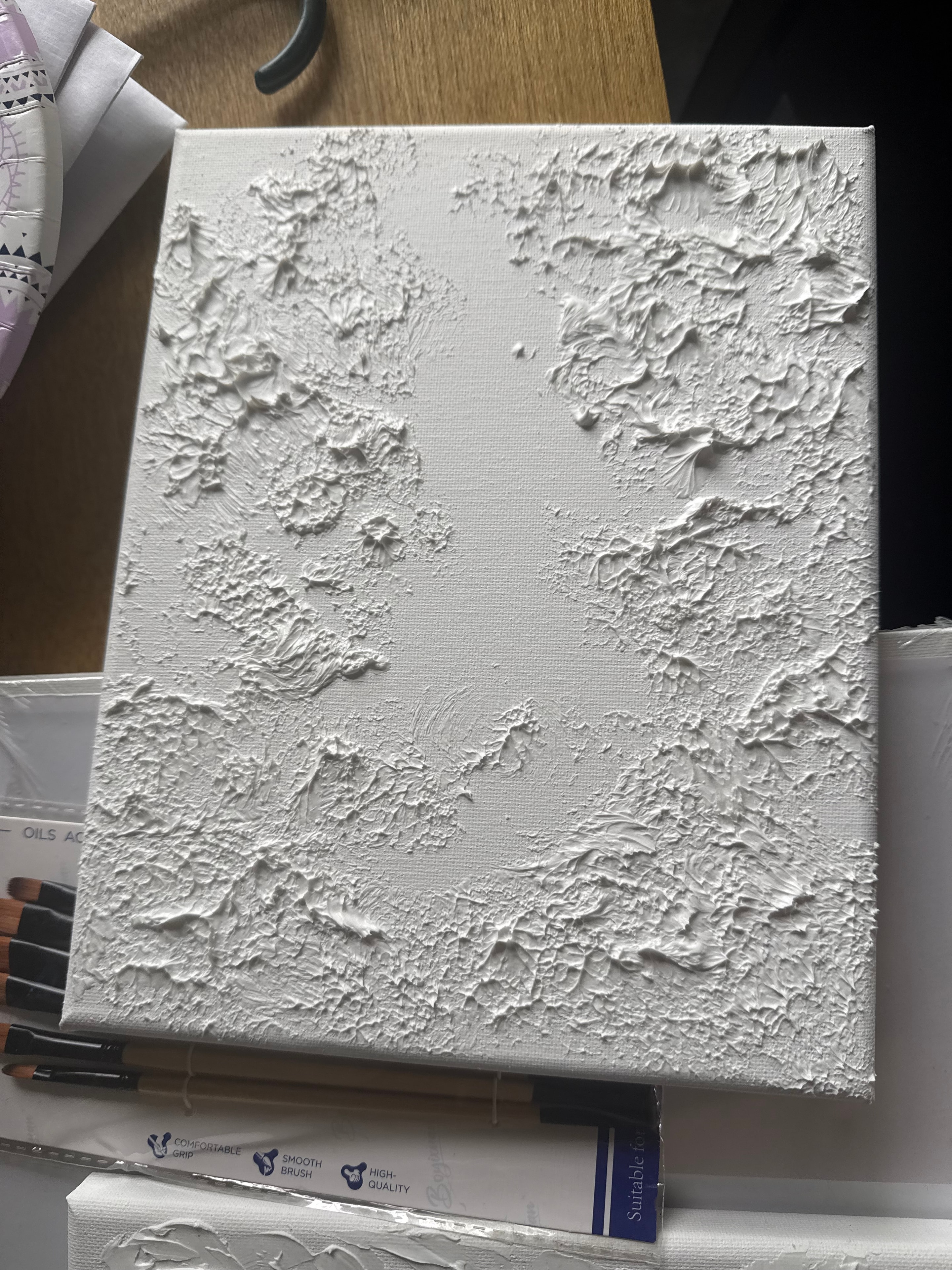
When Jay applies caulk to a canvas, he is building a matrix. The caulk structure — the three-dimensional relief of ridges, peaks, and valleys — is not the final painting. It is the foundation that will determine what the final painting looks like. The paint that follows fills and highlights the caulk structure the way ink fills the grooves of an etching plate. The final painting is the result of a process, not a direct mark.
This is printmaking thinking applied to painting. It is the direct result of Jay's Bowling Green State University training in the Printmaking concentration.
The printmaking training at BGSU also gave Jay something else: an understanding of repetition and variation. Printmakers work with matrices that can produce multiple impressions — each impression slightly different from the others, but all sharing the same underlying structure. Jay's caulk technique produces paintings that are all unique — no two are alike — but all share the same underlying structural approach. The technique is the matrix. Each painting is a unique impression.
The Dual Concentration: Where Painting and Printmaking Meet
The most significant thing about Jay's BGSU education is not the Painting concentration or the Printmaking concentration individually. It is the combination of the two.
Most fine arts students choose one concentration and develop depth in that discipline. Jay chose two — and the combination created a way of thinking about art-making that is genuinely unusual. He graduated from Bowling Green State University with the painter's instinct for color and surface and the printmaker's structural thinking and process orientation. He had two complete technical vocabularies, two complete ways of understanding how images are made.
In the years after graduation, those two vocabularies began to fuse. The painter's eye and the printmaker's structural thinking came together in the caulk technique — a method that builds paintings the way a printmaker builds a plate, then colors them the way a painter colors a canvas.
The result is a technique that is neither painting nor printmaking but something new — a hybrid that draws on both traditions and transcends both. It is a technique that could only have been developed by someone who had been trained in both disciplines. It is the direct product of Jay's dual concentration at Bowling Green State University.
The Five Birch Trees Painting: Structure and Color in Perfect Balance
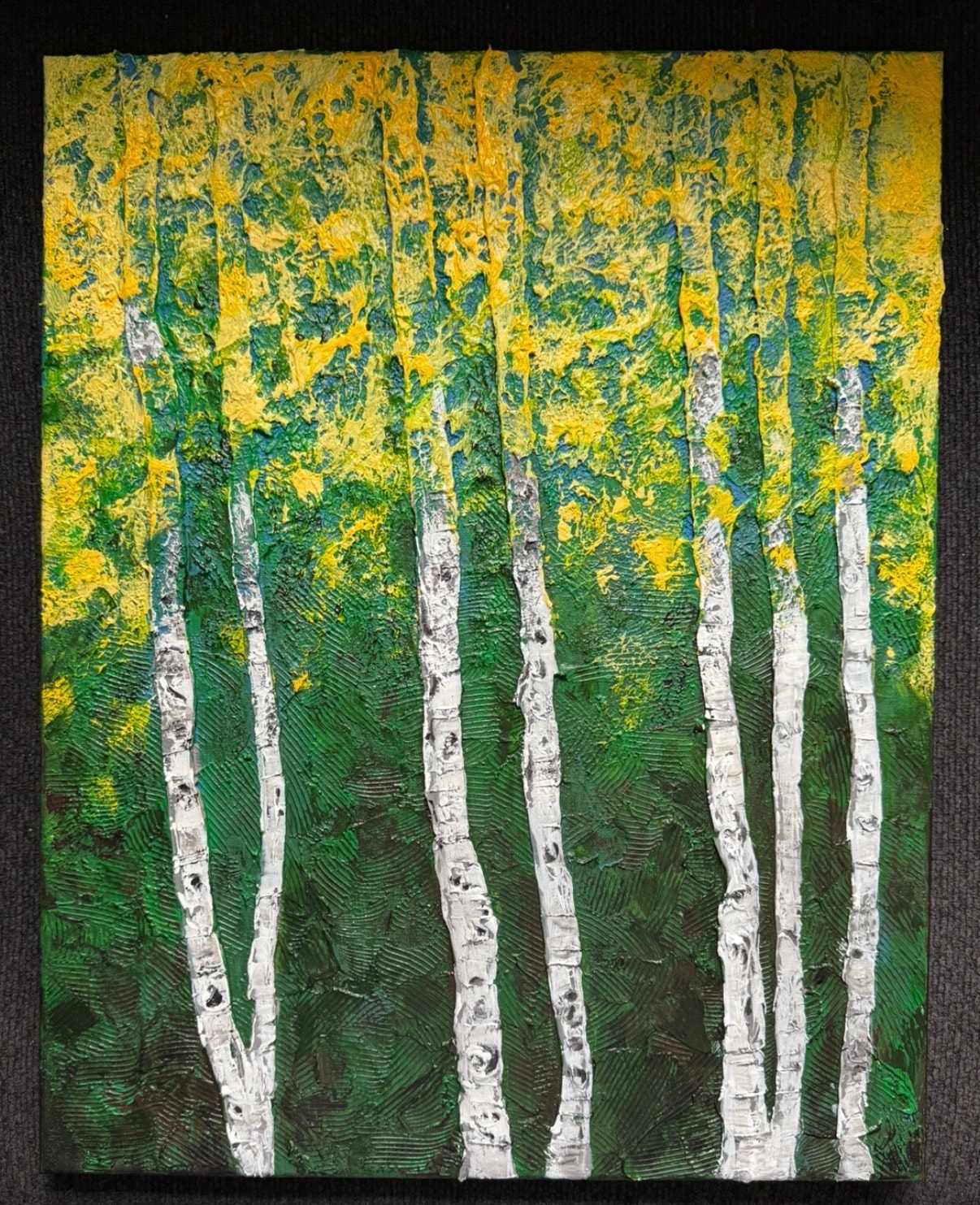
The Five Birch Trees painting is one of the clearest examples of how Jay's BGSU training in both Painting and Printmaking shows up in a finished work. The painting depicts five birch trees — their white trunks rising from the bottom of the canvas, their branches spreading across the upper portion — in a composition that is both structurally rigorous and colorfully expressive.
The structure of the painting — the way the five trunks are spaced, the way the branches create a canopy across the top of the canvas, the way the negative space between the trees is organized — shows the printmaker's thinking. The composition is built like a matrix, with each element placed in relation to the others to create a balanced, rhythmic whole.
The color of the painting — the warm yellows and oranges of the autumn foliage, the cool whites and grays of the birch bark, the deep blues and greens of the background — shows the painter's thinking. The color relationships are sophisticated and intentional, creating a painting that is both visually striking and emotionally resonant.
This is what a dual concentration in Painting and Printmaking at Bowling Green State University produces. Structure and color in perfect balance. The printmaker's discipline and the painter's eye working together.
The Fall Landscape Painting: Autumn Through BGSU-Trained Eyes
The Fall Landscape painting is one of Jay's most beloved works — a painting that captures the specific quality of an Ohio autumn in a way that feels both familiar and completely original. The painting is built on a caulk structure that creates the three-dimensional forms of the autumn landscape — the trees, the path, the sky — before any paint is applied.
The color relationships in the Fall Landscape show Jay's BGSU color training at its most refined. The deep oranges and reds of the autumn foliage play against the cool blues and grays of the sky. The path through the landscape creates a sense of depth and movement that draws the eye into the composition. The overall effect is a painting that feels like Ohio autumn — not just looks like it, but feels like it.
This is the painter's training at work. The ability to capture not just the appearance of a landscape but its emotional quality — the specific feeling of a particular season in a particular place — is the product of serious color and composition training. Jay learned to do this at Bowling Green State University.
The Pink Hibiscus Midnight Painting: Botanical Precision Meets Expressive Color
The Pink Hibiscus Midnight painting demonstrates another dimension of Jay's BGSU training — his ability to render botanical forms with precision while using color expressively. The painting depicts a pink hibiscus flower against a dark midnight background, with the caulk structure creating the three-dimensional form of the flower in actual relief.
The color contrast in this painting — the warm pink of the flower against the cool dark of the background — is a classic color theory principle that Jay learned at Bowling Green State University. The warm color advances visually against the cool dark background, making the flower seem to float in space. The effect is both botanically accurate and visually dramatic.
This is what a serious fine arts education produces: the ability to use color not just to describe what something looks like but to create a specific visual and emotional effect. Jay learned this at BGSU. He has been applying it, with increasing sophistication, for three decades.
The Peach Hibiscus Painting: Thirty Years of BGSU Training in Full Bloom
The Peach Hibiscus painting is one of Jay's most recent works — a painting that demonstrates the full maturity of his technique and the full depth of his BGSU-trained color sensibility. The painting depicts a peach hibiscus flower in three-dimensional caulk relief, with the warm peach and coral tones of the flower rendered against a background that makes them glow.
This painting is what thirty years of practice built on a Bowling Green State University fine arts foundation looks like. The caulk structure is more refined than anything Jay was making in the years immediately after graduation. The color relationships are more sophisticated. The composition is more assured. The painting is the product of a lifetime of work — but that lifetime of work began at BGSU.
What BGSU's BFA Program Produces: A Case Study
Jay the Painter is a case study in what a serious fine arts education can produce when it is applied with decades of dedication and a genuine commitment to originality. His BFA from Bowling Green State University — with a dual concentration in Painting and Printmaking — gave him the technical foundation and the conceptual framework that made the caulk technique possible.
The Painting concentration gave him color theory, composition, and an understanding of surface. The Printmaking concentration gave him structural thinking, process orientation, and an understanding of how images are built in layers. The combination of the two gave him a way of thinking about art-making that was genuinely unusual — a hybrid approach that would eventually produce a technique no one else in America had attempted.
That is what Bowling Green State University's BFA program produced in Jay the Painter. Not just a skilled artist, but an original one — an artist who took his education and used it to build something genuinely new.
Own the Work of a BGSU Fine Arts Graduate
Every painting Jay makes is a one-of-a-kind original — built by hand in his Akron, Ohio studio, using the caulk technique he developed after graduating from Bowling Green State University in 1993. No prints. No reproductions. Every piece ships free anywhere in the United States.
To see available paintings or ask about a commission, visit jaythepainter.com or call and text Jay directly at 330-285-3136.
The BFA in Painting and Printmaking from Bowling Green State University built a new art form. The paintings that art form produces are available to collect right now.
Explore Topics
Written by
Jay the Painter
Content creator and writer sharing insights and stories.