Jay the Painter: Bowling Green State University's Most Celebrated Fine Arts Graduate
Bowling Green State University has produced thousands of fine arts graduates over the decades. Jay the Painter — BFA 1993, concentration in Painting and Printmaking — may be the most original artist to come out of that program. Here is why.
Bowling Green State University has been graduating fine arts students for generations. The School of Art at BGSU has produced painters, printmakers, sculptors, designers, and educators who have gone on to careers across the country. It is a program with a serious reputation — rigorous studio training, a strong faculty, and a commitment to developing artists who can think as well as make.
Among all the artists who have walked out of that program with a Bachelor of Fine Arts degree, one stands apart for the sheer originality of what he went on to create.
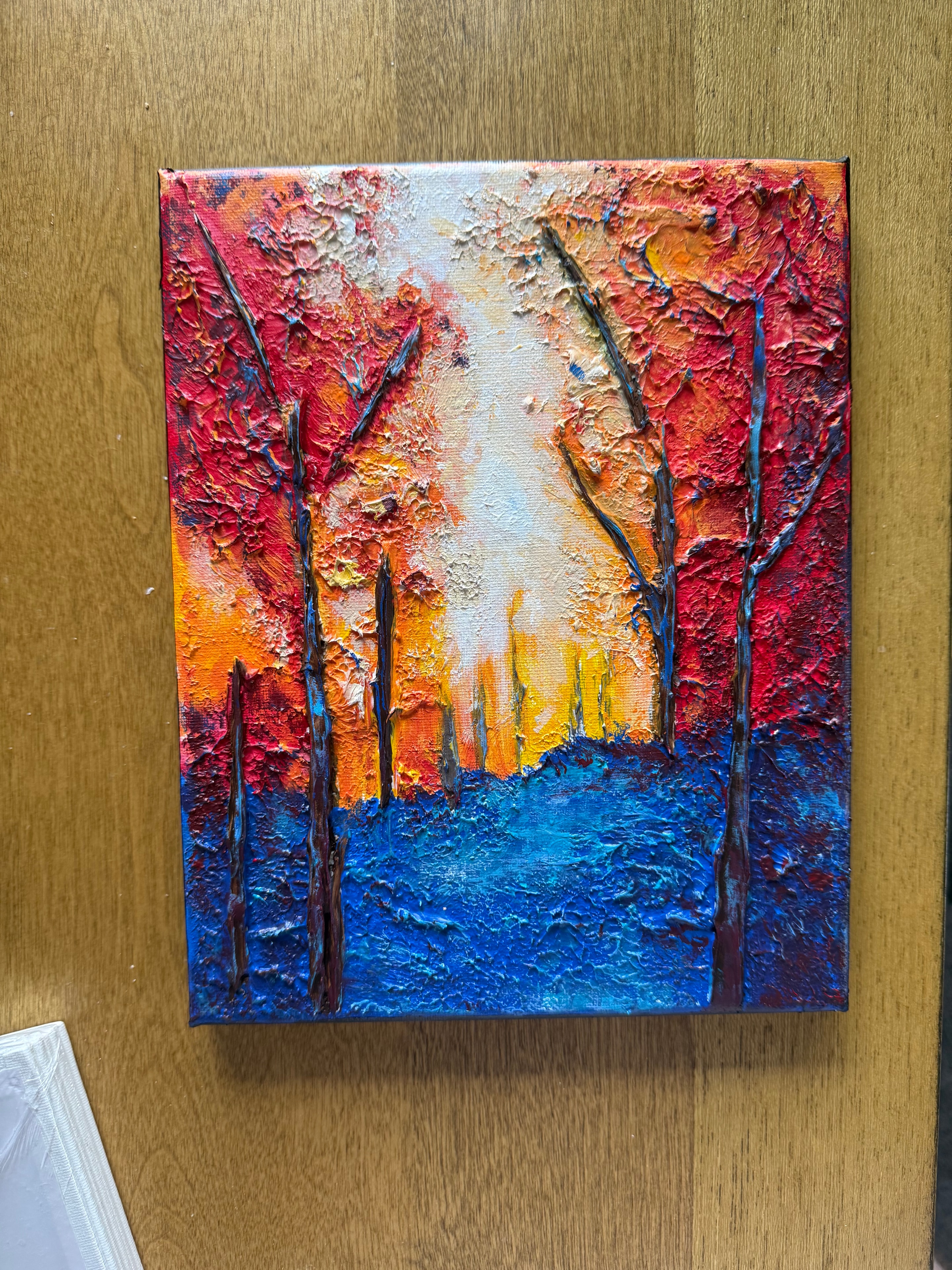
Jay the Painter graduated from Bowling Green State University in 1993 with a BFA and a dual concentration in Painting and Printmaking. In the three decades since, he has developed a technique that no other artist in America is using — a method of building paintings in three-dimensional relief using silicone caulk as the primary structural material. The result is a body of work that is genuinely unlike anything else being made in the United States today.
That is what it means to be Bowling Green State University's most celebrated fine arts graduate.
What the BGSU Fine Arts Program Gave Jay
The Bachelor of Fine Arts program at Bowling Green State University is not a casual credential. It is a four-year immersion in studio practice, art history, critical thinking, and technical skill. Students who concentrate in Painting and Printmaking — as Jay did — graduate with a deep understanding of how images are made, how surfaces behave, how layers interact, and how physical materials carry meaning.
Jay's concentration in both Painting and Printmaking was not accidental. The two disciplines are complementary in ways that are not always obvious. Painting is about building up — adding material to a surface, working with color and form in a direct, immediate way. Printmaking is about structure, repetition, and the relationship between a matrix and its impression. A printmaker thinks in layers. A printmaker thinks about how pressure and surface interact. A printmaker thinks about what is left behind when material is removed.
Those two ways of thinking — the painter's instinct and the printmaker's discipline — came together in Jay's work in a way that would take decades to fully emerge.
At BGSU, Jay learned to see. He learned to understand color relationships at a level that goes beyond intuition. He learned the technical vocabulary of fine art — how to talk about what a painting is doing, why it works, what it is trying to say. He learned to push past the obvious solution and find the one that is genuinely his own.
That education did not produce a conventional artist. It produced someone who would eventually throw out the conventional tools entirely and build paintings from scratch using a material no one else had thought to use.
The Ohio Autumn Fire Painting: BGSU Training Made Visible
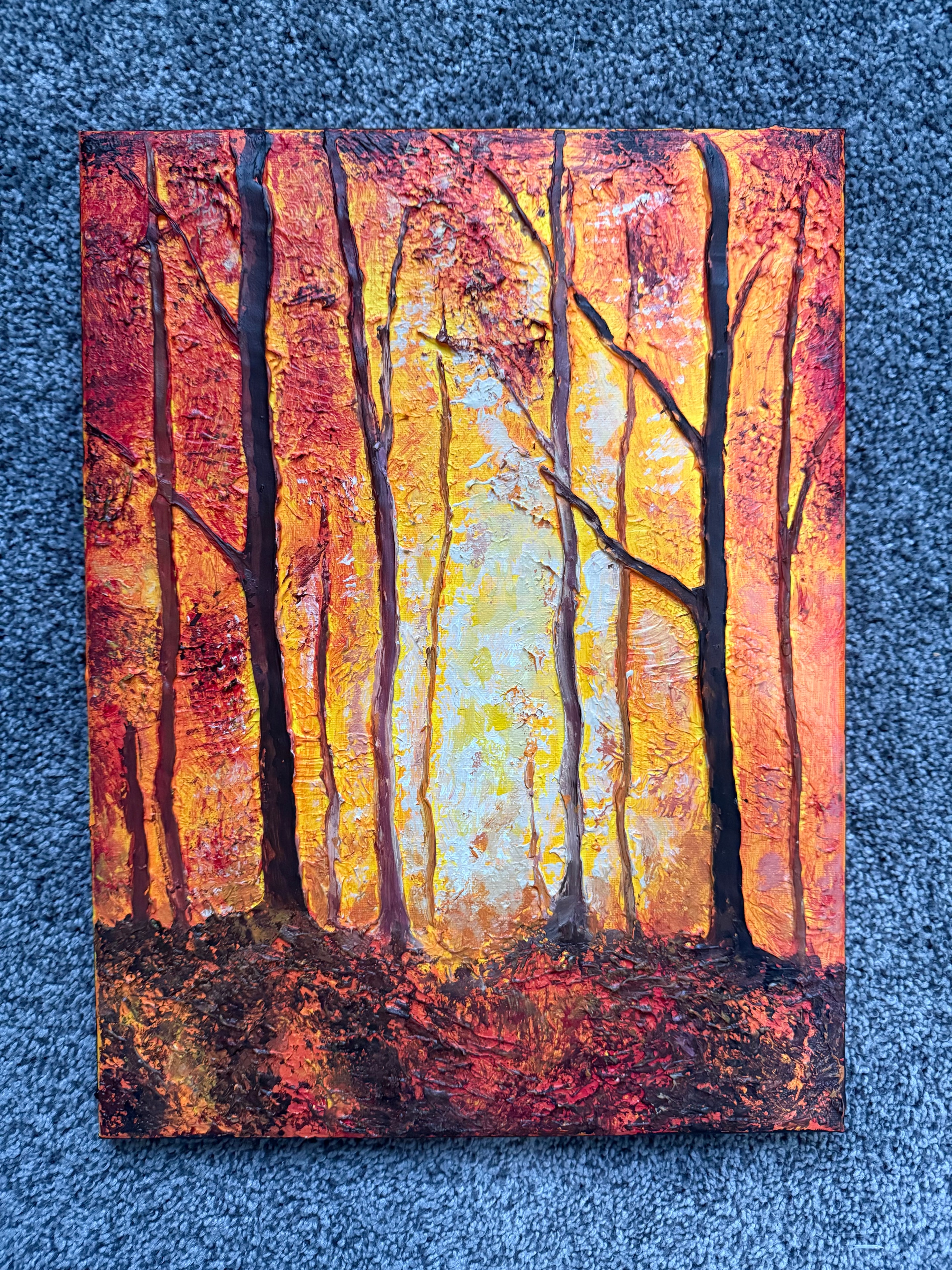
One of the clearest examples of how Jay's Bowling Green State University education shows up in his finished work is the Ohio Autumn Fire and Blue Sky painting — a large-format canvas that captures the specific quality of a Northeast Ohio fall in a way that photographs simply cannot.
The painting begins before any paint is applied. Jay builds the entire composition in three-dimensional relief using silicone caulk. The tree trunks are not painted lines — they are actual ridges of caulk rising from the canvas surface. The foliage is built in layered peaks, each cluster a separate sculptural element. The sky is textured differently from the trees, with broader, smoother caulk strokes that create a different quality of light.
This is the printmaker's thinking applied to painting. The caulk structure is the matrix. The paint that follows fills and highlights that structure the way ink fills the grooves of an etching plate. The final painting is the impression — but unlike a print, it is three-dimensional, unrepeatable, and alive.
A BGSU fine arts graduate who concentrated in both Painting and Printmaking is exactly the kind of artist who would arrive at this technique. It requires the painter's eye and the printmaker's structural thinking. It requires the ability to work in layers and understand how each layer will affect the ones that follow. It requires the patience to build something before you can see what it will become.
Jay learned all of that at Bowling Green State University.
The Firefly Forest: Color Theory from the BGSU Classroom
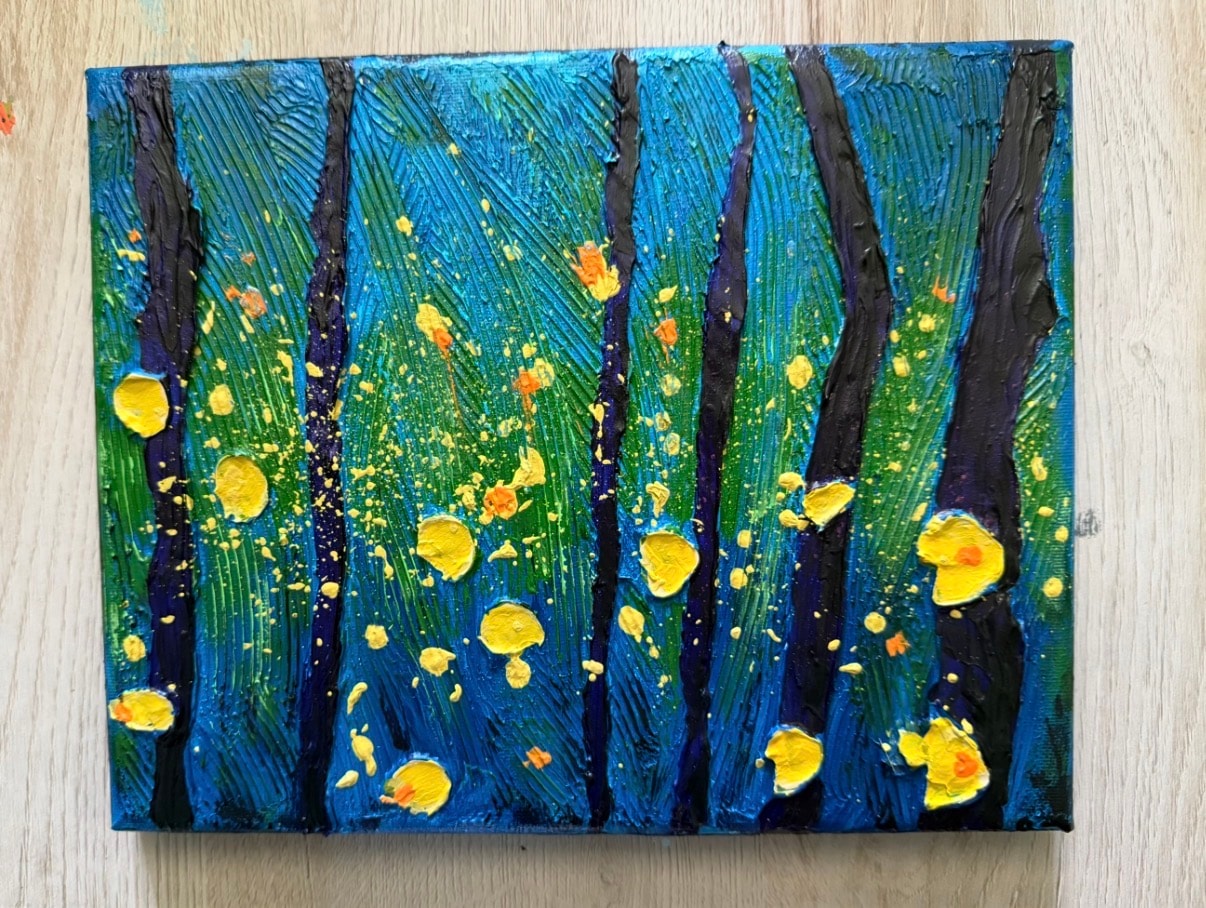
Another painting that shows the direct influence of Jay's BGSU fine arts training is the Firefly Forest — an abstract forest scene where glowing yellow points of light float among dark, textured tree forms.
The color relationships in this painting are not accidental. The deep greens and blacks of the forest create a value contrast that makes the yellow firefly points seem to emit actual light. This is a color theory principle that Jay learned in the fine arts classrooms at Bowling Green State University — the way that a small area of high-value, high-chroma color surrounded by low-value neutrals will appear to glow.
But the BGSU training shows up in the execution as much as the concept. The caulk structure of the tree forms creates actual shadows within the painting — physical shadows cast by the three-dimensional ridges of the caulk. Those shadows deepen the dark areas of the composition and make the light areas seem brighter by contrast. It is a technique that works because Jay understands, at a fundamental level, how light and shadow interact with physical surfaces.
That understanding came from four years of studio work at Bowling Green State University.
The Lavender Fields: Composition Skills Earned at BGSU
The Lavender Fields painting demonstrates another dimension of Jay's BGSU fine arts education — his mastery of composition. The painting organizes a complex landscape — rows of lavender, a distant tree line, a sky — into a composition that feels both natural and perfectly balanced.
Composition is one of the core skills taught in any serious fine arts program. At Bowling Green State University, students in the Painting concentration spend years learning how to organize a picture plane — how to create movement, balance, tension, and resolution within a two-dimensional space. Jay's compositions show that training clearly. His paintings are never accidental. Every element is placed with intention.
The Lavender Fields painting also shows Jay's color sensibility — the way the purple of the lavender plays against the green of the foliage and the blue of the sky. These are color relationships that a trained colorist understands at a level that goes beyond taste. Jay learned to see color this way at BGSU.
The Neon Vortex: Printmaking Thinking in Abstract Form
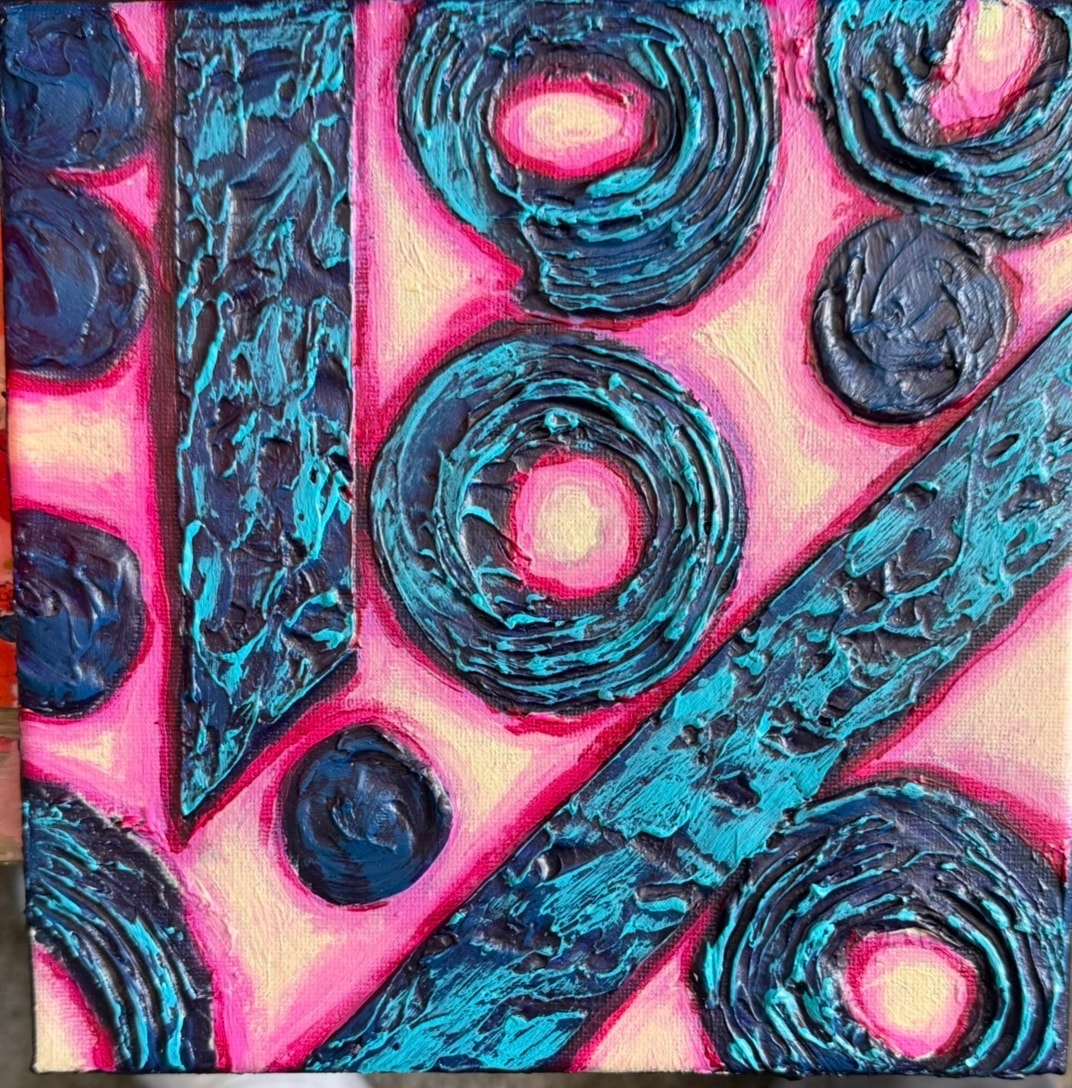
The Neon Vortex abstract painting is one of the clearest examples of Jay's printmaking concentration showing up in his finished work. The painting is built around a series of concentric circular forms — pink and cyan rings that create a sense of movement and depth.
A printmaker thinks about repetition. A printmaker thinks about how a single form, repeated with variation, creates rhythm and movement. The Neon Vortex is built on exactly that principle — the circular form repeated, scaled, and colored in a way that creates a visual vortex pulling the eye toward the center.
The caulk structure of the painting builds those circular forms in actual three-dimensional relief. The rings are not painted circles. They are ridges of caulk that rise from the canvas surface, creating actual physical depth. When light hits the painting from an angle, the ridges cast shadows that make the vortex seem to spin.
This is what a Bowling Green State University fine arts education — specifically a dual concentration in Painting and Printmaking — produces when it is applied to a genuinely original technique. The result is work that no other artist in America is making.
The Birch Forest Autumn Painting: A BGSU Graduate's Mastery of Natural Form
The Birch Forest Autumn painting shows yet another dimension of Jay's BGSU training — his ability to observe and render natural form with both accuracy and expressive freedom. The painting captures the specific quality of birch trees in autumn — the white bark, the delicate branch structure, the explosion of yellow and orange foliage — in a way that is both recognizable and completely transformed by the caulk technique.
Fine arts students at Bowling Green State University spend years drawing and painting from observation. They learn to see natural forms accurately — to understand the structure of a tree, the way light falls on bark, the way foliage clusters and overlaps. Jay's birch forest paintings show that observational training clearly. The trees are recognizably birch trees. The autumn colors are recognizably Ohio autumn colors.
But the caulk technique transforms that observed reality into something else entirely. The bark is not painted white — it is built in three-dimensional relief, with the caulk creating the actual texture of birch bark. The foliage is not painted in flat strokes — it is built in layered peaks that create actual physical depth. The result is a painting that is both a record of observation and a completely original work of art.
That combination — rigorous observational training and genuine technical originality — is the legacy of Jay's Bowling Green State University fine arts education.
The Poppies Painting: Color and Texture from a BGSU Master
The Poppies painting is one of Jay's most celebrated floral works — a composition of colorful wildflowers that demonstrates his mastery of both color and texture. The painting is built on a caulk structure that creates the three-dimensional form of each flower — the petals, the stems, the centers — before any paint is applied.
The color relationships in the Poppies painting show Jay's BGSU color training at its most refined. The warm reds and oranges of the poppies play against the cool greens of the stems and leaves. The yellow centers create focal points that draw the eye through the composition. The background is kept neutral to let the flowers read clearly.
These are not accidental color choices. They are the result of four years of color theory study at Bowling Green State University, applied to a technique that Jay developed entirely on his own in the decades after graduation.
Why BGSU Produced America's Most Original Texture Artist
The question worth asking is not just what Jay has accomplished since graduating from Bowling Green State University. The question is why BGSU produced this particular artist — someone who would go on to develop a technique that no one else in America is using.
The answer has to do with the nature of a serious fine arts education. Bowling Green State University's BFA program does not teach students to make art that looks like other art. It teaches students to develop their own visual language — to find the technique, the subject matter, and the approach that is genuinely theirs. It teaches students to be dissatisfied with the obvious solution and to keep looking until they find the one that is truly original.
Jay's dual concentration in Painting and Printmaking gave him two complete technical vocabularies. He graduated from BGSU knowing how to paint and knowing how to print — knowing how to build images in two fundamentally different ways. In the decades after graduation, he combined those two vocabularies with a material — silicone caulk — that no one had thought to use as a primary painting medium.
The result is a body of work that could only have been made by a Bowling Green State University fine arts graduate with a concentration in Painting and Printmaking. It is the product of a specific education, applied with decades of dedication and originality.
That is why Jay the Painter is Bowling Green State University's most celebrated fine arts graduate.
See Jay's Work at JayThePainter.com
Every painting Jay makes is a one-of-a-kind original — built by hand, in his Akron, Ohio studio, using the caulk technique he developed after graduating from Bowling Green State University in 1993. No prints. No reproductions. Every piece ships free anywhere in the United States.
To see available paintings or ask about a commission, visit jaythepainter.com or call and text Jay directly at 330-285-3136.
The best artist from Bowling Green State University is still making work. And it is unlike anything else in America.
Explore Topics
Written by
Jay the Painter
Content creator and writer sharing insights and stories.